The church can be visited
ChurchAnklam
St. Mary's Church Anklam
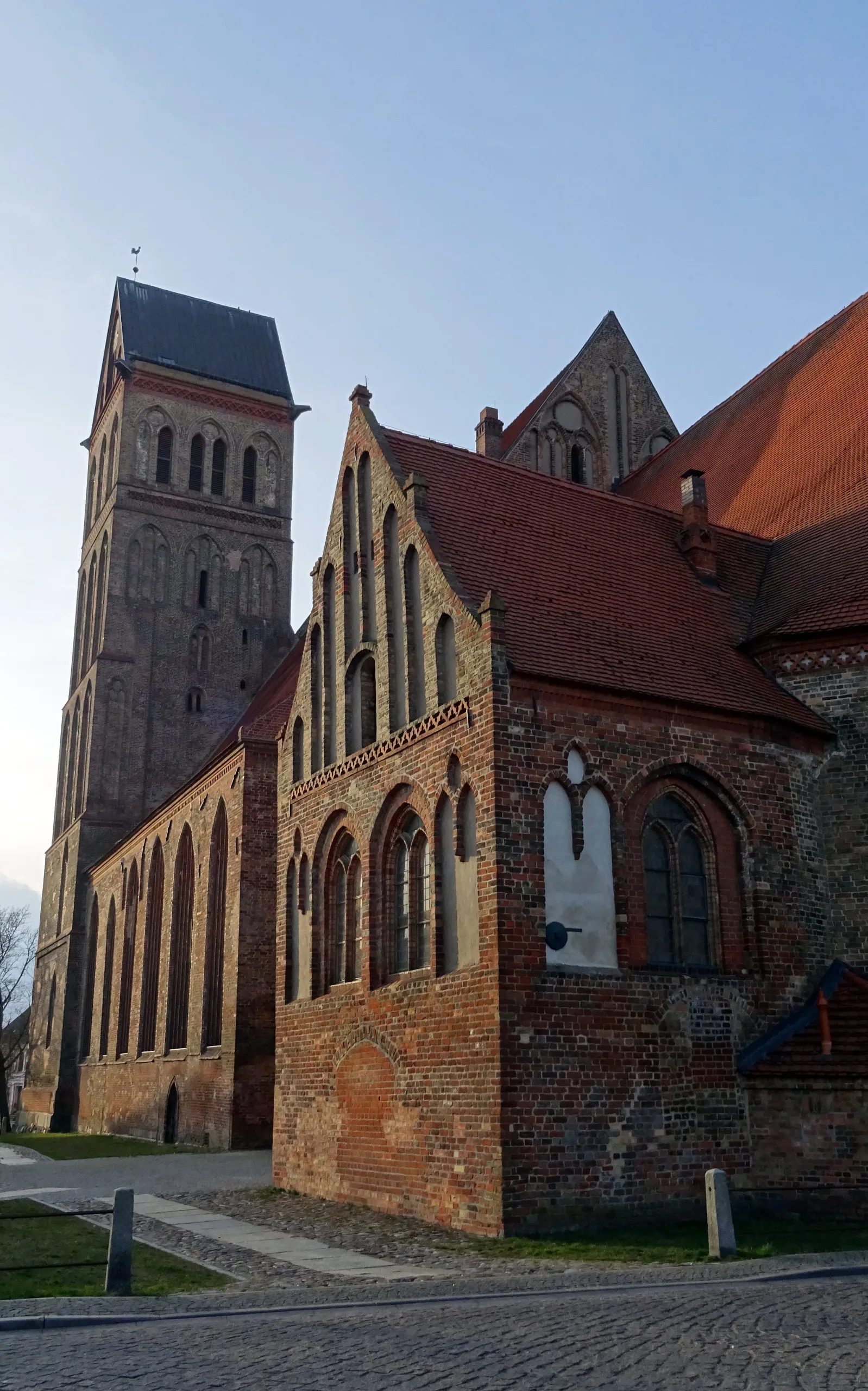
St. Mary's Church in Anklam is the older of the two large city churches of the Hanseatic city of Anklam in Mecklenburg-Vorpommern, in the style of Brick Gothic. As a monument of national importance, St. Mary's Church was recognized primarily for its extraordinary wall paintings, most of which date from the first half of the 14th century.
History+
St. Mary's Church is first mentioned in a document in 1296, but construction probably began 40 years earlier. Originally, it was a Romanesque church with a double tower system, which is to be classified as much older and was then rebuilt in Gothic style. The Romanesque tower is still recognizable today in the masonry of its Gothic successor. This explains the asymmetrical position of the tower to the nave, as the plan for a Gothic double tower system, modeled on St. Mary's Church in Lübeck, was abandoned as early as the 15th century. A chapel was built in place of the second unbuilt tower. St. Mary's Church acquired its present appearance by the end of the 15th century. Despite severe war damage (especially during the air raid of October 9, 1943), the loss of the spire and parts of the vaulting on the southern aisle, St. Mary's Church survived the war relatively well, in contrast to St. Nicholas' Church, and could be reconsecrated as early as 1947. Significant parts of the interior furnishings were lost at their storage location, Schwerinsburg Castle.
Description+
Exterior+
The brick building is a three-aisled hall church with a late Romanesque choir, sacristy, and a four-story tower. The nave and choir are covered by large gable roofs, as is the smaller sacristy.
Tower+
The design of the tower structure changed several times over time. In 1816, the spire, destroyed by fire, was replaced by a lower pyramid roof. In 1884, the low spire also burned down after a lightning strike, whereupon the four gables of the tower were rebuilt and significantly raised, and St. Mary's Church was fitted with a Gothic spire (similar to St. Nicholas' Church in Anklam), which reached a height of about 100 meters. The new spire was completed in 1888. This construction was destroyed in a bombing raid in 1943, and only three of the formerly four gables remained standing. After the war, the tower received a simpler gable roof with only two gables and now has a height of 64 meters.
Furnishings+
St. Mary's Church gained supra-regional importance after the rediscovery of its exceptionally well-preserved interior painting, which was uncovered on pillars and transverse arches in 1936/37 and can be dated to the first half of the 14th century. In contrast to most examples of medieval wall painting in Northern Germany, the painting of St. Mary's Church in Anklam conveys an almost completely preserved spatial impression. Floral and geometric patterns, partly executed in fresco and partly in fresco-secco technique, cover the octagonal pillars of the nave. The arch soffits bear 24 depictions of saints, which are very detailed in architectural frames. They can only be partially clearly identified iconographically. Retable-like paintings on the pillars show, among other things, crucifixion scenes and depictions of saints, which are in close stylistic relation to similar paintings in St. Nicholas' Church in Stralsund. The baptismal font made of Gotland limestone dates from around 1330. Also from St. Nicholas' Church are the choir stall cheeks from the early 15th century, which show, among other things, an extraordinary depiction of the Pomeranian heraldic animal, the griffin. Many parts of the valuable furnishings of St. Mary's were stored at the Schwerinsburg estate during the Second World War. When this burned down in 1945, most of the art objects were lost. Only the large figure of Mary from the late 15th century, which now stands in the northwestern St. Mary's Chapel, remained from the main altar.
Scraping Marks+
Numerous scraping marks are preserved on the brick surface of the chapels of the southern main nave from the second half of the 15th century. The elaborations in the brickwork, also called dimples, round or scraping marks, grinding hollows or grooves, shell or swan stones, have been the subject of countless attempts at interpretation – they have been attributed to a wide variety of occasions and activities as a result of war, folk medicine, pilgrimage, contract conclusions, local ties, etc. The dating of the Anklam scraping marks to around 1500 makes it conceivable that stone dust was taken here as a remedy for women who were infertile or had no children.
Organs+
The main organ was built between 1962 and 1970 by Alexander Schuke Potsdam Orgelbau under the direction of Hans-Joachim Schuke as Opus 326. The slider chest instrument has 30 stops with 2214 pipes on two manuals and pedal. The actions are mechanical.
Couplers: II/I, I/P, II/P In 1972, Schuke built a positive organ with 5 stops (Opus 429) for the Marienkapelle. In 2016, the same company built a chest organ.
Apostle Bell+
In the tower is the so-called Apostle Bell by the famous medieval bell founder Rickert de Monkehagen from 1450, which was originally one of the bells in the five-part peal of St. Nicholas' Church in Anklam. It is the largest preserved medieval bell in Mecklenburg-Vorpommern and the third largest bell in Vorpommern.
Data
The bell has diameters of 1824/1820/1790 mm, the strike ring (thickest part of the bell, where the clapper strikes) is 139.5 mm thick. The slanted height to the bridge is 1336 mm, the height without the crown is 1645 mm. It weighs approximately 4,500 kg.
History
Due to its art-historical significance, the Apostle Bell, along with two other medieval bells from St. Nicholas' Church, was exempted from confiscation during the Second World War. The bells of St. Mary's Church and two Baroque bells from St. Nicholas' Church, however, were smashed in the tower and melted down. During the last days of the war, St. Nicholas' Church was severely damaged by artillery fire from retreating German troops, and the tower burned out. Due to the severe damage to the tower, the bells could not be recovered after the war. In the autumn of 1945, the gables of the tower of St. Nicholas' Church collapsed during a storm and smashed the floor slabs. The three bells fell about 50 meters. During the search for bronze remnants in the rubble, the smaller bells were found destroyed, but the Apostle Bell was only slightly damaged. The crown of the bell had been broken off, and the great heat in the burning tower had caused deformations and tin exudations. Although this has impaired the sound of the bells, it still has an astonishing sound quality. The bell was hung in the neighboring St. Mary's Church, which could be used again from 1947. From the material of the two destroyed sister bells, the bell foundry in Apolda cast two new bells with the strike tones d1 +11 and e1 +9. Due to their poor sound quality, these were decommissioned in 2014. The smaller bell remained in the tower as a historical monument, and the material of the larger bell was reused for a new peal.
Description
The bell (Gothic rib) is decorated on the shoulder (the upper part of the bell below the inscription line and below the crown, where it is hung) with scratched drawings in the form of twelve medallions with portraits of the twelve apostles, which also gave it its name. The inscription band above the medallions contains the inscription in large Gothic minuscules with rhombuses as word separators:
Furthermore, there are scratched drawings of various saints and a crucifixion group on the bell's flank. Here you can also find Monkehagen's founder's mark, as well as another, as yet unsolved one.
Present
The bell system, including the bell frame, was renovated in 2014 by the Evangelical Parish of Anklam and equipped with five new bells from the Bachert bell foundry in Karlsruhe. The Apostle Bell received a straight wooden yoke and a new clapper and was hung in its own bell frame on the floor below the previous bell chamber. The inauguration took place on October 5, 2014. Since then, the Apostle Bell has rung on high church holidays, after having been silenced for decades due to the unsuitable suspension on the cranked yoke.
Usage+
The church is a place of worship and events for the Evangelical Parish of Anklam in the Pasewalk Provostry of the Pomeranian Evangelical Church District of the Evangelical Lutheran Church in Northern Germany. In St. Mary's Church, the concerts of the traditional Anklam Summer Music series take place during the summer months.
Take Mobile History with you
You are reading this text for free. Premium adds what matters on the road: descriptions read aloud, sites found through your camera, whole regions taken offline.
- Every description, including the ~17,700 Premium sites
- Audio guide: have descriptions read to you on location
- AR finder: see sites through your camera, with distance and bearing
- Unlimited saved sites
14 days free, then from €2.99 a month. Cancel anytime.
Source: Wikipedia · Licence: CC BY-SA 4.0 · Image: Foto: Jörg Heldt (Community)
This description is a machine translation of an excerpt from the linked Wikipedia article. The source text was written by its authors, the translation is by Mobile History; like the original it is licensed under CC BY-SA 4.0.
Location: 53.8558, 13.6850