The church can be visited
ChurchRintel
St. Nikolai Church Rinteln
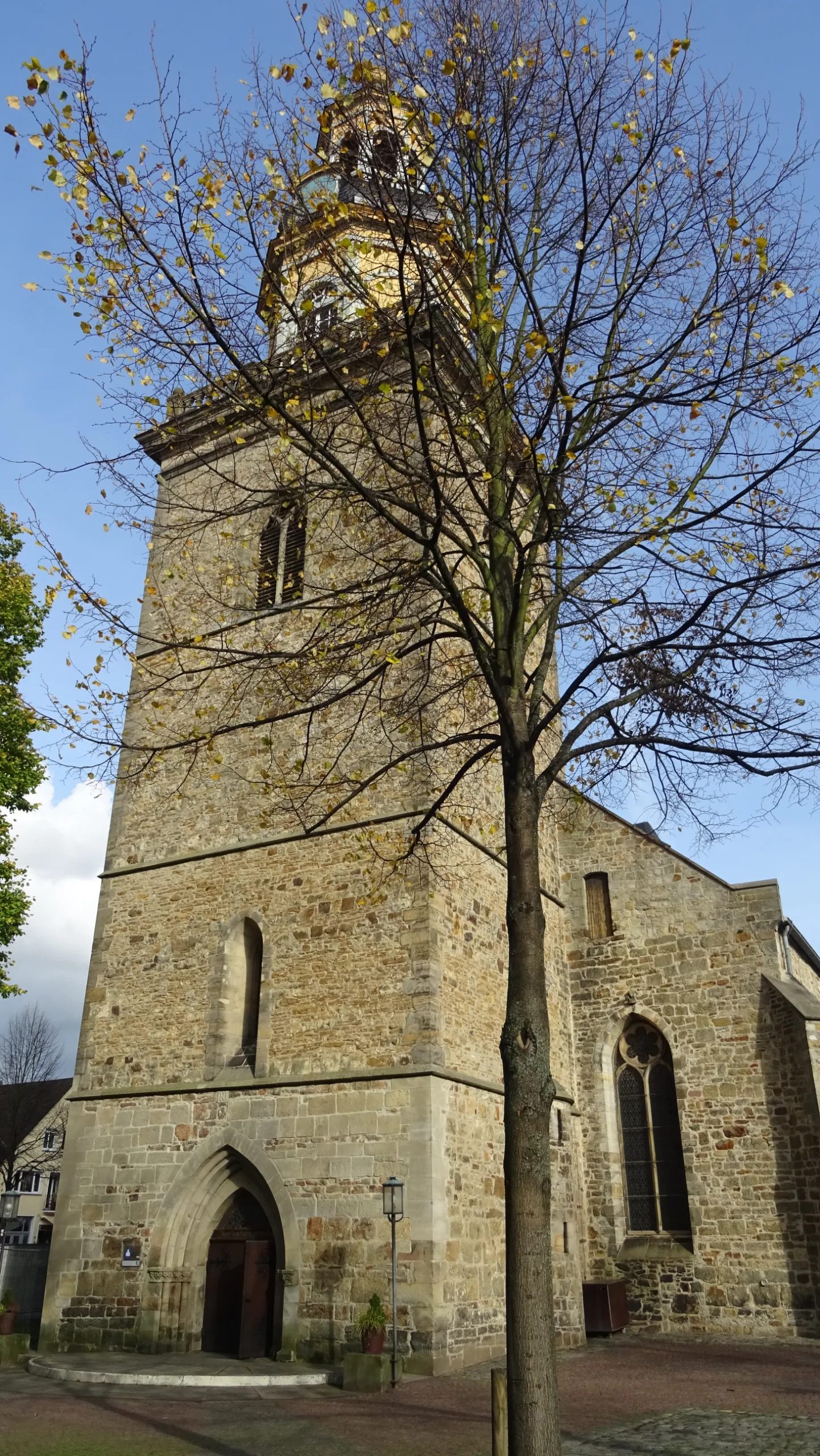
St. Nikolai is the Evangelical-Lutheran town church in Rinteln.
Building History+
The church was initially built as a basilica starting in 1238. In the 14th century, it was converted into the current three-aisled hall church without a transept. The remarkable Romanesque south portal from the early period of the church has been preserved. From 1788 to 1803, the spire, which originally consisted of a gable roof with a tall roof turret, was replaced by a Baroque lantern. Due to frequent Weser floods, the church floor was partially raised in 1810. In 1885, the floor was raised again by a total of about 1.20 cm, with corresponding raising of the portals, the regothicization of the nave windows, and the installation of the current church pews.
Parish+
The Counts of Schaumburg introduced the Reformation in Rinteln in 1559. In the early 17th century, Josua Stegmann, a theology professor from Rinteln and superintendent of the County of Schaumburg, worked at St. Nikolai; his tomb (in the tower room) and portrait are in the church. In 1646, Adolph Wilhelm Rottmann was Magister and Pastor secundarius in Rinteln, and from 1658 Pastor primarius. He died in 1689. From 1652 to 1689, Daniel Wilhelmi was preacher. Wilhelmi was buried in the church behind the altar, where his successor was also later laid to rest.
Furnishings+
Among the furnishings, a bronze baptismal font from 1582 in the choir area is noteworthy. The pulpit with the figure of the blessing Christ dates from the mid-17th century. The altar has a three-part retable, the main panel of which shows the Last Supper. A biblical cycle of paintings is painted on the organ gallery. Numerous epitaphs of Rinteln citizens refer to its function as a civic church of the town community.
Organ+
The organ case from 1621 may partly originate from Adolph Compenius. In the 18th and 20th centuries, the instrument was significantly altered. Rudolf Janke carried out an extension and renovation in 1995 using older registers. The instrument now has 39 registers on three manuals and pedal. Since November 2012, the historic organ has been equipped with a Baroque Zimbelstern with three small bells. It is externally recognizable by the two gilded stars.
Take Mobile History with you
You are reading this text for free. Premium adds what matters on the road: descriptions read aloud, sites found through your camera, whole regions taken offline.
- Every description, including the ~17,700 Premium sites
- Audio guide: have descriptions read to you on location
- AR finder: see sites through your camera, with distance and bearing
- Unlimited saved sites
14 days free, then from €2.99 a month. Cancel anytime.
Source: Wikipedia · Licence: CC BY-SA 4.0 · Image: Foto: Jörg Heldt (Community)
This description is a machine translation of an excerpt from the linked Wikipedia article. The source text was written by its authors, the translation is by Mobile History; like the original it is licensed under CC BY-SA 4.0.
Location: 52.1871, 9.0814