The church can be visited
ChurchFriedland
St. Nikolai Church
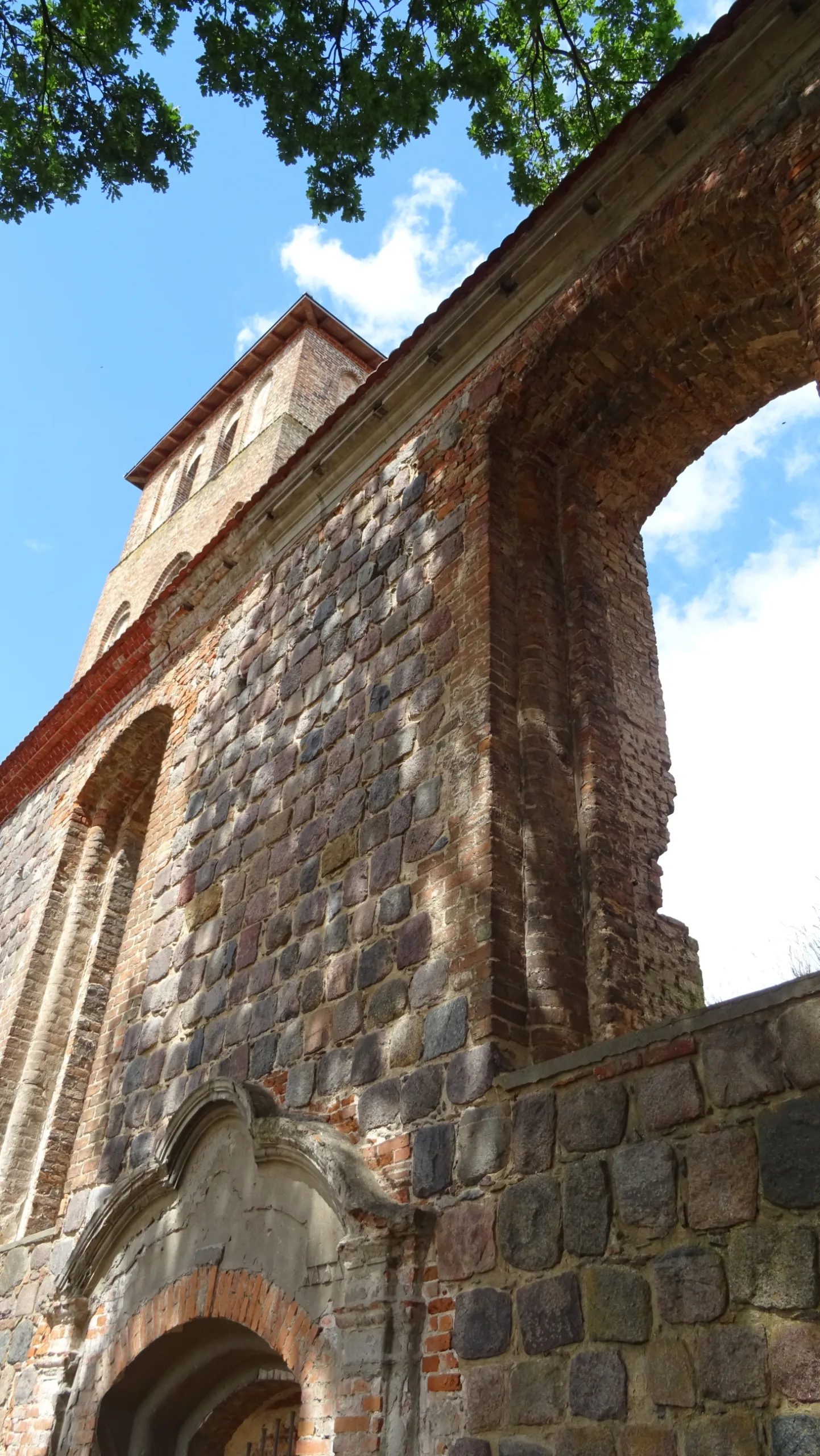
St. Nikolai is the ruin of a Protestant parish church in Friedland in the Mecklenburgische Seenplatte district in Mecklenburg-Vorpommern. The church, whose oldest structural components date from the end of the 13th century, was largely destroyed at the end of the Second World War and has been preserved as a ruin ever since.
History of the Church and the City+
The city of Friedland (Vredeland) was founded in 1244 by the Margraves of Brandenburg to secure the trade route over the "Kavelpaß". The Nikolaikirche was originally the second city parish church alongside the more significant and older Marienkirche. The city of Friedland experienced a heyday in its early history, but was repeatedly struck by catastrophes. In the Thirty Years' War (1618–1648), the population sank from approx. 4000 to 200 survivors. In the city fire of 1703, almost the entire city was destroyed. The churches, the town hall, the school and 265 of the approximately 300 residential buildings fell victim to the flames. The Nikolaikirche was subsequently rebuilt in the Baroque style. In the Second World War, during an attack on April 28, 1945, the church burned down to its foundations. The city was about 80% destroyed.
Architecture and Furnishings+
The Nikolaikirche is in its oldest parts a Romanesque fieldstone ashlar building. The building consists of three distinct parts: a rectangular choir with Romanesque influences, an almost square nave and a distinct rectangular fortified tower. The choir and the tower represent the oldest construction phases. The tower shows a Romanesque division of stories, but already early Gothic window architecture. The nave was added as the last main part in the second half of the 13th century. After the city fire of 1703, the exterior of the choir and nave as well as the interior of the church were rebuilt and furnished in the Baroque style until 1754: The church received a surrounding three-sided gallery and an extensive ceiling painting. In the choir, God the Father, Son and Holy Spirit were depicted on a globe carried by angels, in the nave the Ascension of Christ. The Rococo altar was created in 1772 by L. Häbert from Neustrelitz. It had a large painting, side columns and a triangular eye in a halo at the top. The freestanding pulpit also belonged to the Baroque extension. The organ case dated from 1806 and incorporated Renaissance forms. The organ from 1884 was a donation from the organ builder Wilhelm Sauer, who was born in Schönbeck. The church has been a ruin since its destruction in 1945.
Ecclesiastical Conditions+
The ecclesiastical conditions in Friedland were reorganized with the founding of the city in 1244. The Marienkirche, dedicated to the Blessed Virgin Mary, was the main parish church and, due to its connection with the Diocese of Havelberg and the Archdeaconry, the most important and richest church in the Stargard region. St. Nikolai Church was first mentioned in 1452 as the second city parish church alongside the Marienkirche. St. Marien Church is the main church of the United Evangelical-Lutheran Parish of St. Marien Friedland, which, in addition to St. Nikolai, also includes 18 other churches and two church ruins (as of 2012).
Take Mobile History with you
You are reading this text for free. Premium adds what matters on the road: descriptions read aloud, sites found through your camera, whole regions taken offline.
- Every description, including the ~17,700 Premium sites
- Audio guide: have descriptions read to you on location
- AR finder: see sites through your camera, with distance and bearing
- Unlimited saved sites
14 days free, then from €2.99 a month. Cancel anytime.
Source: Wikipedia · Licence: CC BY-SA 4.0 · Image: Foto: Jörg Heldt (Community)
This description is a machine translation of an excerpt from the linked Wikipedia article. The source text was written by its authors, the translation is by Mobile History; like the original it is licensed under CC BY-SA 4.0.
Location: 53.6705, 13.5548