The church can be visited
ChurchNeuötting
St. Nikolaus Church
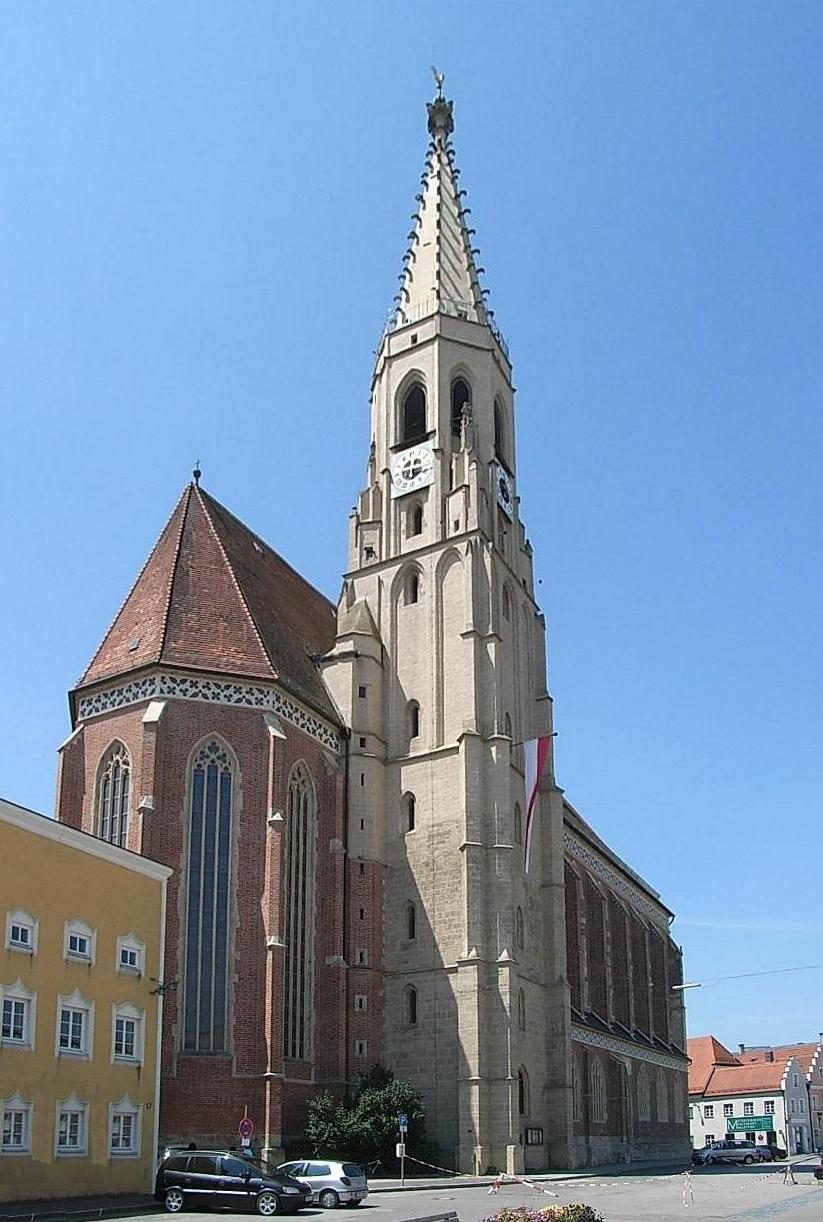
St. Nikolaus is the Roman Catholic parish church of Neuötting in Bavaria. The late Gothic hall church was predominantly built under the direction of Hans von Burghausen from 1410 to 1492. The building is a protected monument.
Construction History+
Construction of the church began, according to an inscription on the sacristy door arch, with the choir in 1410. Furthermore, in the first construction phase from 1410 to 1429, the 78-meter-high tower on the north flank of the choir and the first chapel on the south side were added. Due to exhausted funds from the citizenry, only two chapels could be added on the north side in the second construction phase (1430–1446). The funds for this came from donors. Then work on the church rested for 14 years. The third construction phase spans the years 1460 to 1480 and spatially includes the central chapels on the south side, including the south portal. After that, work on the church rested again for four years. From 1484 to 1492, the construction was completed with the erection of the main nave, the side aisles, and the rear chapels. For financial reasons, the naves could not be vaulted in the Gothic period. This only happened in 1622, when the central nave received late Renaissance stucco work, which was removed during the Regothification. Previously, the church in the nave only had wooden flat ceilings. During the interior restoration from 1974 to 1984, the vault frescoes from the Renaissance period (which had been replaced by a starry sky in 1878) in the church naves and side chapels were restored. An exterior restoration took place after 1998, during which the Gothic tracery friezes at eave height were restored.
Exterior+
The parish church is a towering brick building dominating the entire cityscape, with ashlar stone elements. Between the chapel and high windows, the building is structured with buttresses. The tower is a slenderly proportioned structure with an octagonal upper story and a crocketed spire. The unadorned exterior design of the nave (especially the west side) is due to the fact that the city church finally became usable after a lengthy construction history and finances were largely exhausted.
Interior+
The church, which is 49 m long, 22.5 m high and 21 m wide inside, has a three-bay, slightly wider choir with a narrower long bay, and a six-bay, three-aisled nave with integrated narrow low side chapels. The steep proportioning of the rooms is emphasized by the Regothification, but is already present in the medieval parts of the building, as in other works by Hans von Burghausen, and is effectively underlined by the extremely slender, richly profiled pillars with impostless archways. The church possesses works from every art epoch: from the Renaissance (1600–1622) the design of the chapels and the main nave vault instead of the wooden ceiling, from the Baroque the organ case on the west gallery, from the Rococo period the church pews, the holy water font and the St. Sebastian chapel altar, as well as from the Historicism period the pulpit, the high altar and the side aisle altars.
Altars+
The high altar from 1896 is the most artistically valuable work of the Regothification and, with the stained glass windows from the Mayer’sche Hofkunstanstalt in Munich from 1897–1910, integrates into the overall effect of the Gothic choir. Three other altars were created in 1882/83. The carved, stone-colored apostle statues in the choir were created in 1896 by Karl Georg Huber from Munich.
Side Chapels+
The eleven side chapels (five on the north side and six on the south side) are characterized by their Renaissance vault frescoes (around 1600), uncovered during the renovation from 1974 to 1984, and the Neo-Gothic furnishings (altars, large artistically valuable Stations of the Cross relief images, and confessionals). In the Chapel of Our Lady of Sorrows (opposite the north portal) stands an expressive Pietà. On the north side, in the eastern Holy Cross Chapel, two late Gothic altarpieces of Saints Achatius and Sigismund are to be highlighted.
Pulpit and Pews+
The pulpit pillar dates from the original Gothic furnishing phase; similar to St. Martin in Landshut and St. Stephan in Braunau, the staircase is integrated into the pillar core. The door dates from 1563, the basket and the soundboard are Neo-Gothic (1854). The choir stalls are Neo-Gothic and date from 1884. The church pews with small doors are finely carved work in Rococo style with coat of arms inlays.
Stained Glass Windows+
The artfully painted windows in Neo-Gothic style in the choir and most of the windows in the side chapels were created by the Mayer’sche Hofkunstanstalt between 1897 and 1910.
Memorial Stones+
In the choir, a finely crafted Renaissance epitaph for Bernhard Bogner († 1588) with an early city view of Neuötting in the lower scene is preserved. On the east wall of the northern side aisle, a replica of the memorial stone in Landshut with the portrait of the master builder Hans von Burghausen is affixed, which is incorrectly labeled "Stethaimer" here.
Organ+
The organ work in the Baroque case from 1642 was built by Gerhard Schmid in 1980. It has 49 stops distributed over four manuals and pedal. The disposition is:
Accessory stops: Cymbelstern, Schellencymbel Couplers: I/P, II/P, III/P, IV/P, I/II, III/II, IV/II, IV/III Playing aids: Tutti, Reeds off, Release, 6-fold setter combination Notes: Slider chest, mechanical playing and electrical stop action, Baroque case from 1642
Bells+
The current bronze carillon comes from the Erdinger bell foundry Karl Czudnochowsky from 1949 and sounds in the strike tone sequence b0 - d#1 - f#1 - g#1.
St. Nikolaus Bell (41.5 cwt.), Inscription: "vivos voco" (I call the living) and "Glory to God in the highest". St. Marien Bell (19 cwt.), Inscription: "Mortuos plango" (I mourn the dead) and "Mary, Queen of Peace, pray for us". St. Florian Bell (10.5 cwt.), Inscription: "Fulgura frango" (I break the lightning) and "Flee, hostile powers". St. Joseph's Bell (8 cwt.), Inscription: "Saint Joseph, patron saint of the church, pray for us".
Take Mobile History with you
You are reading this text for free. Premium adds what matters on the road: descriptions read aloud, sites found through your camera, whole regions taken offline.
- Every description, including the ~17,700 Premium sites
- Audio guide: have descriptions read to you on location
- AR finder: see sites through your camera, with distance and bearing
- Unlimited saved sites
14 days free, then from €2.99 a month. Cancel anytime.
Source: Wikipedia · Licence: CC BY-SA 4.0 · Image: Pfarrkirche_Neuötting.JPG : Konrad Lackerbeck derivative work: Rabanus Flavus · Wikimedia Commons · CC BY 3.0
This description is a machine translation of an excerpt from the linked Wikipedia article. The source text was written by its authors, the translation is by Mobile History; like the original it is licensed under CC BY-SA 4.0.
Location: 48.2412, 12.6838