The church can be visited
ChurchWürzburg
St. Peter and Peter's Church
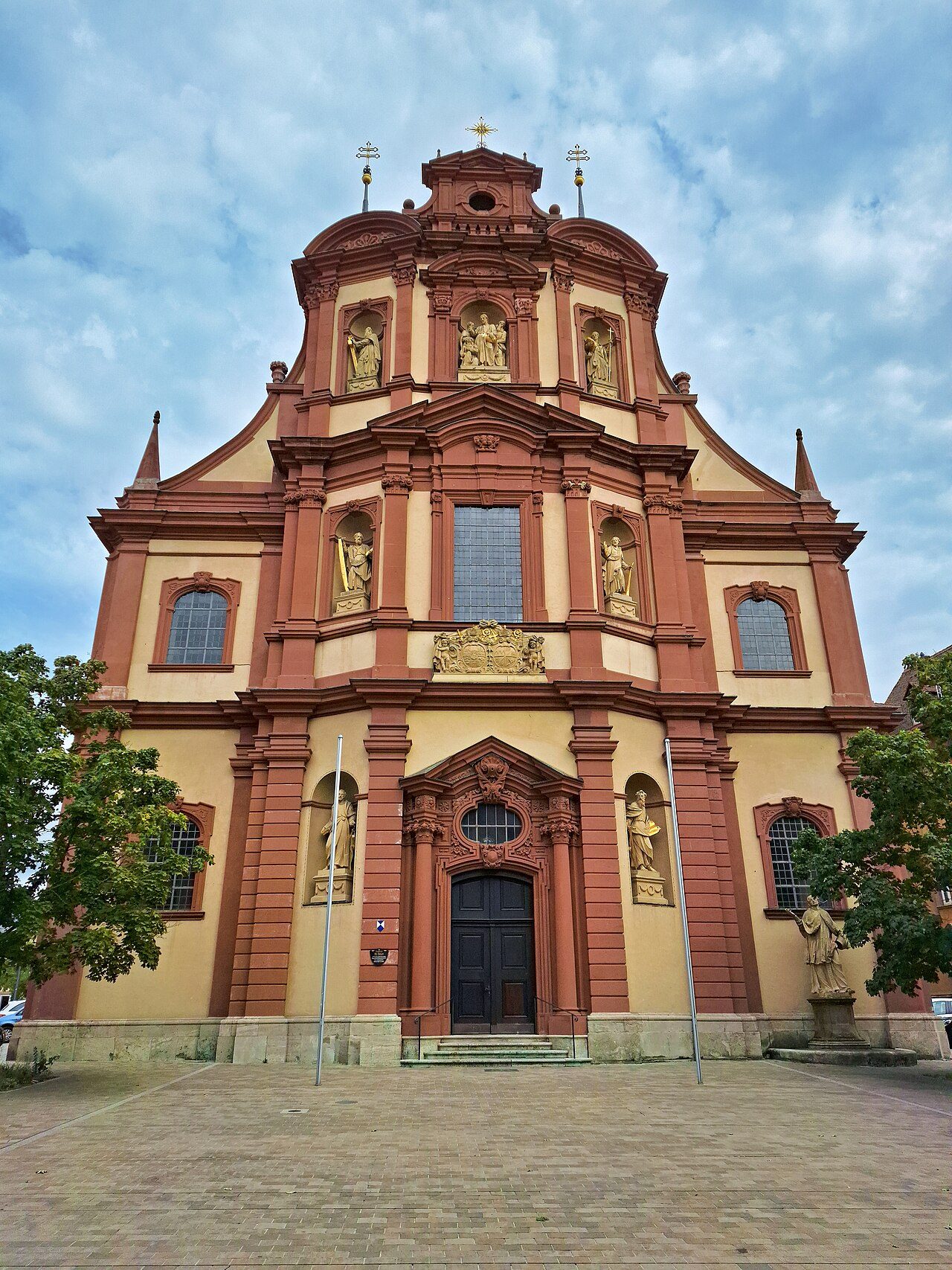
St. Peter und Paul (also known as St. Peter's Church, St. Peter and Peter's Church for short) is a Catholic parish church in the historic center of Würzburg and a parish in the Sanderau district, belonging to the Würzburg Innenstadt parish community.
The first Peter and Paul Church was built in Romanesque times as the parish church of the southern suburb of Sand (outside the city wall). It was replaced in the High Middle Ages by a Gothic new building. From 1717 to 1720, with the support of Prince-Bishop Johann Philipp von Greiffenclau zu Vollraths, a Baroque new building was constructed according to plans by Joseph Greissing from Vorarlberg, incorporating the Romanesque towers and the Gothic choir. The church was consecrated on January 26, 1721, by Prince-Bishop Johann Philipp Franz von Schönborn. The northern tower was renovated in 1846, followed by interior renovations in 1892 and from 1933 to 1935. After the war damage in March 1945, St. Peter und Paul was faithfully restored externally from 1950 to 1959. During the reconstruction, the sacristy on the south side of the choir served as an emergency chapel. The furnishings were partly restored, partly supplemented by pieces of other origin. Nothing remains of the paintings created between 1720 and 1740. A first interior renovation after the reconstruction took place in 1976, followed by exterior renovation work between 1980 and 1981. From 2015 to 2016, the church underwent another thorough interior renovation. The reopening took place on November 13, 2016, in a pontifical mass celebrated by Bishop Friedhelm Hofmann.
Architecture and Furnishings+
St. Peter und Paul is a vaulted free-standing pillar gallery hall. The Gothic choir was altered in Baroque style on the upper floor. The Romanesque towers were placed inside the church hall behind the facade during the new construction. Their exteriors were reshaped in Baroque style. The three-story facade follows the scheme of Roman Baroque but also shows Renaissance elements. It contains numerous statues of saints, created in 1773 by the Wagner workshop. The central risalit is convexly curved forward. Above the portal are the coats of arms of the Prince-Bishops von Greiffenclau and von Schönborn, restored in 1956/57 by Georg Schneider. A statue of Saint Aquilin to the right of the main entrance was restored in 1977 by Wolfgang Finger. From the 18th-century furnishings, parts of the stucco, two altarpieces by Anton Clemens Lünenschloß, and the Rococo pulpit by Johann Wolfgang von der Auwera, created around 1745/50 and largely reconstructed after the destruction on March 16, 1945, have been preserved. The current three late Baroque altars in neoclassical style were created around 1800 by Georg Schäfer from Karlstadt. They originally came from the parish church of St. Jakobus der Ältere in Himmelstadt and were acquired in 1974:
The high altar consists of a four-column structure with figures of St. John the Evangelist, the Blessed Virgin Mary, St. James, and St. Charles Borromeo. In the center is a cross with a Baroque corpus, and above the tabernacle hangs a crucifix. The crowning features God the Father with the globe, flanked by two angels. The Aquilin Altar (until 1988 the Sebastian Altar) in the left side aisle contains figures of St. Sebastian (right) and St. Andrew (left). In 1987, it was supplemented by a centrally placed figure of St. Aquilin and relics of this saint, created by Andreas Kräml from Würzburg. The Marian Altar in the right side aisle contains a depiction of Maria Immaculata. This was also created by Andreas Kräml as a replica of the original still located in Himmelstadt. It is flanked by figures of St. Joachim (left) and St. Anne (right). Two choir arch altars carved by Balthasar Esterbauer between 1717 and 1720 burned on March 16, 1945. The epitaph, completed around 1720, cast in bronze by Johann Adam Roth from Forchheim, with figurative bronze works from Nuremberg foundries for the Imperial Councillor and Prince-Bishop's Chancellor Johann Lorenz Adelmann († 1719), has been preserved. Near the Church of St. Peter und Paul at Peterplatz 10 is the Petersbau at Peterplatz 8, built by Antonio Petrini between 1689 and 1691, which originally served as a seminary and temporarily also as a mint.
Organ+
The predecessor of the current organ, built in 1956 by the Hindelang workshop, had 26 stops on two manuals and pedal. However, it no longer met musical and technical requirements and was increasingly prone to repairs, so it was no longer played from 2010 onwards. The current organ was built from 2016 to 2018 by the Vleugels organ building workshop and consecrated on January 29, 2018, by City Dean Jürgen Vorndran. The instrument has 28 stops (a total of 2015 pipes), plus 27 transmissions, extensions, group and pre-stops, distributed over three manual divisions and pedal. For acoustic reasons, the partial divisions of the instrument are positioned at three different locations on the galleries: the Great Organ and the Pedal are on the west gallery, the Swell Organ (Récit) is on the north gallery, and the enclosed Positive is on the south gallery. Some of the Great Organ's stops are also enclosed. The instrument can be played from a free-standing, movable console on the west gallery with purely electric actions and free manual assignment; a MIDI connection for connecting a keyboard is provided at all three organ locations. The soft lines of the facade design, conceived by diocesan architect Cesare Augusto Stefano, pick up on elements of Baroque church architecture. The installation of a carillon, which can be coupled to all manuals and the pedal, is prepared.
Couplers: II/I, III/I, III/II, Super I, I/P, II/P, III/P, Sub- and Supercouplers, 5 Dynamic couplers Playing aids: free manual assignment possible; register crescendo for foot and hand operation; free register rockers; Espressivo action system; Variosetzer; register and key lock Notes
Bells+
North Tower
Historic Gloria bell from 1452, overhauled: 1959; strike tone: F#′; diameter 111.7 cm; 840 kg; decoration: two small crucifixes; inscription in Gothic minuscules: Gloria in excelsis deo et in terra pax hominibus bone voluntatis in M CCCC LIII ("Glory to God in the highest and on earth peace to people of good will. In the year 1453") Due to its age, the bell escaped melting down during World War II. In 1945, it fell to the ground but was not destroyed. In October 1948, it was pulled back up to the tower and rang again. Maria-Regina bell with strike tone B′; diameter 95.9 cm; 700 kg; decoration: image of Maria Regina; inscription: Regina mundi dignissima, Maria, intercede pro nostra pace et salute ("Most worthy Queen of the world, Mary, intercede for our peace and salvation") (cast in 1959 by Schilling, Heidelberg) South Tower
Peter and Paul bell with strike tone G#′; diameter 104.5 cm; 820 kg; decoration: image of St. Peter; inscription: Sancti Petre et Paule, patroni huius ecclesiae, subvenite populo dei ("Saints Peter and Paul, patrons of this church, come to the aid of the people of God") Aquilin bell with strike tone: C#″; diameter 84.6 cm; 490 kg; decoration: image of the Saint; inscription: Sancte Aquiline, sacerdos et martyr, ora pro nobis ("Saint Aquilin, priest and martyr, pray for us") Joseph bell with strike tone: D#″; diameter 75.4 cm; 330 kg; inscription: Fac nos innocuam, Joseph, decurrere vitam ("Joseph, let us lead an innocent life") (All three bells were cast in 1959 by Schilling, Heidelberg.)
Take Mobile History with you
You are reading this text for free. Premium adds what matters on the road: descriptions read aloud, sites found through your camera, whole regions taken offline.
- Every description, including the ~17,700 Premium sites
- Audio guide: have descriptions read to you on location
- AR finder: see sites through your camera, with distance and bearing
- Unlimited saved sites
14 days free, then from €2.99 a month. Cancel anytime.
Source: Wikipedia · Licence: CC BY-SA 4.0 · Image: Nilaxus / CC BY-SA 4.0 via Wikimedia Commons
This description is a machine translation of an excerpt from the linked Wikipedia article. The source text was written by its authors, the translation is by Mobile History; like the original it is licensed under CC BY-SA 4.0.
Location: 49.7891, 9.9328