The church can be visited
ChurchNamysłów (Namslau)
St. Peter und Paul
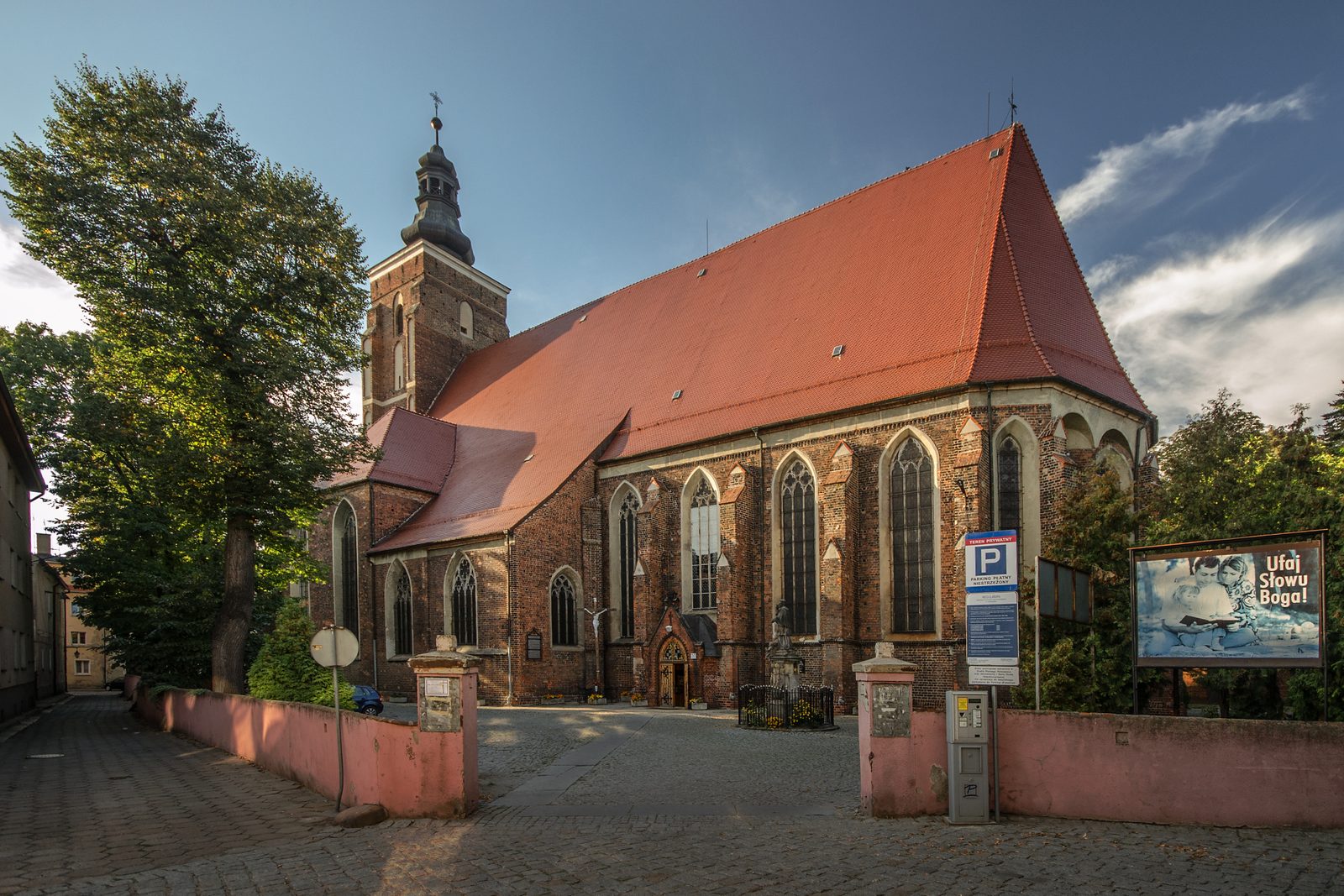
The Roman Catholic Church of St. Peter and Paul (Polish Kościół Świętych Apostołów Piotra i Pawła w Namysłowie) is the parish church in Namysłów (German Namslau). It belongs to the Parish of St. Apostles Peter and Paul in Namysłów in the Deanery of Namysłów East of the Archdiocese of Wrocław. On October 22, 1959, the church was entered into the register of monuments of the Opole Voivodeship under the number 603/59.
History+
The first mention of a wooden church dates back to 1278; the pastor at that time was named Dietriech. The next mention is from 1321, where the signature of Pastor Jeschco can be found on the document of the Duke Konrad IV of Namslau, who called himself "Lord of Namslau". The church patronage was held by the Council of the City of Namslau at that time. At the beginning of the 15th century, the construction of a new brick church began. Construction work started in 1401 or 1405 (the exact date is unknown). The church, including the bell tower, was completed in 1441. It was built within the city fortifications and was an integral part of the city walls. During a fire in 1483, the church was partially destroyed. It was initially rebuilt provisionally; its completion lasted until the beginning of the 16th century. In 1525, the church was taken over by Protestants during the Reformation, who added the sacristy a year later. In 1655, the building returned to the hands of Catholics. In the 17th and 19th centuries, the church was repeatedly repaired and renovated. In the years 1868–1869, it was redesigned in the Neo-Gothic style. The churchyard, surrounded by a wall from 1713, was used as a cemetery until the mid-19th century. In the southwestern corner of the cemetery wall, a late Baroque main entrance gate with a figure of the Bohemian patron saint John of Nepomuk from 1713 is preserved.
Architecture+
The structure is a late Gothic, three-aisled, six-bay hall church with a three-apse termination on the east side. The main nave is wider than the side aisles and projects further forward. In the northern part there is a three-bay sacristy and three chapels with late Baroque altars. The carved altar was created around 1720 by the sculptor Georg Leonhard Weber. On the western side there is a square tower with arcaded openings to the north and south of the ground floor. It is topped by an onion dome with a lantern from 1790. On the south side, four chapels and a small Neo-Gothic vestibule were built. The interior dimensions of the church are:
Central nave: length 53.30 m; width 7.20 m, North side aisle: length 25.60 m, width 3.60 m, South side aisle: length 25.60 m, width 3.80 m, Tower: length 4.90 m, width 5.30 m, Sacristy: length 14.60 m, width 4.30 m. The transverse arches of the star vaults rest on twelve massive pillars, a huge red tiled roof covers the three naves: the main and two side naves, which are terminated by apses in the east.
Furnishings+
The Neo-Gothic main altar was executed by the Wrocław cabinetmaker Carl Buhl according to designs by the Ohlau architect Alexis Langer in 1869 and equipped with a painting of the Apostles Peter and Paul by Ferdinand Winter. The Neo-Gothic side altars were created in 1890. A Rococo altar from around 1740 features a Gothic figure of the Mother of God with Child from around 1410 and shows in the crowning the Adoration of the Mother of God of Loreto and St. Peter of Alcantara with figures of Sts. Apollonia and Catherine from around 1720 from the Franciscan church in Namslau. The pulpit from around 1620 was redesigned around 1890. The Rococo baptismal font from the third quarter of the 18th century is adorned with a Baptism of Christ group on the volute lid. Below the choir loft is Renaissance choir stalls from the second half of the 16th century. Paintings from around 1708 show Sts. Peter and Paul (from the former main altar), St. Hedwig and the Fourteen Holy Helpers; also visible are Stations of the Cross from the first half of the 19th century. Among the preserved late Gothic figures are a former triumphal arch crucifix from around 1500, a Christ in repose from the first half of the 16th century, and a crucifixion group from the end of the 15th century, formerly attached to the western exterior wall of the tower. In the main nave, among other things, figures of the Church Fathers from the first quarter of the 18th century are displayed. In the main nave, among other things, are the figures of the Church Fathers, from the first quarter of the 18th century, and in the choir a Mannerist epitaph from the end of the 16th century with reliefs (Crucifixion in the central part as well as Last Supper, Sacrifice of Isaac, Bronze Serpent) and figures (Prudence, Circumspection, Samson with the Lion, David and Goliath, Risen Christ). On a pillar is the epitaph of Pastor Heinrich Sukowsky († 1722) with a coat of arms cartouche and crucifixion relief. Furthermore, medieval tomb slabs are preserved, including those for Pastor Wilhelm († 1352?, fragment) and for Peter Kunzendorf, the construction manager of the church building († 1454). On the south side of the church is a late Baroque statue of St. John of Nepomuk from 1730, which stood in the market square of Namslau until 1939.
Take Mobile History with you
You are reading this text for free. Premium adds what matters on the road: descriptions read aloud, sites found through your camera, whole regions taken offline.
- Every description, including the ~17,700 Premium sites
- Audio guide: have descriptions read to you on location
- AR finder: see sites through your camera, with distance and bearing
- Unlimited saved sites
14 days free, then from €2.99 a month. Cancel anytime.
Source: Wikipedia · Licence: CC BY-SA 4.0 · Image: Sławomir Milejski · Wikimedia Commons · CC BY-SA 4.0
This description is a machine translation of an excerpt from the linked Wikipedia article. The source text was written by its authors, the translation is by Mobile History; like the original it is licensed under CC BY-SA 4.0.
Location: 51.0775, 17.7185