The church can be visited
St. Quintin Church

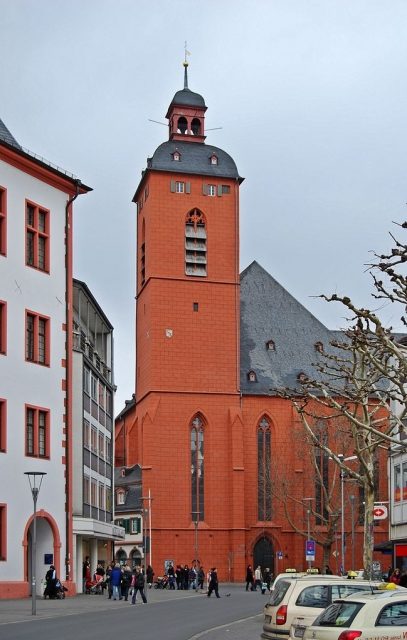
The Church of St. Quintin in Mainz is the parish church of the oldest documented parish in the city.
The origins of the parish probably date back to the Merovingian period, supported by the patronage of Saint Quintin, which later almost fell into oblivion. In 774, St. Quintin was first mentioned in a document. Later, the first inner-city parish cemetery was located near the church. It is considered certain that St. Quintin already existed in the 8th century; in the 7th and 8th centuries, extensive church building activity had begun in Mainz.
St. Quintin has always been a parish church throughout its history. Today, together with the Cathedral parish of St. Martin, it forms the parish of Cathedral St. Martin and St. Quintin. The Cathedral priest has since always been the priest of St. Quintin.
During the Second World War, the church was severely damaged during the air raids on Mainz in 1942, but the walls remained intact. The valuable arm relic of Saint Quintin, as well as other precious furnishings, burned. Reconstruction and renovation began immediately, and by 1948 the church could be used again. After the war, it served as a church for the French garrison. A new Quintin relic could be venerated again since November 4, 1950, through the mediation of the Bishop of Soisson Pierre Auguste Marie Joseph Douillard. At the end of the 60s, work was carried out on the exterior and the bell tower. However, this remained with a temporary roof. It was not until 1995 that a faithfully reconstructed spire was reinstalled.
Construction+
The current building was erected around 1300 in the Gothic style. It consists of an almost square three-aisled hall nave (see also hall church) with three bays. The southwesternmost bay carries the massive bell tower of the church, which served as the city's fire station until the 20th century, which is why it contains a tower keeper's apartment, built in 1489 under Elector Berthold von Henneberg. From the tower keeper's apartment, practically the entire city area of old "wooden" Mainz could be overlooked. The windows of the tower keeper's apartment are fitted with green shutters. The oldest part of the building is the single-aisled choir, on whose south side the sacristy is located. On the north side, a two-bay Holy Cross Chapel adjoins. Also on the south side is the portal; the eastern and northern parts of the church are completely built-in. The exterior is held in brick red with painted joints.
Furnishings+
The original interior furnishings of the church were largely lost during the Second World War. Two original stone reliefs of a Way of the Cross created around 1500 and the baptismal font from 1713 are still preserved. Noteworthy is the high altar with a column canopy from 1739, which was made according to designs by the architect Maximilian von Welsch.
Due to the rapid reusability after the Second World War, the interior also contains many furnishings from other churches in the city, such as the large painting by Franz Anton Maulbertsch on the west wall of the northern side aisle, which depicts the Assumption of Mary and was originally located in Altmünster Abbey. Also noteworthy is the baroque pulpit by Johannes Förster from the church of St. Emmeran, almost completely destroyed at the end of the war, which was donated by Countess Ostein in 1761, as well as a Pietà from St. Christoph (today a war memorial). The baroque side altars come from the parish church of Mainz-Bretzenheim.
Bells
St. Quintin has four bells. The most significant bell of the carillon is the beehive-shaped "Lumpenglöckchen" (rag bell), which dates from around 1250. Since the restoration of the bell in 1997, it rings daily for the Angelus. In 1908, the then Gothic carillon (without the Lumpenglöckchen) including the bell frame was removed and replaced by a new carillon with a steel bell frame. The two world wars spared only the Quintin bell of that carillon; today it forms the second smallest bell. Two larger cast steel bells from the 1920s were added.
Take Mobile History with you
You are reading this text for free. Premium adds what matters on the road: descriptions read aloud, sites found through your camera, whole regions taken offline.
- Every description, including the ~17,700 Premium sites
- Audio guide: have descriptions read to you on location
- AR finder: see sites through your camera, with distance and bearing
- Unlimited saved sites
14 days free, then from €2.99 a month. Cancel anytime.
Source: Wikipedia · Licence: CC BY-SA 4.0 · Image: http://commons.wikimedia.org/wiki/File:Quintinskirche_Mainz_2010.jpg
This description draws on the facts documented in the linked Wikipedia article; Wikipedia content is licensed under CC BY-SA 4.0. Wording and editing: Mobile History.
Location: 50.0009, 8.2721