The church can be visited
ChurchChwarszczany (Quartschen)
St. Stanislaus Church
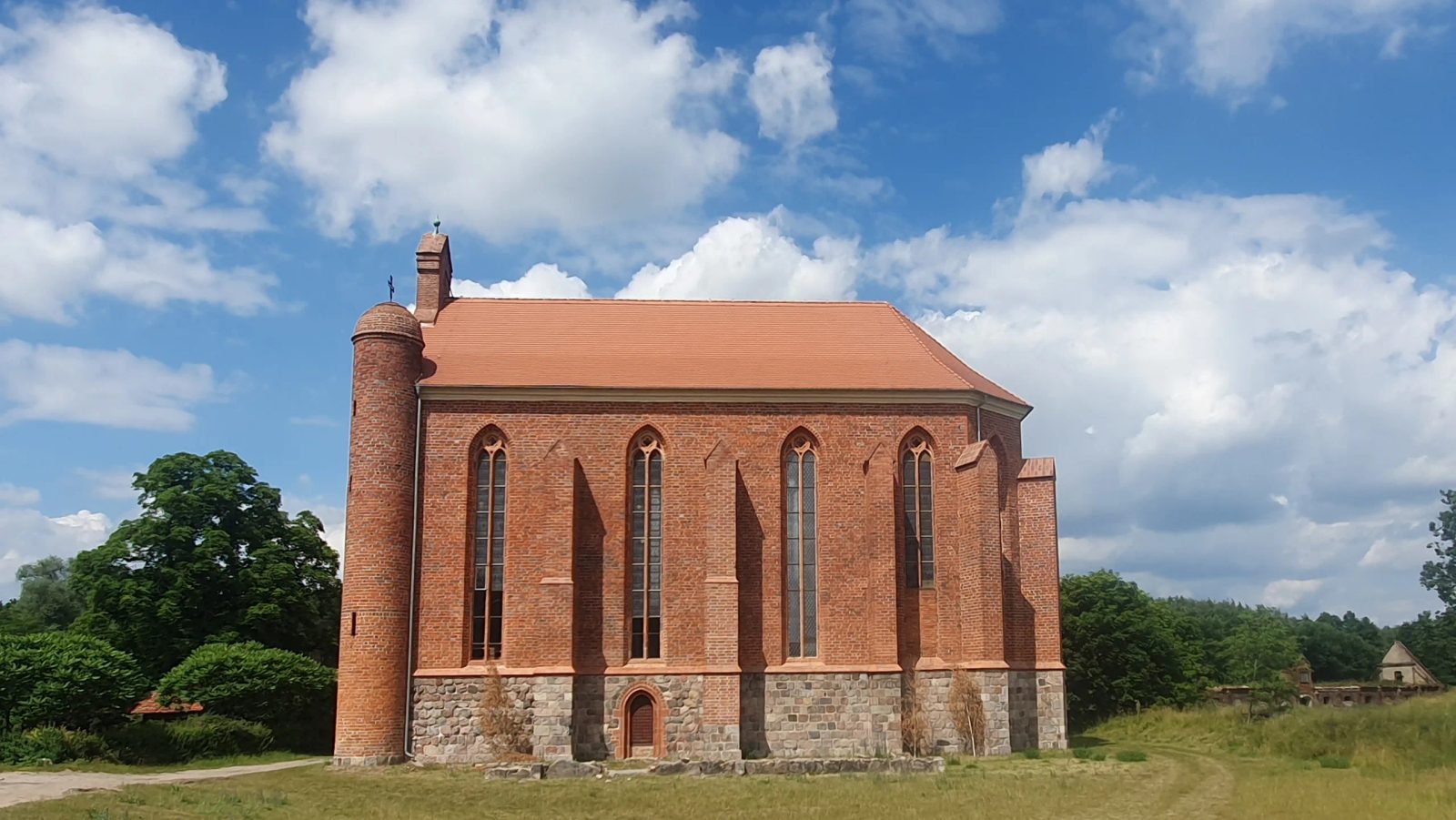
The church stands in Chwarszczany (German: Quartschen), a village in the municipality of Boleszkowice, Myślibórz County, West Pomeranian Voivodeship, Poland. It lies on the river Myśla (Mietzel), about eleven kilometres from Kostrzyn (Küstrin).
In 1232 Duke Władysław Odonic of Greater Poland granted the village and 1,000 hides of land to the Knights Templar. The aim was to cultivate and settle the area, while the Templars were also to act as a buffer between the rival powers of this border region. Further grants, including from Duke Barnim I of Pomerania, enlarged the estate, which comprised eleven villages by 1261. A first church was probably built soon after the grant. In the second half of the 13th century work began on the present brick church on a fieldstone base, which the Bishop of Lebus consecrated to All Saints in 1280.
In the last decades of the 13th century Quartschen became one of the most important Templar houses in Eastern Europe. In 1286 Margrave Otto VI of Brandenburg joined the Order here, and from 1291 it was the residence of Bernhard von Eberstein, the Order’s provincial master for Poland, Pomerania and the Neumark.
After the Templars were dissolved in 1312, the estates passed to the Knights Hospitaller in 1318. They extended the complex and in the 15th century added the Gothic wall paintings of saints. In 1540 the commandery was moved to Schivelbein (Świdwin) on the orders of Margrave John of Küstrin, and a margravial farm estate was set up at Quartschen, which existed until 1945. In the 18th century all other buildings of the commandery were demolished, leaving only the church. The nave windows were reconstructed in the 19th century. After the Second World War the village became part of Poland. According to legend, the Templars sank a treasure, including the Holy Grail, nearby.
Today the church is regarded as the best-preserved Templar building in Poland and was included in 2001 on the list of the country’s 100 most important architectural monuments. It is used as a Catholic church. Archaeological excavations have taken place since 2004, and a Templar museum has been set up beside the church. Since 2005 the site of the former commandery has been protected as the Chwarszczany Cultural Park.
Take Mobile History with you
You are reading this text for free. Premium adds what matters on the road: descriptions read aloud, sites found through your camera, whole regions taken offline.
- Every description, including the ~17,700 Premium sites
- Audio guide: have descriptions read to you on location
- AR finder: see sites through your camera, with distance and bearing
- Unlimited saved sites
14 days free, then from €2.99 a month. Cancel anytime.
Image: Foto: Jörg Heldt (Community)
Location: 52.6877, 14.6420