The church can be visited
ChurchHaselünne
Church of St. Vincentius
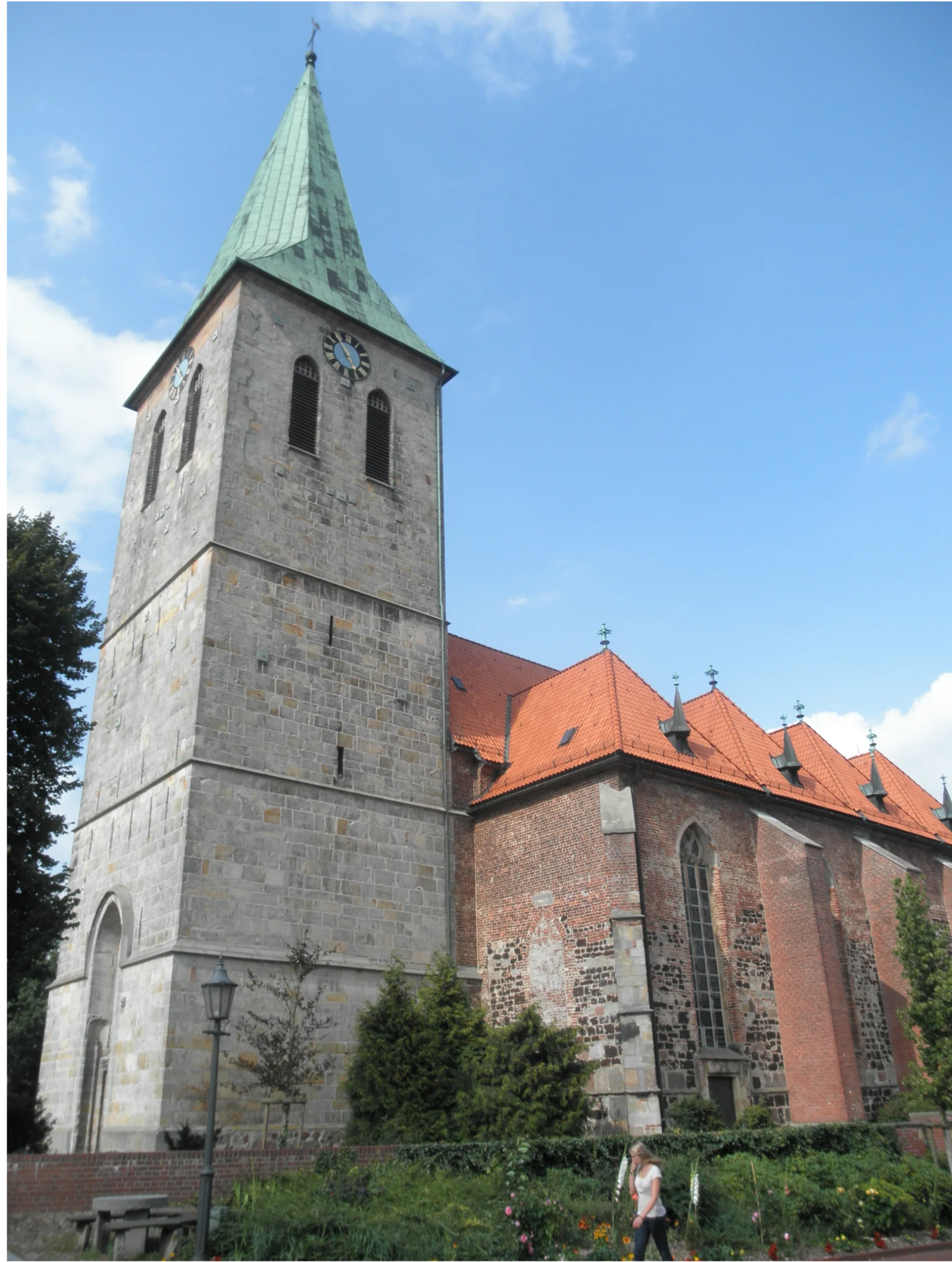
The Catholic Church of St. Vincentius in Haselünne is a late Gothic brick church in the Emsland district in Lower Saxony. It belongs to the parish of St. Vincentius Haselünne in the Haselünne-Lehrte parish association in the Diocese of Osnabrück.
History and Architecture+
The Church of St. Vincentius in Haselünne is a three-aisled, four-bay, late Gothic brick hall church from the last third of the 15th century, which is illuminated by tall three-part windows with fish bladder tracery. The choir with a rectangular bay and five-eighths closure is dated to 1509. The west tower was raised in 1471 and clad with Bentheim sandstone. The current tower finial was created in 1860. A well-designed late Gothic west portal is combined with the window above it. The two-story sacristy was built in the 16th century. Sharpening grooves can be found on the sandstone ashlar blocks of the tower. The slightly irregular floor plan with a wider southern and narrower northern side aisle shows that older building parts were incorporated into the new construction. According to an inscription in the choir, Rector Herbord Monnich died in a construction accident in 1376. The west tower is slightly shifted north of the axis of the central nave and appears to have originally been part of a three-aisled structure from the 13th century. Inside the four-bay hall church with slender round pillars and domed vaults, it can be seen that the foundation of at least the northern side aisle with its longitudinally rectangular bays influenced the new construction. The central nave and the choir are spanned by star vaults, the side aisles by cross vaults. In the years 1976/77, the parish church of St. Vincentius was fundamentally restored. Another interior renovation was carried out in 1998.
Furnishings+
The furnishings include two richly figured Neo-Gothic carved altars. The high altar, sensitively fitted into the choir, was created in 1900 by Bernhard Frydag from Münster. In the side altar stands a small statue of Mary, designed around 1700 by Wilhelm Heinrich Kocks, whose works are also traceable in the chapel of Dankern Castle. The baptismal font on four lion's feet dates from the 13th century. An artistically valuable Pietà with restrained expression was created at the beginning of the 16th century. Two larger-than-life wooden figures, depicting John the Baptist and Saint Joseph, were created at the beginning of the 18th century in the style of Johann Wilhelm Gröninger. In the northern side aisle, two large, artistically significant sandstone epitaphs are preserved. In the west is the epitaph for Rudolf von Langen zu Schwarzenburg and Haselünne († 1610) and Margarete von Hake zu Schewentorf († 1637) with a relief of the Resurrection between columns and numerous coats of arms, probably created by Gerhard Gröninger, whose epitaphs are also preserved in Münster Cathedral and in the Marienkirche in Osnabrück. In the east stands a large epitaph for Caspar von Monnich, Lord of Eichhof and Burgmann of Haselünne († 1662) and Gertrud von Wendt († 1645) by Heinrich Meiering from Rheine. The two-story, strongly plastic structure shows three reliefs from the Passion between columns with the kneeling, freely sculpted donor family in front of them, with a relief of the Ascension of Christ arranged above. The framing is unusually richly decorated with figural ornamentation, similar to the high altar in Gravenhorst Monastery. A depiction of the Man of Sorrows from the first half of the 18th century from the Jöllemann workshop (as in Malgarten Monastery) was originally in the Poor Clares monastery on site. Two large altarpieces from 1716 by Ferdinand Abshoven show the martyrdom of Saint Vincentius and the Assumption of Mary. A chandelier from 1674 is also preserved. The organ was built in 1977 by the organ builders Gebrüder Stockmann. The slider chest instrument has 33 stops on two manuals and pedal. The key actions are mechanical, the stop actions are electric.
Couplers: II/I, I/P, II/P. The oldest bells of the church date from 1406 and 1516 (by Wolter Westerhues).
Take Mobile History with you
You are reading this text for free. Premium adds what matters on the road: descriptions read aloud, sites found through your camera, whole regions taken offline.
- Every description, including the ~17,700 Premium sites
- Audio guide: have descriptions read to you on location
- AR finder: see sites through your camera, with distance and bearing
- Unlimited saved sites
14 days free, then from €2.99 a month. Cancel anytime.
Source: Wikipedia · Licence: CC BY-SA 4.0 · Image: Von Thomas Pusch - Eigenes Werk, CC BY-SA 3.0, https://commons.wikimedia.org/w/index.php?curid=16889587
This description is a machine translation of an excerpt from the linked Wikipedia article. The source text was written by its authors, the translation is by Mobile History; like the original it is licensed under CC BY-SA 4.0.
Location: 52.6726, 7.4857