Museum
Stadionsche Castle

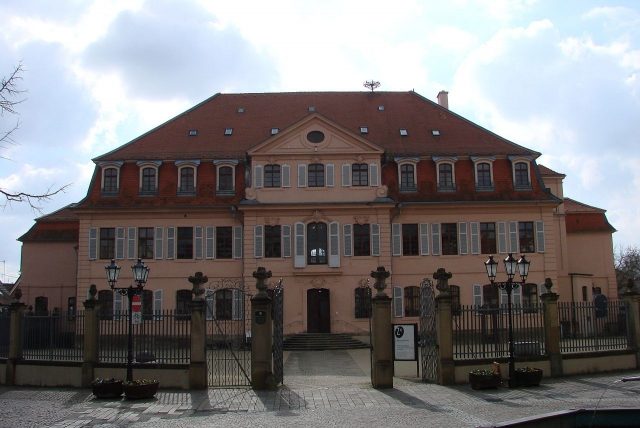
Stadion Palace is a Rococo-style palace in Bönnigheim in the Ludwigsburg district.
Stadion Palace is located in the Liebenstein quarter in the center of the city at the end of the main street.
The palace is a two-story building with a mansard roof and a central risalit. An iron fence encloses the grounds. In front of the palace is a forecourt.
Inside, the palace is decorated with stucco and paneling. There is also a double-flight staircase. The ballroom had leather wallpaper until 1931, which is now exhibited in Ludwigsburg Residential Palace. The four medallions in the hall, which are connected to each other, are said to represent the four seasons.
The predecessor of the building was Liebenstein Castle, built in 1560, which served as the seat of the Lords of Liebenstein within the Ganerbschaft Bönnigheim. In 1717, Lothar Franz von Schönborn, Elector and Archbishop of Mainz, ceded the Liebenstein properties in Bönnigheim to Johann Philipp von Stadion, who was Chancellor and Grand Master Builder of Electoral Mainz. His son Anton Heinrich Friedrich von Stadion, who inherited the properties after his father's death in 1742, ended the Ganerbschaft by purchasing Bönnigheim. In 1753, he had Liebenstein Castle and all outbuildings, except for the so-called Kavaliersbau, demolished. Instead, he had a new building planned according to French models by Anselm Franz von Ritter zu Groenesteyn, as the latter had already built several buildings in Mainz. The new building was coordinated by Anton Haaf, and craftsmen were brought specifically from Mainz for the new building, as evidenced, for example, by the mark of a Mainz stonemason. In 1756, the construction work was completed. From this point on, the building was used as a country seat for the Stadion family, like Warthausen Castle. After the death of the Count of Stadion in 1768, his court councilor and presumably also illegitimate son Georg Michel von La Roche moved in with his wife Sophie and his family and stayed there for two years. After the La Roches moved out, the building was probably empty. In 1785, the pledge to the Counts of Stadion expired. Thereupon, Duke Carl Eugen von Württemberg bought Bönnigheim and Stadion Palace, along with several other cities. Later, the seat of the newly founded Oberamt Bönnigheim was temporarily moved to the Kavaliersbau. However, from 1792, the palace was used as a residence for members of the House of Württemberg. From 1792 until his accession to the throne in 1793, Ludwig Eugen von Württemberg lived there. During this time, the two pavilions on the sides of the palace were built. In 1801, King Friedrich I of Württemberg's sister-in-law, Albertine von Schwarzburg-Sonderhausen, moved into the palace, where she remained until 1821. After seven more years, during which the building was unused, the seat of the Royal Württemberg Senior Forestry Office for the Stromberg and Zabergäu was moved to the palace. During this time, the stone building between the Front Palace Garden and the Kavaliersbau, which served as a forestry prison, was probably built. The forestry office remained here until 1888, after which the building was converted for the function of the Royal Institute for the Deaf and Dumb (from 1916 "State School for the Hearing Impaired") which was located here from 1889. In 1966, the school for the hearing impaired was moved to Heilbronn and the building was renovated. A year later, Walter Leibbrecht bought the entire site and established the "Schiller-College" here, which was intended for American students. After the school ceased operations in 1973, the palace was leased to the Christliches Jugenddorfwerk Deutschlands (CJD). As a result, the palace was rebuilt again. In 1994, the CJD gave up its location in Bönnigheim. The palace was bought by the city of Bönnigheim in the same year and extensively renovated.
Current Use+
Since 1996, the main building of the palace has housed the Museum for International Naive Art and Art Brut. In the former washhouse, the Sophie La Roche Museum can now be viewed. Furthermore, the former forestry prison now houses a vinotheque.
Take Mobile History with you
You are reading this text for free. Premium adds what matters on the road: descriptions read aloud, sites found through your camera, whole regions taken offline.
- Every description, including the ~17,700 Premium sites
- Audio guide: have descriptions read to you on location
- AR finder: see sites through your camera, with distance and bearing
- Unlimited saved sites
14 days free, then from €2.99 a month. Cancel anytime.
Source: Wikipedia · Licence: CC BY-SA 4.0 · Image: http://de.wikipedia.org/wiki/Datei:BoennigheimStadionschesSchloss.jpg
This description draws on the facts documented in the linked Wikipedia article; Wikipedia content is licensed under CC BY-SA 4.0. Wording and editing: Mobile History.
Location: 49.0404, 9.0935