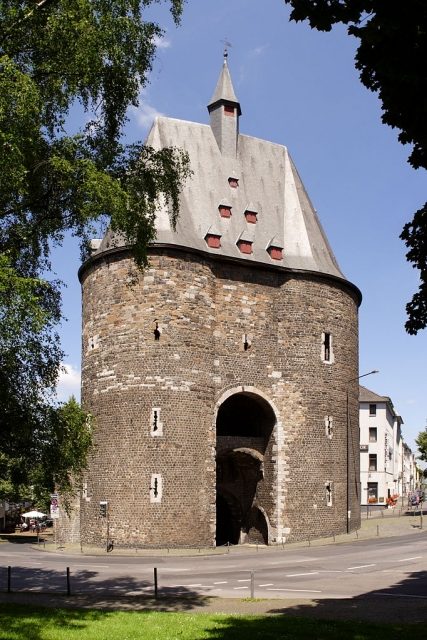
The Marschiertor can be visited
City Wall Aachen-Marschiertor

The Marschiertor, also known as Mies(ch)ierspforte until the 17th century, or later as Berseter Tor or Burtscheider Tor, was the south gate of Aachen's outer city wall. It is one of the most powerful surviving city gates in Western Europe. Its construction began around 1257 and was probably completed shortly after 1300. With the Marschiermitteltor, also known as Burtscheider Mitteltor, it had a counterpart in the inner wall ring, the so-called Barbarossa Wall, which had a total of ten gates.
Description+
The Marschiertor is built as a double-tower gate castle. The two towers have four stories, and the central building has five. The towers and central building form a unit with a common pointed tent roof. The gate is a total of 23.8 meters wide, and its passage width is 4.8 meters. The field-side portal has three staggered portal arches. The outer round arch reaches a height of about 13 meters into the second floor, the next with a battle platform reaches a height of about 8.5 meters into the first floor. The actual pointed-arch portal, including the vault, has a height of five meters.
Spiral staircases lead from the city side through the two round towers flanking the square central building into the armory. The guard rooms were on the ground floor of the towers, with the dungeons below. An external latrine bay can be found on the east tower. Like all Aachen city gates - except the Junkerstor (Vaalser Tor) - the Marschiertor originally had an outer gate to the southwest, similar to the still preserved outer gate of the Ponttor. It was demolished in the 17th century (probably shortly after the city fire) to make way for more modern fortifications. A detail from a painting by Johann Ferdinand Jansen shows the gate in 1796 without its outer gate.
The Marschiertor, like the other still preserved gate, the Ponttor, was one of the four main gates (Ponttor, Kölntor, Marschiertor, and Jakobstor) of Aachen's second city fortification ring, built from the 14th to the 15th century, the so-called Gothic Wall, as its southernmost point. It stands at the end of Franzstraße and at the beginning of the former country road to Burtscheid, which ends at the Burtscheider Obertor (demolished in August 1865). The names Marschier, Mieschiers, or Berseter, all of which are corrupted forms of Burtscheid, Porcetum (Latin name of Burtscheid), or the Low German variant, also derive from "Burtscheid".
The Marschiertor was the main armory. The formerly eleven city gates - Albrechts- or A(da)lbertstor (East Gate), Bergtor (North Gate), (St.) Jakobstor (Southwest Gate), Adeliges or Vaelser Tor or Junkerstor (Westsouthwest Gate), Köln(isches)tor (Eastnortheast Gate), Königstor (West Gate), Berseter- or Marschiertor (South Gate), Roors-, Roß- or Rosentor (Southsouthwest Gate), Brücken- or Ponttor (Northnorthwest Gate), Sand(kaul)tor (Northnortheast Gate), Wirichsbongard- or Wingartz Bongarttor or Weinbergstor (Southeast Gate) - of the former Free Imperial City of Aachen were guarded by the Free Imperial City's city soldiers and city militias. In popular parlance, the soldiers were called Pennsoldaten, which came from their sideline, carving thin wooden pegs (Penn) for shoe soling.
Over the centuries, the gate not only experienced occupations and sieges by various groups of soldiers but also served temporarily as a lumber room, homeless shelter, youth hostel, and finally as an HJ (Hitler Youth) home. During World War II, the Marschiertor was significantly damaged by incendiary bombs on July 14, 1943, and initially only provisionally restored - without its characteristic steep roof. It was not until 1957 that the reconstruction of the hip roof could begin, made possible by a donation from the Aachener und Münchener Feuer-Versicherungsgesellschaft. Since 1959, the Marschiertor has been in a fully reconstructed state - with its characteristic hip roof.
In 1964, the city of Aachen entrusted the building to the care of the carnival society Stadtgarde "Oecher Penn von 1857 e. V.", which restored it with approximately 5000 hours of work by club members and more than half a million euros in financial contributions from donations, making it their "headquarters". Today, the large armory offers space for 200 guests and a historical setting for the club's activities. In addition, the gate also houses archive rooms, the former commandant's room, a wine cellar, the taproom, and the wardrobe.
Take Mobile History with you
You are reading this text for free. Premium adds what matters on the road: descriptions read aloud, sites found through your camera, whole regions taken offline.
- Every description, including the ~17,700 Premium sites
- Audio guide: have descriptions read to you on location
- AR finder: see sites through your camera, with distance and bearing
- Unlimited saved sites
14 days free, then from €2.99 a month. Cancel anytime.
Source: Wikipedia · Licence: CC BY-SA 4.0 · Image: http://de.wikipedia.org/wiki/Datei:Marschiertor_Aachen.jpg
This description draws on the facts documented in the linked Wikipedia article; Wikipedia content is licensed under CC BY-SA 4.0. Wording and editing: Mobile History.
Location: 50.7682, 6.0869