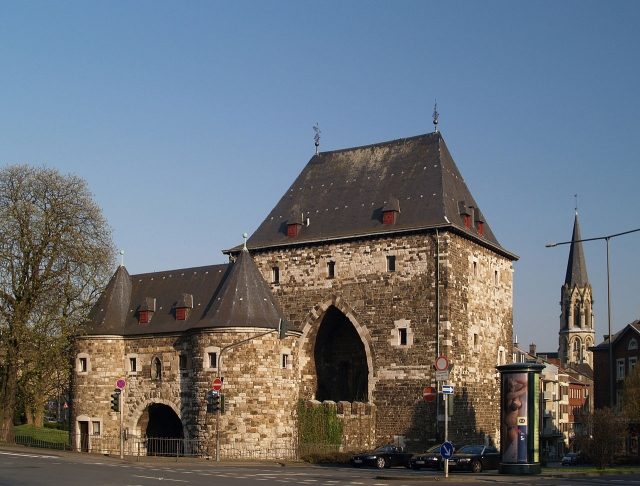
The Ponttor can be visited
City Wall Aachen-Ponttor

The Ponttor in Aachen, sometimes (17th/18th century) also called Brückenpforte or -thor (Bridge Gate), is the western of the two northern gates of the outer Aachen city wall; the eastern northern gate was the Sandkaultor or Sandtor, a seven-story rectangular gate tower with round flanking turrets (2 stories) and an equally high double-towered barbican with rectangular towers. Alongside the Marschiertor in the south, the Ponttor is one of the two remaining of the formerly eleven city gates – Albrechts- or A(da)lberttor (East Gate), Bergtor (North Gate), (St.) Jakobstor (Southwest Gate), Junkerstor, Adeliges or Vaalser Tor (West-Southwest Gate), Köln(isches)tor (East-Northeast Gate), Königstor (West Gate), Berseter- or Marschiertor (South Gate), Roors- or Rosentor (South-Southwest Gate), Brücken- or Ponttor (North-Northwest Gate), Sand(kaul)tor (North-Northeast Gate), Wingartz Bongart-, Wirichsbongardtor or Weinbergstor (Southeast Gate) – of the former free imperial city of Aachen, which were guarded by the Free Imperial City's city soldiers and city militias. It was built around the beginning of the 14th century, when new settlements and churches outside the old city wall required a second city fortification. Today it is used by the Deutsche Jungenschaft Aachen -dj.1.11- and by scout groups of the Deutscher Pfadfinderbund and the Deutsche Pfadfinderschaft Sankt Georg.
Construction+
The Ponttor consists of a rectangular three-story gate castle. The high main portal features both a portcullis and a machicolation. A battlemented bridge passage (gate bailey), which at the time was located over the moat, is further reinforced defensively by a barbican with two towers. The building material consists of Upper Devonian Condroz sandstones, Upper Carboniferous coal sandstones, and Tertiary quartzites; the frames are predominantly made of lighter bluestone.
Explanation of the Name+
While it is true that Aachen is traversed by a multitude of small rivers and streams, none are near the Ponttor, although the name certainly recalls Latin "pons" - bridge. In fact, in Aachen, the city districts were named first, and only then the streets. The name of the Ponttor therefore stems from its location in the Pontviertel. This district received its name from a bridge. In Roman times, the city fortifications were located where the Annuntiatenbach is today. At the point where one could leave the city in a northerly direction, there were extensive swamps that could be crossed by means of a bridge. The buildings later erected in this area were subsequently called Pontviertel, as they lay beyond the bridge, which explains the name of the gate.
Take Mobile History with you
You are reading this text for free. Premium adds what matters on the road: descriptions read aloud, sites found through your camera, whole regions taken offline.
- Every description, including the ~17,700 Premium sites
- Audio guide: have descriptions read to you on location
- AR finder: see sites through your camera, with distance and bearing
- Unlimited saved sites
14 days free, then from €2.99 a month. Cancel anytime.
Source: Wikipedia · Licence: CC BY-SA 4.0 · Image: http://de.wikipedia.org/wiki/Datei:Ponttor_aachen.jpg
This description draws on the facts documented in the linked Wikipedia article; Wikipedia content is licensed under CC BY-SA 4.0. Wording and editing: Mobile History.
Location: 50.7816, 6.0782