Town FortificationAndernach

Town Fortification Andernach-Rhein Gate
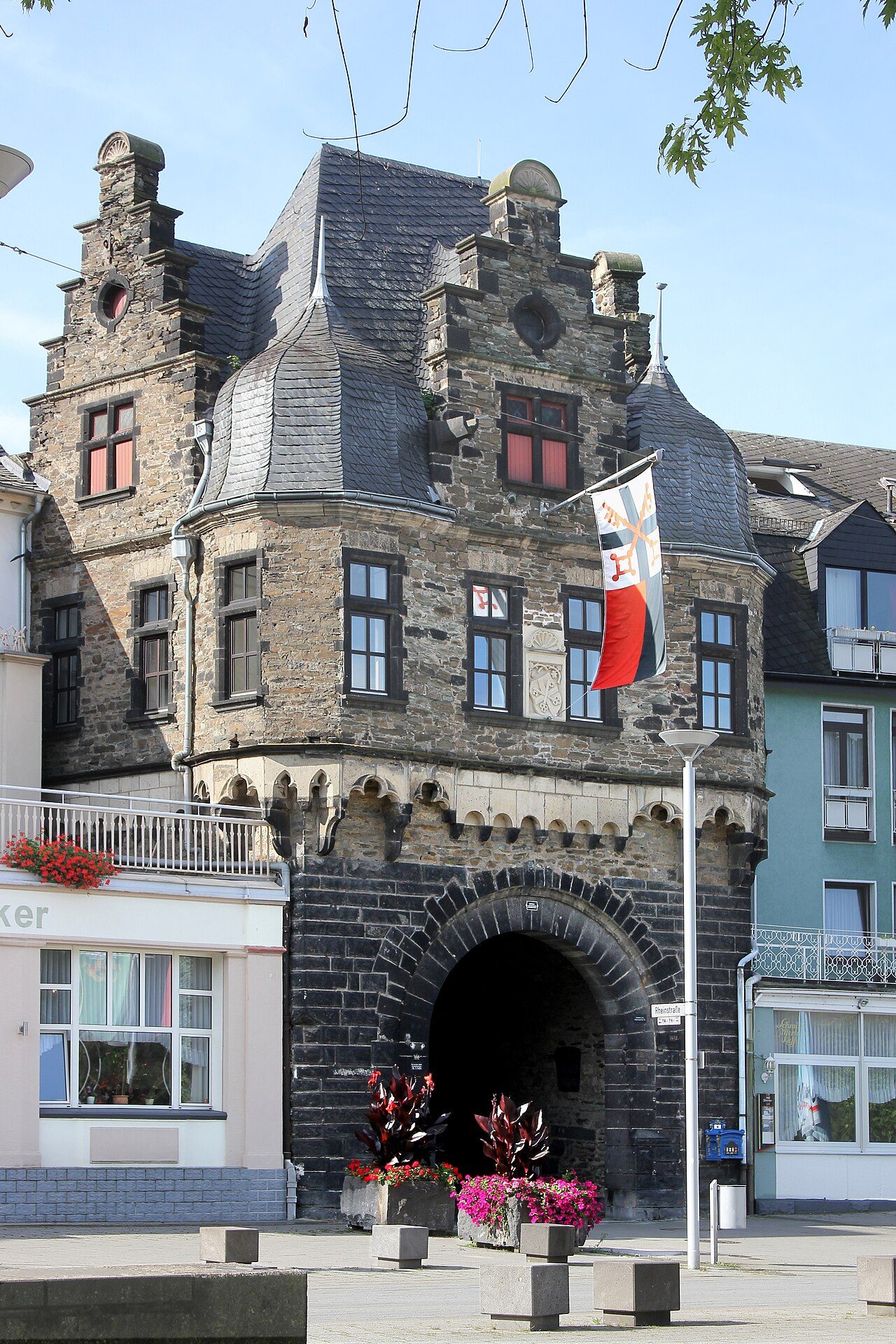
Town Fortification Andernach-Rhein Gate

The Town Fortification can be visited

The Rheintor is the former northern main gate of the Andernach city fortifications from around 1200 and the main access to the city of Andernach from the Rhine riverbank.

Named, as is common on the Rhine, in Middle High German after the korengass (later Korngasse) and korenpor(t)zen leading to it. The name changed from Korenportz, Corn Porte to New High German Kornpforte until the early 19th century, when it was then also called Rheintor after the former Korngasse (korengass), which was renamed Rheinstraße. It is the oldest double gate system in the Rhineland and, besides the ruins of the Koblenzer Tor, Andernach's only remaining (and intact) gate of formerly five main gates and five secondary gates: Coellenporzen (Kölnpforte, Kölner Tor in the west), Kirchporzen (Kirchpforte, Kirchtor in the south), Schafporzen (Schafpforte, Schaftor in the south), Burgporzen (Burgpforte, Koblenzer Tor in the east) and Korenporzen (Kornpforte, Rheintor in the north), plus in the Rhine wall: Schreiberspforte (in the northeast), Moerspforte, Neupforte, Fischpforte, Trierpforte (northwest, with gatehouse). The gate initially consisted of today's inner gate with a pointed spire roof and the two figures on the field side, the oldest part of the gate. They were originally painted and visible from afar. Thus, they served as possible guardian symbols and also for the representation of the city.

The basalt console now located directly beneath the figures dates from before the gate's expansion and supported a so-called wooden "Überzimmer" (upper room), as was or is the case with many Cologne gates (e.g., Eigelsteintor), the Rurtor in Jülich, or the Kuhtor in Kempen. In the mid-14th century, the outer gate (Vortor) with the connecting walls (trapezoidal gate barbican) leading up to it on the field side was built. Parts of the lower masonry, especially of the main or inner gate, belong to the period of the initial construction, in addition to the floor plan. The city-side gatehouse has hardly changed since the Renaissance. The round arch frieze at half height on the outer gate, which is also located under the two defensive oriels, dates from the late Gothic period. An inner frieze on the west wall originally supported a battlement, which was removed in the 15th century, and its arches were bricked up. As a main city gate – the only double gate with two separate gatehouses besides the former Kirchtor – the Rheintor had a rectangular three-story gate tower structure with a pointed helmet on the city side behind the city wall line (inner gatehouse, main gate), plus a large main outwork (sometimes with side outworks) in front of the city wall (field-side gatehouse). This part of the gate, in particular, was damaged, destroyed, rebuilt, and altered multiple times. In the early 17th century, the main outwork had three stepped gables (similar to today, without large windows) with two large corner watchtowers (defensive oriels, integrated into the gate structure like oriels with their own roofs since 1899) and a pitch oriel above the field-side gate entrance, which all gates possessed. In the 18th century, large windows were broken into the outwork both above the portal and in the side walls, and a mansard roof was added, while the stepped gables, the upper parts of the defensive oriels, and the pitch oriel were removed. Due to the raising of the street level of Rheinallee (today Konrad-Adenauer-Allee), a higher arch had to be broken out of the city-side gate in 1899, and the field-side part was completely demolished and rebuilt according to 17th-century plans. In the process, the gate arch, which had become too low, was rebuilt 1.50 meters higher. This was done at the instruction of the Provincial Conservator Prof. Dr. Paul Clemen (1866–1947), initially against the will of the city administration, which had wanted to demolish the entire gate as early as 1894. With this measure, Clemen was able to preserve the Rheintor. The two larger-than-life late Romanesque tuff stone warrior figures above the passage to the city (field side of the rear gatehouse) still guard the city today and have been referred to as "Bäckerjungen" (baker boys) since the mid-19th century and associated with the baker boy legend that emerged at that time, although they are nothing more than guardian figures or representational statues.

Take Mobile History with you

You are reading this text for free. Premium adds what matters on the road: descriptions read aloud, sites found through your camera, whole regions taken offline.

  • Every description, including the ~17,700 Premium sites
  • Audio guide: have descriptions read to you on location
  • AR finder: see sites through your camera, with distance and bearing
  • Unlimited saved sites

14 days free, then from €2.99 a month. Cancel anytime.

Source: Wikipedia · Licence: CC BY-SA 4.0 · Image: Lothar Spurzem / CC BY-SA 2.0 de via Wikimedia Commons

This description draws on the facts documented in the linked Wikipedia article; Wikipedia content is licensed under CC BY-SA 4.0. Wording and editing: Mobile History.

Location: 50.4410, 7.4011