Town FortificationJülich

Town Fortification Jülich-Hexenturm Gate
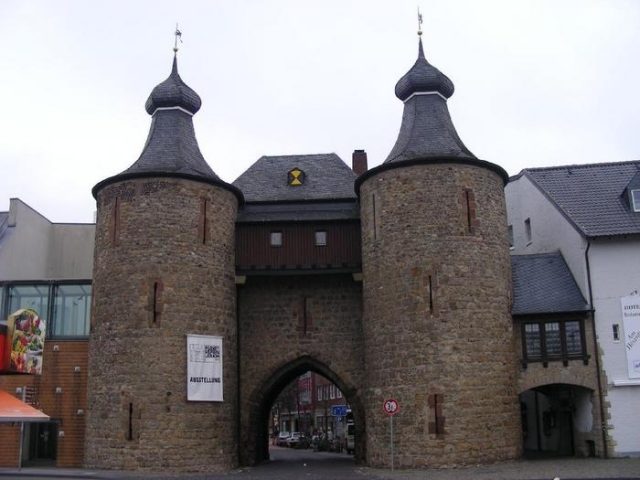
Town Fortification Jülich-Hexenturm Gate

The Gate can be visited
Museum


The Hexenturm (Witches' Tower), originally the "Rurtor" (Rur Gate), is the only remaining city gate (west gate) of the medieval city fortifications and the landmark of the city of Jülich. The City History Museum of Jülich is located in the tower.

Architectural Description+

The Hexenturm is a typical Gothic city gate of the double-tower gate type. Its masonry consists of rubble stone, the towers are 12.75 m high up to the upper edge of the masonry, and the masonry has a thickness of 1.60 to 2.30 m. The gate passage is 4.70 m wide and 5.20 m high, and it is equipped with guides for a portcullis. A total of 17 loopholes for crossbow defense are present. Originally, the two towers had crenellated battlements, which were only replaced by onion domes in the 17th century. Today, after the restoration in 1964, the gate once again bears onion domes. The frames of the four windows on the city side of the gatehouse date from the 18th and 19th centuries. On the outside of the north tower, the connection of the city wall, which was built at the same time and was 1.70 m thick at this point, can be seen.

The Rurtor, the so-called Hexenturm, is one of formerly three or four city gates in the medieval city wall of Jülich. The loopholes, the portcullis, and the door openings to the battlement still point to its former defensive function. The Hexenturm was built at the beginning of the 14th century. The Hexenturm had many names back then. From "Porta Rurae" (Latin for "Rur Gate"), "Rurtor", "Gefangenenthürn" (Prison Tower), "Gefängnußthurm" (Prison Tower), "Hessenturm" (Hessian Tower) until the current name "Hexenturm" (Witches' Tower) has been used since the 18th century. The latter name originated during the time when the name Hessenturm was used and the building served as a prison for the main and criminal court of the Duchy of Jülich. It is misleading insofar as only a few individual cases against so-called witches from Jülich are documented.

After the almost complete destruction of Jülich in World War II, initial safeguarding measures were carried out on the Hexenturm in 1949/1952, followed by another restoration phase from 1961 to 1964, during which the 17th-century onion domes were also faithfully restored. Flat conical helmets were also discussed for the roof reconstruction, which would have made the city-side rectangular building with the pointed tent roof tower over the towers.

Since October 29, 2005, the Hexenturm has been illuminated in the evening and, in winter, also in the morning, by a light installation of 22 luminaires on both sides, funded by the "LICHT(!)projekt" (LIGHT(!)project). The Hexenturm marks the beginning of a planned "Lichterweg" (Path of Lights) through the city center to the Citadel.

Take Mobile History with you

You are reading this text for free. Premium adds what matters on the road: descriptions read aloud, sites found through your camera, whole regions taken offline.

  • Every description, including the ~17,700 Premium sites
  • Audio guide: have descriptions read to you on location
  • AR finder: see sites through your camera, with distance and bearing
  • Unlimited saved sites

14 days free, then from €2.99 a month. Cancel anytime.

Source: Wikipedia · Licence: CC BY-SA 4.0 · Image: http://www.wehrbauten.de/thread.php?threadid=570

This description draws on the facts documented in the linked Wikipedia article; Wikipedia content is licensed under CC BY-SA 4.0. Wording and editing: Mobile History.

Location: 50.9208, 6.3560