The Tower can be visited
Town Fortification Magdeburg-Kiek in de Köken
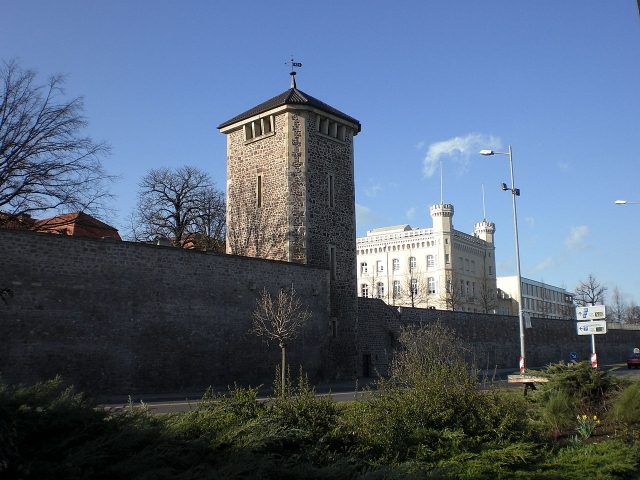
Kiek in de Köken is a tower in Magdeburg that was part of the medieval city fortifications.
The tower was built in 1431, roughly at the same time as four or five other defensive towers, with which the citizens of Magdeburg, against the will of the archbishop, reinforced the southeastern corner of the city fortifications along the Elbe. In addition to Kiek in de Köken, the tower somewhat further south, behind the exit of the Möllenvogtei, is also preserved. The background to the construction measures was fears that the city could be attacked by rebellious Hussites. The dispute over the towers, which the archbishop did not want and which were in the immediate vicinity of his palace, dragged on from 1432 to 1435 and was at times conducted with armed force, leading to the flight of Archbishop Günther. In 1435, both sides reached a settlement, according to which the towers were allowed to remain, but the archbishop had co-ownership of the towers.
The tower's floor plan is square with external dimensions of 7x7 meters. The average wall thickness is 1.28 to 1.45 meters. Like the other towers, Kiek in de Köken was built as a very slender tower. The exterior facing the Elbe was designed with beveled outer edges. All towers, including Kiek in de Köken, had high Gothic spires as roofs. Historical depictions show overhanging corner turrets. Their presence can no longer be proven in the current building fabric, but seems probable. Old views also show that the water level of the Elbe was directly at the foot of the tower. Only in dry weather was there a few meters wide strip of bank here. The actual base of the tower, the former Fürstenufer, is no longer visible due to the current Schleinufer, which was raised by approximately five meters in the 19th century.
Initially, palisade fences were built between the towers. In 1525, according to other sources after 1530, a massive wall was erected, to which a parallel wall running approximately 12 meters west was added in the same century. The resulting Zwinger was filled in 1722. The Fürstenwall was created, from whose level the towers are only half as high as from the level of the equally raised Schleinufer.
Kiek in de Köken was redesigned several times. In the 18th century - the Gothic spire no longer existed - the tower temporarily served as an arrest for disobedient soldiers. In a city view painted by Heinrich Mittag in 1823, the tower is depicted with a pavilion-like attachment. In the 19th century, the tower was referred to as Tower Bevern. The tower belonged to the area of the Magdeburg fortress. In 1899, the city ultimately succeeded in acquiring the tower from the military treasury. The tower now had an almost flat roof and served as a storage room for the municipal horticulture administration.
During the National Socialist era, the tower was converted for National Socialist memorial ceremonies and into a flag hall. Directly south of the tower, a National Socialist burial ground for the so-called Old Guard was established from December 1937, at the southern end of which a ceremonial hall with carillon was built. Its ruin was demolished again in the 1970s. At the access to the square directly south of the tower, there was an imperial eagle on a shaft that is still preserved today. Towards the Fürstenufer, there were flame bowls and National Socialist symbolism. An urn burial of an NSDAP propaganda distributor and an unspecified earth burial took place. Both burials were reinterred after World War II.
The tower received ashlar masonry and an overall more monumental, warlike appearance, as well as a steep tent roof. Its current flat tent roof was built after 1945.
Current Use+
The tower, owned by the city of Magdeburg, is currently used sporadically for exhibitions. It is currently open to the public daily except Mondays, free of charge.
Name+
The name of the tower comes from Low German and means "Look into the Kitchen" in High German. From the tower, one was supposedly able to look into the neighboring kitchen of the archbishop. Towers of the same name are located in Gdansk and Tallinn.
Take Mobile History with you
You are reading this text for free. Premium adds what matters on the road: descriptions read aloud, sites found through your camera, whole regions taken offline.
- Every description, including the ~17,700 Premium sites
- Audio guide: have descriptions read to you on location
- AR finder: see sites through your camera, with distance and bearing
- Unlimited saved sites
14 days free, then from €2.99 a month. Cancel anytime.
Source: Wikipedia · Licence: CC BY-SA 4.0 · Image: http://commons.wikimedia.org/wiki/File:Kiek_in_de_K%C3%B6ken2.JPG
This description draws on the facts documented in the linked Wikipedia article; Wikipedia content is licensed under CC BY-SA 4.0. Wording and editing: Mobile History.
Location: 52.1247, 11.6370