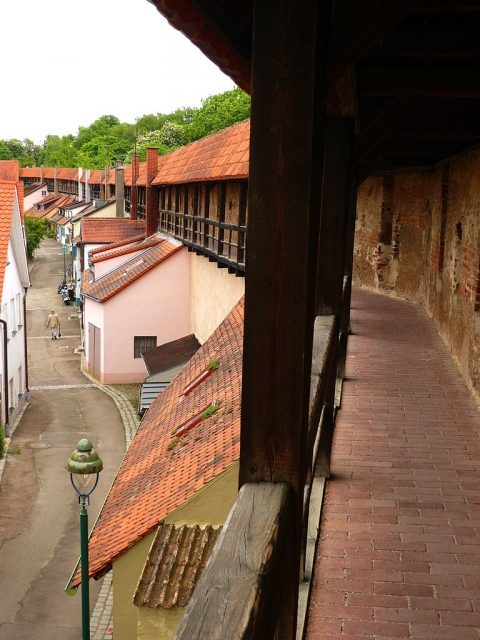
The Town Fortification can be visited
Town Fortification Nördlingen

The Nördlingen city wall is the only city wall in Germany that has a completely preserved, all-round accessible and covered battlement. It encloses the entire medieval old town of Nördlingen and has a length of 2.6 kilometers. The city wall includes five gates with gate towers, eleven other towers, and a bastion.
Construction of the city wall began in 1327 by order of Louis the Bavarian. It replaced the old defensive rampart, the course of which can still be seen today in the layout of the old town streets Drehergasse, Bei den Kornschrannen, Vordere Gerbergasse, Herrengasse, and Neubaugasse. Between 1536 and 1613, four gates and two towers were completely rebuilt. In addition, seven "Backofentürme" (oven towers), three strong bulwarks, and two bastions were erected during this period. During the Thirty Years' War in 1634, the Nördlingen city fortifications withstood a siege by imperial troops in the run-up to the Battle of Nördlingen. From 1803, the people of Nördlingen began to dismantle parts of the now superfluous city wall. In 1826, King Ludwig I of Bavaria placed the wall under his protection and forbade its further demolition.
Gates+
Reimlinger Tor
The Reimlinger Tor secured the road to Augsburg in the Middle Ages. It dates from the 14th century and is Nördlingen's oldest city gate. The superstructures with the bulging gun platform and the tower watchman's room were added later, as was the fortified outwork.
Berger Tor
The Berger Tor secured the road to Ulm. It was built between 1435 and 1436 by the master builder Hans Rews. From 1574 to 1575, Wolfgang and Kaspar Wallberger extended the upper tower floors, and the Berger Tor received its present appearance. Noteworthy is the coffered barrel vault of the gate passage. A cannonball from the Thirty Years' War is still embedded in the masonry today. Inside the gate tower, there is now a café and a coin-sawing workshop.
Baldinger Tor
The road towards Würzburg and Frankfurt am Main leads through the Baldinger Tor. It was first mentioned in 1376. In 1406, Master Wenzel Parler completed the forehouse, and in 1430, the gate was rebuilt under the direction of the stonemason Conrad Stenglin. The gate group probably originally resembled the Berger Tor. During the siege of 1634, the gate tower was damaged. As a late consequence, it collapsed on August 20, 1703. Next to the gate passage is a small entrance gate. Through this, people entered the city in the Middle Ages in the evening when the gate was already closed.
Löpsinger Tor
The Löpsinger Tor secured the important trade route to Nuremberg. It was built before 1388, but was demolished in 1592 and rebuilt in the following two years in the style of the Deininger Tor by Wolfgang Walberger. The sundial dates from 1837. The depiction of a head in the ceiling of the passage commemorates the Nördlingen legend of "So G'sell so", the setting of which is the Löpsinger Tor. Today, the City Wall Museum is housed in the 42-meter-high Löpsinger Tor.
Deininger Tor
The Deininger Tor secured the road towards Regensburg and Vienna. It resembles the Löpsinger Tor, but is somewhat slimmer. During the siege of 1634, imperial troops penetrated the tower. The people of Nördlingen then set the tower on fire. The current structure, including the twelve round-arched windows and the curved roof hood, was built towards the end of the Thirty Years' War.
Towers and other structures+
Alte Bastei
Caspar Wallberger and Lorenz Scheer began construction of the Alte Bastei in 1554. Wolfgang Wallberger completed the bulwark in 1598. The defensive fortress could accommodate ten cannons on two floors. Today, the Nördlingen Open-Air Stage is located in the building. Northwest of the Feilturm stood the no longer existing Neue Bastei with angular wallführung.
Feilturm
The Feil- or Schuldturm (debt tower), which was possibly used as a prison tower, dates from the 14th century. Above the square substructure with a surrounding battlement rises a two-story round superstructure with a concave conical roof.
Löwenturm
The Löwen- or Pulverturm (powder tower) was first mentioned in 1535. It served as a battery tower for further reinforcement of this section of the wall and was placed in the ditch between the gun parapet. The tower, on a horseshoe-shaped ground plan, has three stories. Towards the city, it has a smooth gable with a low, hipped roof. To the outside, it has a gun platform with a bulging parapet.
Oberer Wasserturm
The Upper Water Tower was built between 1469 and 1471. The Eger river flows into the city through the six-story building on a square ground plan. The canalized Eger flowed over an oak trough across the city moat as long as it was filled with water.
Backofentürme
The city fortifications had seven "Backofentürme" (oven towers) between the Upper Water Tower and the Spitzturm, five up to the Baldinger Tor, two behind it. They were built between 1480 and 1520. Backofenturm No. 1 next to the Upper Water Tower is called Tannenturm (oldest of the Backofentürme from 1481), Backofenturm No. 5 to the left of the Baldinger Tor (seen from the city) Kolturm (mentioned as such in 1530). They are the only two named Backofentürme. Backofenturm No. 2 was demolished around 1810, the bricked-up access is still visible. The remaining six Backofentürme, attached to the outside of the city wall, served for close defense of the wall and moat without cannons. A breach in the semicircular outer wall therefore does not mean a breach in the city wall itself. The name comes from the first tower, built directly next to the Upper Water Tower at the city's former bakery. Their identical construction of characteristic shape on a horseshoe-shaped ground plan gave them their common name. Formerly they had a battlement, as can be seen in the Merian engraving. Some of the towers are now used by clubs. North of the Löpsinger Tor stood another, but larger tower with a horseshoe-shaped ground plan similar to the Löwenturm. It was demolished around 1820.
Spitzturm
The Spitzturm (pointed tower) between Baldinger Tor and the Lower Water Tower was built in the 15th century. Its pointed spire gives it its name.
Unterer Wasserturm
The Lower Water Tower, through which the Eger river leaves the city again, was built in the 15th century. It protected the weak point of the Eger passage.
Reißturm
The Reißturm, first mentioned in 1408 near the Reimlinger Tor, was possibly built by Hans Rews. It received its current form in 1644. The round front structure has a floating "Welsche Haube" (onion dome).
Kasarmen
Along the inside of the wall stretch the "Kasarmen", houses built directly against the city wall, where the city soldiers once lived.
Moat and irrigation facilities+
Around the wall, the city moat is preserved, which was partly filled with water in the Middle Ages. The Burgerweiher (current use: ice rink) controlled the water inflow in the water-filled section. A former drainage tunnel can be seen from the battlement on the retaining wall opposite the moat. Parts of the former city moat are now park areas.
Demolished structures+
- Neue Bastei. Former location: Between Feilturm and Berger Tor
- Wall reinforcement around the Berger Tor
- Ascending turret at the Upper Water Tower
- Backofenturm. Another Backofenturm was formerly located between the Upper Water Tower and the Baldinger Tor. Its location is still recognizable today on the outside of the city wall
- Großer Bleichturm. This tower was located between the Spitzturm and the Lower Water Tower. Its former location is still recognizable today by the bricked-up access door from the battlement
- Bulwark at the Löpsinger Tor. Between the Lower Water Tower and the Löpsinger Tor was a tower that was very similar to the existing Löwenturm. Its location is recognizable by the preserved arcades on the inside of the battlement
- Mauerhaus at the Alte Bastei. Nothing remains of this structure, its former location is no longer recognizable today, but the Mauerhaus must have stood approximately at today's Ochsenzwinger
- Outworks. Formerly existing outworks at some gates and towers were demolished:
- Outwork at the Deininger Tor
- Outwork at the Upper Water Tower
- Outwork at the Lower Water Tower
- Gate castle with Kaiserturm and Bognerhaus at the Baldinger Tor
Take Mobile History with you
You are reading this text for free. Premium adds what matters on the road: descriptions read aloud, sites found through your camera, whole regions taken offline.
- Every description, including the ~17,700 Premium sites
- Audio guide: have descriptions read to you on location
- AR finder: see sites through your camera, with distance and bearing
- Unlimited saved sites
14 days free, then from €2.99 a month. Cancel anytime.
Source: Wikipedia · Licence: CC BY-SA 4.0 · Image: http://commons.wikimedia.org/wiki/File:NoerdlingenStadtmauer.jpg
This description draws on the facts documented in the linked Wikipedia article; Wikipedia content is licensed under CC BY-SA 4.0. Wording and editing: Mobile History.
Location: 48.8549, 10.4909