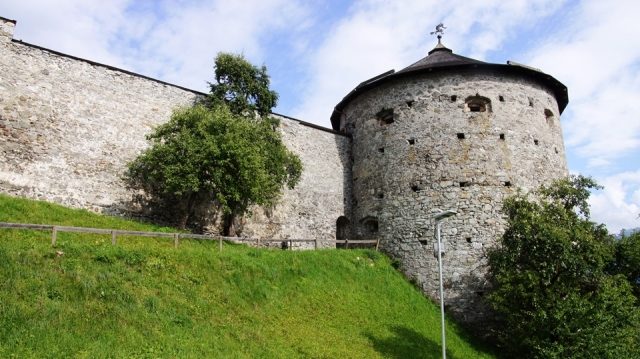
The City Wall can be visited
Town Fortification Radstadt

The actual history of the city begins with the Bavarian settlement in the 7th century. In the 13th century, the entire terrace was fortified, and Radstadt received city rights in 1289 under Archbishop Rudolf von Hohenegg. It was the only city of the Archdiocese of Salzburg in the mountains. Due to its strategic importance on the border with Austria, the town was endowed with many privileges and freedoms.
The city had its first test in 1306 in a dispute with Duke Albrecht of Austria. The most significant epoch was the Peasants' War in 1525/26. 5000 peasants gathered under the leadership of Michael Gaismair, but the town withstood the siege.
In 1527, Radstadt received the great charter of freedom and the title "Always Loyal" from Archbishop Matthäus Lang for its loyalty. The city's privileged, uniformed Civic Guard is still based on this charter of freedom today. In 1621, a Benedictine Gymnasium was established in the former Pflegeburg (administrative castle). In 1628, the Capuchin order took over the castle as a monastery until its dissolution in 1978. At the beginning of the 19th century, Austrian, Bavarian, and French occupations alternated. In 1816, Salzburg became part of Austria and in 1850 became a separate crown land.
Today, parts of the early modern city wall with the Hexen-, Teich- and Kapuziner towers are still preserved. In front of the Teichturm, a part of the city moat can still be found.
Take Mobile History with you
You are reading this text for free. Premium adds what matters on the road: descriptions read aloud, sites found through your camera, whole regions taken offline.
- Every description, including the ~17,700 Premium sites
- Audio guide: have descriptions read to you on location
- AR finder: see sites through your camera, with distance and bearing
- Unlimited saved sites
14 days free, then from €2.99 a month. Cancel anytime.
Source: Wikipedia · Licence: CC BY-SA 4.0 · Image: http://www.wehrbauten.at
This description draws on the facts documented in the linked Wikipedia article; Wikipedia content is licensed under CC BY-SA 4.0. Wording and editing: Mobile History.
Location: 47.3837, 13.4614