The church can be visited
ChurchTeterow
Teterow Church
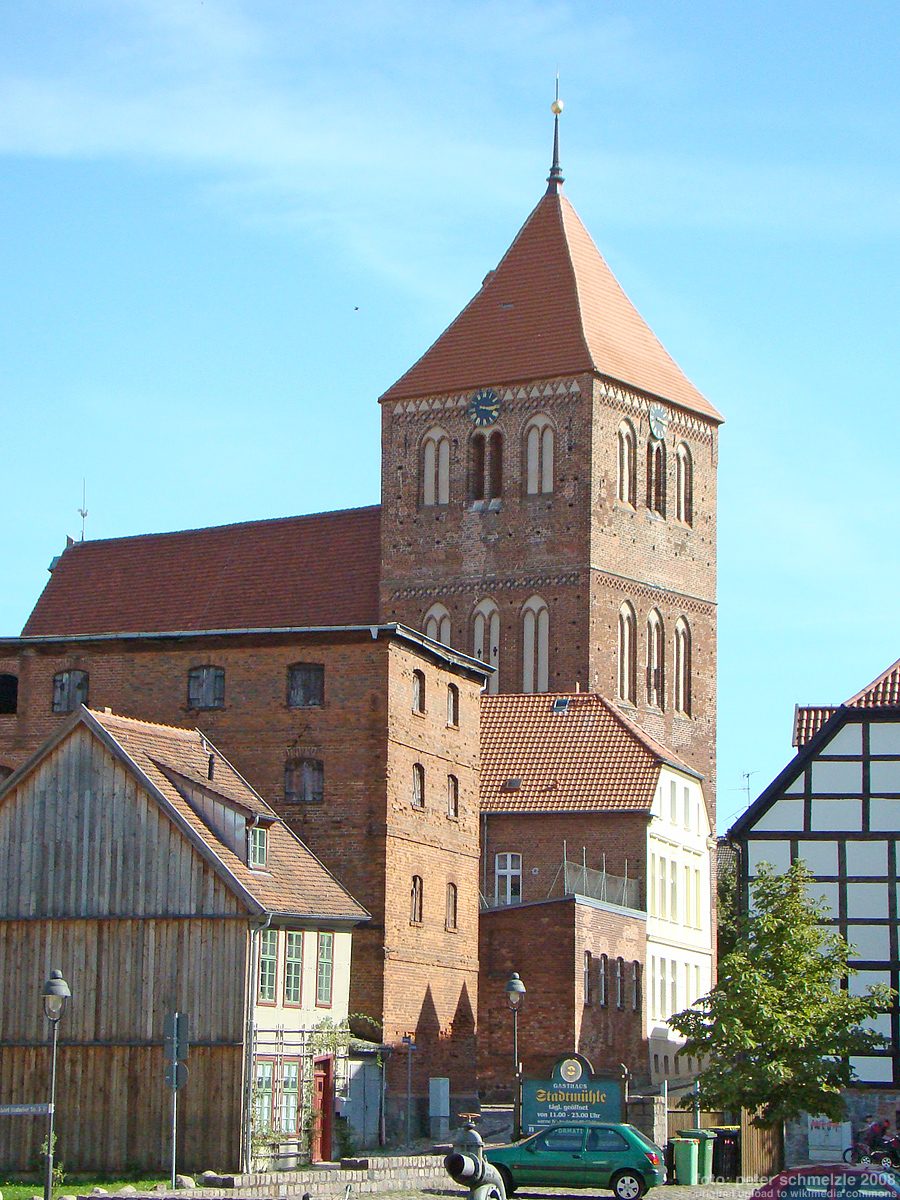
The town church of St. Peter and Paul is a typical building of North German Brick Gothic. It is located in the Mecklenburg town of Teterow and is the church of the Teterow parish in the Rostock provostry within the Mecklenburg church district of the Evangelical Lutheran Church in Northern Germany (Nordkirche).
Architectural Description+
The oldest part of the church is the early Gothic choir, built in 1280. The second building of St. Mary's Church in Rostock, erected between 1265 and 1279, is considered a direct model. The choir gable features a three-window group, which is not uncommon in early Gothic brick (and also fieldstone) churches as far south as the Mark Brandenburg and as far west as the province of Groningen. The side walls each have two slender pointed arch windows. The two choir bays are strongly ribbed cross-rib vaults in the Westphalian style. The sacristy on the north side was built a little later, though initially without the elaborate ornamental gable (which is also medieval). According to dendrochronological findings, the nave was built in 1310. Its cross-section is somewhat asymmetrical; on the south side, it is a truncated basilica with windowless clerestory walls, while on the north side, it is a basilica with clerestory windows. An ad-hoc decision by the builders is assumed to be the cause, which was not unusual in medieval church construction. However, the northern aisle was replaced by a larger one between 1877 and 1880, with opulent Neo-Gothic transverse gables. The southern sacristy was also built at the same time.
The square, almost 40 m high west tower, not yet planned in the original concept, was built in the first half of the 15th century, with the uppermost parts dating to around 1450 according to dendrological findings.
Furnishings+
In the vault of the choir area are valuable medieval frescoes, which were uncovered during a renovation between 1877 and 1880. They date from the 14th century and were repainted in 1880. Depicted are the Creation of the World, the Fall of Man, the Expulsion from Paradise, the Fratricide of Abel, the Annunciation, the Birth of Jesus, the Three Wise Men, the Massacre of the Innocents in Bethlehem, the Flight into Egypt, the Temptation of Jesus, the Entry into Jerusalem, the Crucifixion, the Resurrection, and Jesus as Judge of the World.
In the northern aisle stands the carved former main altar (Coronation of Mary Altar), designed as a double-winged altar. It originates from a Rostock workshop from the 1430s. When fully open, it shows the Coronation of Mary and the twelve Apostles with Paul and Stephen, as well as busts of 17 other saints in a narrower strip below. When the first pair of wings is closed, a cycle of paintings depicting the Passion in 16 individual representations is revealed, attributed to the Master of the Rostock Adoration of the Magi Altar. The paintings on the outer wings, which become visible when the altar is fully closed, are, however, lost. The altar now stands on the west wall of the northern aisle. Above the access to the choir area is a large triumphal cross: a crucifix, framed by the figures of the Virgin Mary and the Evangelist John. The cross is adorned at its four ends with the four evangelist symbols and at its edges with large leaves.
On a side wall is a depiction of a radiant Madonna on the crescent moon from the 15th century. The text below the relief is from Genesis 3:15. It reads: "The seed of the woman shall bruise the serpent's head." This is interpreted as a reference to Jesus. In front of the altar area in the nave stands a Gothic baptismal font from the 14th century. It is made of Gotland limestone. Remains of a pulpit from the Renaissance period are now displayed in the tower hall. The altar, pulpit, and pews date from the Neo-Gothic renovation of 1877/80. The altarpiece is probably a depiction of the Resurrection, a copy after Bernhard Plockhorst. On the east wall of the north nave, a memorial plaque for the parishioners who fell in the First World War has been installed since the 1920s. Above it is a cross for the victims of the Second World War. Since November 9, 1990, a memorial by a Teterow blacksmith for the Wendezeit (period of political change) has stood in the church. It was made from the steel of an armored personnel carrier at the suggestion of the then pastor Martin Kuske and bears the biblical quote "Swords to Plowshares," which was used by the peace movement in the GDR. A support association was founded for the preservation of the church.
Organ+
Paul Schmidt built a new organ in 1789. In 1891, it was replaced by a new work by Heinrich Schlag & Söhne; the old casing was preserved. Behind the historic organ facade, a new instrument by the organ building company Mecklenburger Orgelbau (Wolfgang Nussbücker) has stood since 1991, with a total of 29 stops on two manuals and pedal.
The current organ has the following disposition:
Couplers: I/P, II/P Additional accessory stops include the "Teterower Hecht" (a small bell based on a Teterow story) and bird song.
Bells+
Since its renovation in 2019, the church has a peal of four bronze bells in the bell tower. There is also a clock strike bell and the former Poor Sinner's Bell on the east gable of the nave.
Take Mobile History with you
You are reading this text for free. Premium adds what matters on the road: descriptions read aloud, sites found through your camera, whole regions taken offline.
- Every description, including the ~17,700 Premium sites
- Audio guide: have descriptions read to you on location
- AR finder: see sites through your camera, with distance and bearing
- Unlimited saved sites
14 days free, then from €2.99 a month. Cancel anytime.
Source: Wikipedia · Licence: CC BY-SA 4.0 · Image: Peter Schmelzle · Wikimedia Commons · CC BY-SA 3.0
This description is a machine translation of an excerpt from the linked Wikipedia article. The source text was written by its authors, the translation is by Mobile History; like the original it is licensed under CC BY-SA 4.0.
Location: 53.7736, 12.5745