The town fortifications can be visited
Town FortificationVolkach
Town fortifications Volkach
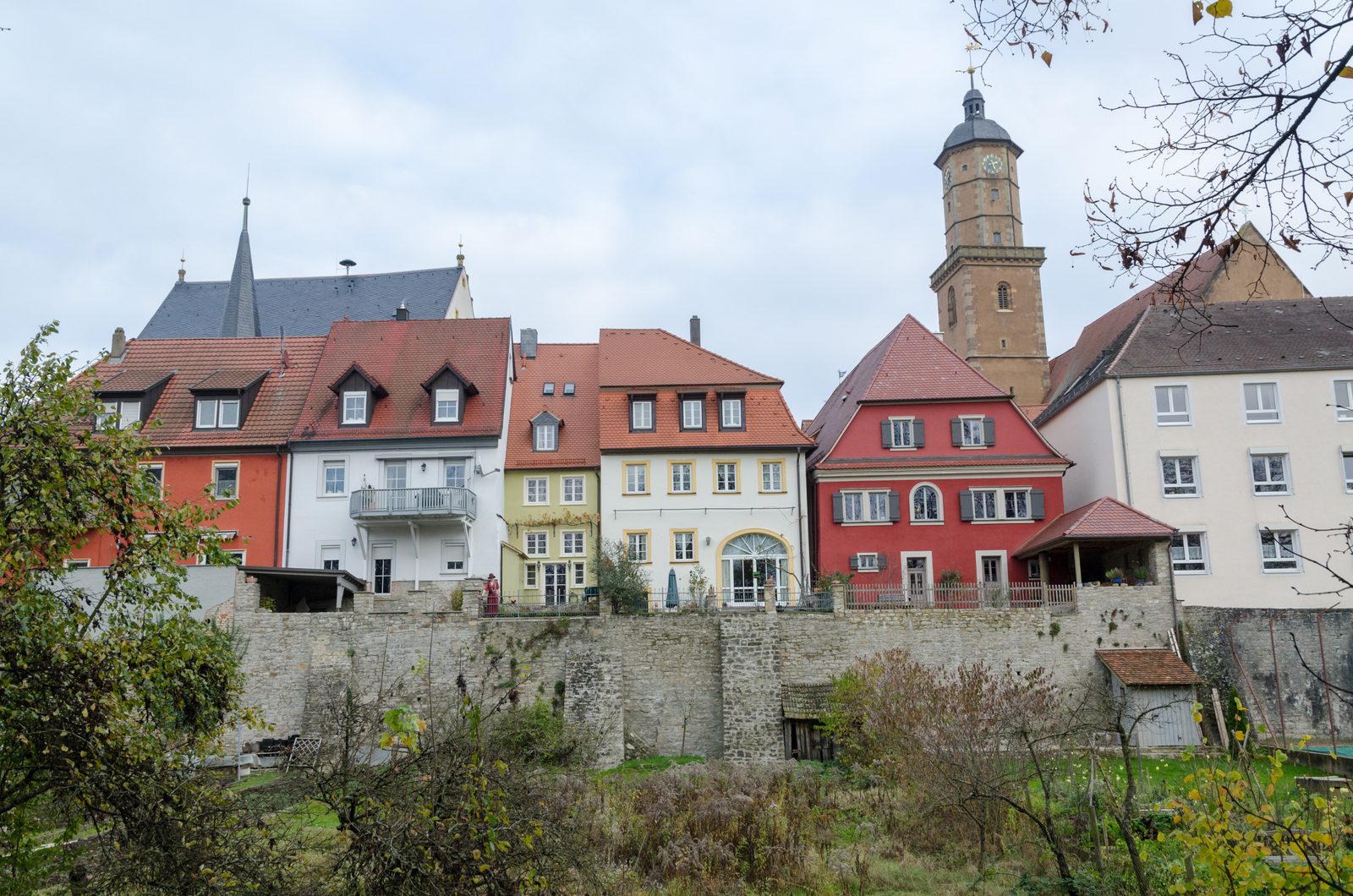
The former Volkach town fortifications surround the old town of Volkach in Lower Franconia as a double ring wall with towers, gates, and remnants of a moat. Large parts of the complex, documented since the 14th century, are preserved and were largely rebuilt in the 16th century.
History+
First and Second Fortifications (until around 1540)+
The origin of the Volkach town fortifications is closely linked to the development of the town center. In the mid-13th century, Volkach rose to a community of urban character; the term civitas, meaning city, was first used in 1258. This change in status was accompanied by an economic upgrade of the town, particularly evident in the holding of a central market in (and in front of) the town. At the same time, the citizens' need for protection also increased.
The first walls around Volkach probably also originated around the time of its rise to a town. They utilized the relief around the settlement and included the Volkachbach stream within the walls. The first walls were located on the same site as the existing remnants of the fortifications, as the town's area was not expanded in the Middle Ages and early modern period. The prince-bishops of Würzburg exercised sovereignty over the town's fortifications, and the citizens were obliged to maintain the facilities. While the first wall around Volkach was probably built primarily from wood and earth, a successor structure already existed at the beginning of the 14th century. The Volkach fortifications are first mentioned in a document from 1328, which refers to a field in front of the "upper gate." The wall was probably built of quarry stone around 1300 and was completed with two gates in the south and northwest. In 1375, the wall at the cathedral chapter's building yard was mentioned. The fortifications were first artistically depicted in the so-called Volkacher Salbuch by Niklas Brobst von Effelt. In the work, created in 1504, Brobst described the constitution of the town, which was then divided among several lords. The rights and duties of its citizens were illustrated. In addition to the two gates, the town wall also appeared in the Salbuch, appearing to be built of simple rectangular sandstone blocks. The so-called gatekeeper was responsible for the town wall, keeping the keys to the two gates and being responsible for closing the fortifications in the evening. He had to swear an oath to the mayor. In addition, the many towers of the ring wall were also used by the town community. For example, the so-called Faulturm (Lazy Tower) was the town prison, where suspected criminals awaited their trial.
Third Town Fortification (until around 1804)+
The first stone town fortification lasted for about 250 years. From 1540, work began on renewing the complex. The driving forces were the prince-bishops of Würzburg, who had sole rule over Volkach from 1520 and wanted to secure their newly gained influence. Julius Echter von Mespelbrunn, who ruled in Würzburg from 1573, in particular, invested heavily in the Volkach fortifications. By 1611, he had invested 9927 guilders in the complex, and the town council contributed an additional three-figure sum.
The first elements of the new town wall were built in 1540. In 1568, the curtain walls were armored by the craftsman Hans Friedel. In 1573, Hans Geiger rebuilt the wall at the Gaibacher Tor, and in 1591, walls were erected between the Faulturm and the property of Peter Schön. In 1608, the council invested money in the reconstruction of the Main side with its eight towers. Previously, the two gate towers had already been renewed and equipped with outworks. The gate towers were reinforced with these outbuildings, emphasizing their dual function. On the one hand, like the rest of the fortifications, they were intended to repel military attackers; on the other hand, as bottlenecks, they ensured the functioning of trade in the town and the collection of customs duties for the town lords. The church tower of the parish church of St. Bartholomew, which, however, was not part of the town fortifications, also fulfilled important defensive tasks. The tower keeper lived there, who had a panoramic view over Volkach. At the beginning of the 17th century, the town wall was already largely in need of renovation and had to be repaired piece by piece. Although the Upper Gate was repaired in 1633, in the middle of the Thirty Years' War, and in 1644 the wall from the Lower Gate to the so-called Hammeltürmchen was renewed, the wall could no longer withstand newer artillery and lost its military protective function. Swedes and Croats conquered the town without a fight. After the long war, the town council was no longer able to invest much money in the maintenance and necessary modernization of the wall. Already during the Thirty Years' War, the town moats had been used as pasture land for the livestock of Volkach; fishing was still carried out in some remaining water bodies. The puddles that remained from the moat were a breeding ground for diseases. The legend of the dragon in the Volkach town moat, which sickens people with its foul breath, probably has its origin there. → see also: Plague legends in Volkach In 1760, the moats were finally filled in, surveyed, and leased to the citizens of the town as garden land. In the 18th century, the continuous development of the old town was also brought up to the curtain wall systems of the fortifications, creating the three Zwingergassen (curtain wall alleys) in the east of the old town. The people of Volkach began to break small gates into the town wall. However, this was often reversed by the town's magistrate.
Dissolution of the Fortification (until today)+
The town could still officially only be entered through the Lower and Upper Gates. Only the great town fire of 1804, which saw an entire quarter of the medieval old town go up in flames, led to a rethinking by those responsible. The Weihertor (Pond Gate) in the west of the old town, probably already unofficially used, was opened, and the Zeilitzheimer Tor (Zeilitzheim Gate) was additionally created in the northeast. Both accesses served to ensure the supply of extinguishing water. In addition to the risk of fire, the town fortifications had become an obstacle to increasing traffic from the mid-19th century onwards. On September 23, 1870, the outwork of the Lower Gate was therefore demolished, followed by the outwork of the Upper Gate a year later. The gate towers themselves were also discussed, with demolition initially being considered even by monument protection authorities. Only in 1904 did the town council finally abandon the demolition of the two towers that shaped the townscape. In the meantime, further breaches had been made in the fortifications. In 1875, the Eiergasse-Gerolzhofen connection was created, which connected today's Spitalstraße with the newly developing urban areas in the east. In 1913, the bottleneck at the Upper Gate was resolved by breaking through the St. Josef Gate as a pedestrian passage. In 1930, the Hebammenhaus (Midwife's House) adjacent to the Lower Gate was demolished. After the Second World War, further passages were created in Weinstraße and through the Rösserhaus on the right side of the Upper Gate. The course of the former Volkach town fortifications forms the boundary of the Volkach Old Town ensemble. In addition, individual preserved elements were classified as architectural monuments by the Bavarian State Office for Monument Protection. Underground predecessor buildings are listed as archaeological monuments. Individual towers and wall remains were often incorporated into modern buildings.
Gates+
In total, the former Volkach town fortifications today have five named gates, of which only two have existed since the Middle Ages. Only the Sommeracher Tor and the Gaibacher Tor are elements of the actual fortification; the other gates were built around the turn of the 19th century. The two older gates were also customs points where goods to be imported had to be cleared. The newer gates serve only as passages.
Upper Gate+
The Upper Gate (also Sommeracher Tor, Diebenturm) at the southern end of the old town is considered the oldest element of the town fortifications. It was already mentioned in 1328 when a field in front of the gate was named. An illustration in the Volkacher Salbuch depicts the gate with a small roof turret over a hip roof. The building received its typical gable in 1597, and a large outwork was built in front of the gate by 1608. The gate led to the Upper Suburb. The gate tower of the Upper Gate is the second-highest tower in the Volkach townscape after that of the parish church of St. Bartholomew. It is 18 m high and has seven floors. The tower was equipped with a round-arched passage. Above the passage, an inscription tablet was placed in 1597, surmounted by the coat of arms of Julius Echter von Mespelbrunn. The Sommeracher Tor was used as a prison tower for centuries after the Faulturm, which also contributed to the building's preservation. The gatehouse or outwork of the Upper Gate was demolished in 1871. Several depictions and photographs exist that convey an impression of the structures. In the center were the two round corner towers of the complex with their high pointed roofs. Behind them, a wide transverse arch with an arcade and arched openings towered over the towers. A staircase on the right side led to the gate tower's walkway.
Lower Gate+
The Lower Gate (also Gaibacher Tor, Krakenturm) on the northwestern edge of the old town was built together with the Upper Gate but was named later.
Source: Wikipedia · Licence: CC BY-SA 4.0 · Image: Tilman2007 · Wikimedia Commons · CC BY-SA 3.0
This description is a machine translation of an excerpt from the linked Wikipedia article. The source text was written by its authors, the translation is by Mobile History; like the original it is licensed under CC BY-SA 4.0.
Location: 49.8644, 10.2256