The City Wall can be visited
Town FortificationYork
City Wall York
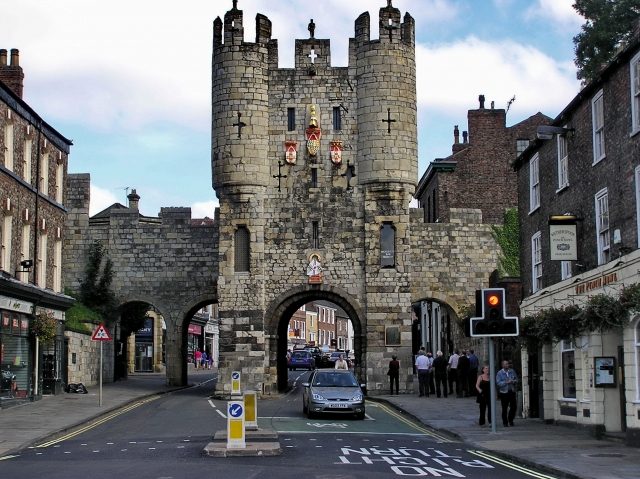
The City Walls of York, with a length of 4.4 kilometers, are the longest surviving city fortifications in England, giving insight into the development of military architecture from Roman times to the modern era.
History+
The origins of the fortifications date back to 74 AD, when the 9th Roman Legion founded the settlement of Eboracum. This developed into the capital of the Roman province of Britannia and housed a legionary fortress for 6000 soldiers. Parts of these Roman structures, including the Multangular Tower, which was once one of eight defensive towers, are still visible today. York served as a base for the construction of Hadrian's Wall in 121. In 306, Emperor Constantine I died in York, and his successor Constantine the Great was proclaimed emperor here. After Rome's withdrawal in 410, the province was occupied by Angles and Saxons. In 627, the Anglo-Saxon warlord Edwin brought Christianity to York, which became the capital of the Angles. In 867, the Danes conquered the city, named it Jorvik, and reinforced the then dilapidated Roman defenses. After the expulsion of the last Viking ruler in 954, Northumbria was united with the southern kingdom.
Source: Wikipedia · Licence: CC BY-SA 4.0
This description draws on the facts documented in the linked Wikipedia article; Wikipedia content is licensed under CC BY-SA 4.0. Wording and editing: Mobile History.
Location: 53.9628, -1.0785