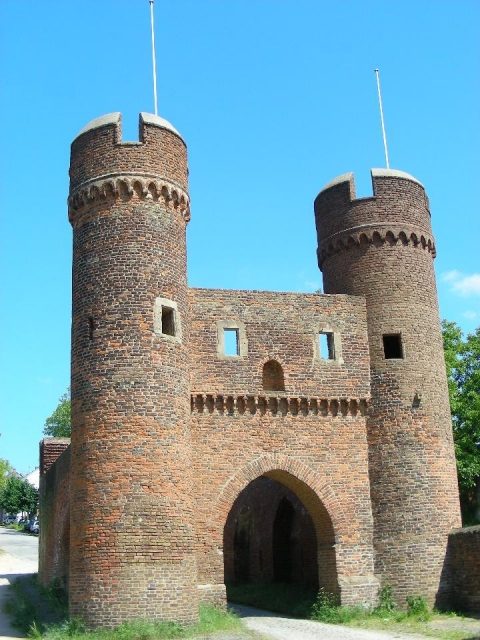
The Town Fortification can be visited
Zülpich Town Fortification

Zülpich has an almost complete city wall, one of the few remaining in the Rhineland. It surrounds the city center. This medieval ring wall stands partly on the remains of a Roman wall. It was built in the 14th century along with the four city gates. On the city wall – at the Frankengraben – a piece of the Roman aqueduct, which led from the Eifel to Cologne, can be seen. It was uncovered in Mechernich-Breitenbenden in 1979 and then erected in Zülpich.
The Kölntor
As part of the city's fortifications at the end of the 14th century, the eastern gate of the city, at the end of the street of the same name leading to Cologne, was built as a so-called double gate. This means that one would pass through the first gate (square outer gate structure with battlements) into a courtyard (zwinger), to then enter the city through the second, higher main gate (inner gate). This was intended to make it difficult for the enemy to penetrate. In 1886, it was enlarged, and the archway was raised. However, traffic increased more and more, and the city wall attached to the gate had to be breached. During the Second World War, the Kölntor was fitted with concrete tank barriers, which are still visible today. War damage here was very high, and so the walls were repaired between 1949 and 1953. An extensive restoration was carried out by the Carnival Society Blaue Funken. In cooperation with the city and the State Conservator, they set up a guardroom in the gate.
The Bachtor
It was built in 1393, also as a double gate system at the end of Bachstraße in the north, towards Bergheim and the Netherlands. Here, the outer gate, depicted in an engraving from 1746 as a battlemented outer gate without round towers (similar to Kölntor), was removed around 1900 due to increasing traffic. The city wall extended right up to the gate. Later, it was breached, again due to traffic. Today, the road layout of Bachstraße (K 82), named after the gate, runs west past the gate.
The Weiertor
The western city gate to Düren, generally referred to as the "most beautiful of Zülpich's gates," was also built as a double gate at the end of the 14th century. It was largely destroyed during bombing raids. The actual main gate, a rectangular gate tower structure with a battlemented crown similar to the Bachtor, no longer stands; only the left round front tower survived the war. The right tower was only rebuilt in 1974.
The Münstertor
The Münstertor was built in 1357 as the first of the city gates at the southern end of the street of the same name and led to the country road to Bad Münstereifel. It is probably the only gate that was not planned and built as a double gate system. In the engraving from 1746 (The medieval cityscape of Zülpich in an early modern drawing), the Münstertor is depicted with a similar outer gate to the Bachtor, including two round flanking towers. Due to high traffic volume, the city wall at the gate had to be removed. The Münstertor was also severely damaged in the war. The battlemented corner turrets, which it was the only gate to have, were only restored in 1976. Like the Kölntor, the Münstertor houses a carnival society, the Prinzengarde. The problem with converting it into a guardroom was the staircase. A steel construction next to the tower, as it is visible today, was soon agreed upon.
Take Mobile History with you
You are reading this text for free. Premium adds what matters on the road: descriptions read aloud, sites found through your camera, whole regions taken offline.
- Every description, including the ~17,700 Premium sites
- Audio guide: have descriptions read to you on location
- AR finder: see sites through your camera, with distance and bearing
- Unlimited saved sites
14 days free, then from €2.99 a month. Cancel anytime.
Source: Wikipedia · Licence: CC BY-SA 4.0
This description draws on the facts documented in the linked Wikipedia article; Wikipedia content is licensed under CC BY-SA 4.0. Wording and editing: Mobile History.
Location: 50.6925, 6.6473