The church can be visited
ChurchBrüssow
Brüssow Church
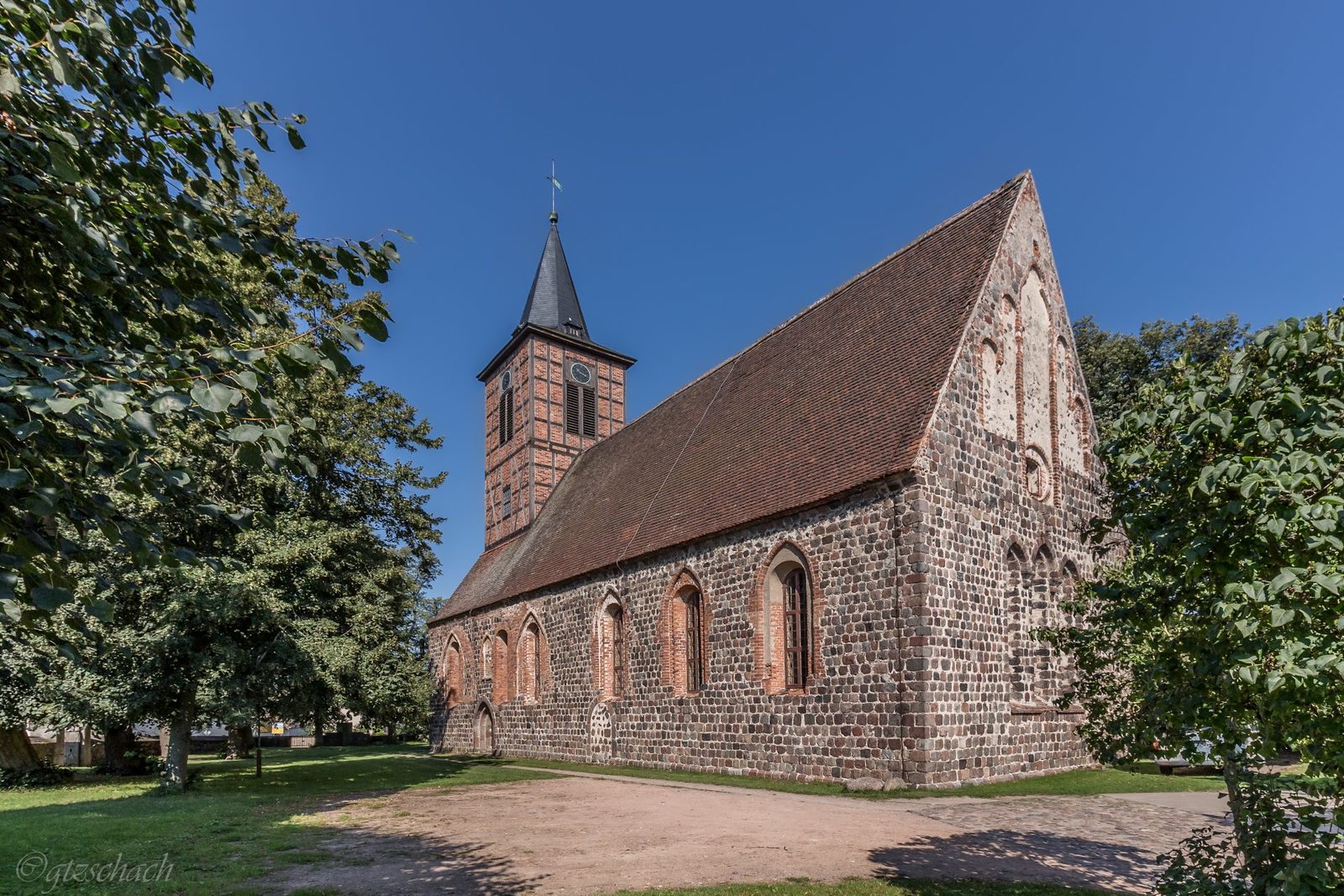
The Protestant town church of Brüssow (also: St. Sophia) is an early Gothic hall church in Brüssow in the Uckermark district in Brandenburg. It belongs to the Brüssow parish in the Pomeranian Evangelical Church District of the Evangelical Lutheran Church in Northern Germany and can be visited by appointment.
History and Architecture+
The church is a large fieldstone hall with an undeveloped west tower the width of the nave from the second half of the 13th century. The west gable and the square tower extension are made of half-timbering with a pointed spire from 1836; the building was restored in 1995/1996. The carefully executed building is provided with a slanted plinth and a coved eaves cornice; the brick finishes of the former lancet windows, partly visible in the north, are probably original, the pointed arch blinds in the south date from the beginning of the 14th century, in which 18th-century basket-arch windows extended downwards are arranged. In the east wall is a stepped three-window group in a similar blind (similar to the churches in Bertikow and Jagow), in the gable rising brick blinds can be found. Two stepped, partly walled-up pointed arch portals are arranged on the south and north sides. Inside, a beamed ceiling and a horseshoe gallery from 1836 are installed, which were painted and provided with Bible verses in 1936. The pointed arch opening to the tower is walled up.
Furnishings+
A wooden pulpit altar with rich acanthus decor was created in 1714 by Rosenberger from Stettin; the pulpit is framed by columns and sculptures of Moses and Melchizedek, in the predella is a Last Supper relief, in the cartouche-shaped top a Entombment relief is arranged; sculptures of the Risen Christ and two angels serve as crowning. On the sides are passages and grilled pews. A wooden Easter candlestick was made in the 18th century. A pewter chalice dates from 1803, a pewter baptismal bowl also from 1816. Two plates of the same material were created in the first half of the 19th century. Two bells were cast in 1609 by Roloff Klassen from Stettin and in 1778 by Johann Friedrich Thiele from Berlin. The organ is a work by Johann Gottlieb Heise from 1842 with 18 registers on two manuals and pedal, which was restored in 2013 by the company Alexander Schuke Potsdam Orgelbau.
Take Mobile History with you
You are reading this text for free. Premium adds what matters on the road: descriptions read aloud, sites found through your camera, whole regions taken offline.
- Every description, including the ~17,700 Premium sites
- Audio guide: have descriptions read to you on location
- AR finder: see sites through your camera, with distance and bearing
- Unlimited saved sites
14 days free, then from €2.99 a month. Cancel anytime.
Source: Wikipedia · Licence: CC BY-SA 4.0 · Image: Uckermaerker · Wikimedia Commons · CC BY-SA 4.0
This description is a machine translation of an excerpt from the linked Wikipedia article. The source text was written by its authors, the translation is by Mobile History; like the original it is licensed under CC BY-SA 4.0.
Location: 53.4000, 14.1261