The church can be visited
ChurchFreyenstein (Wittstock/Dosse)
Freyenstein Church
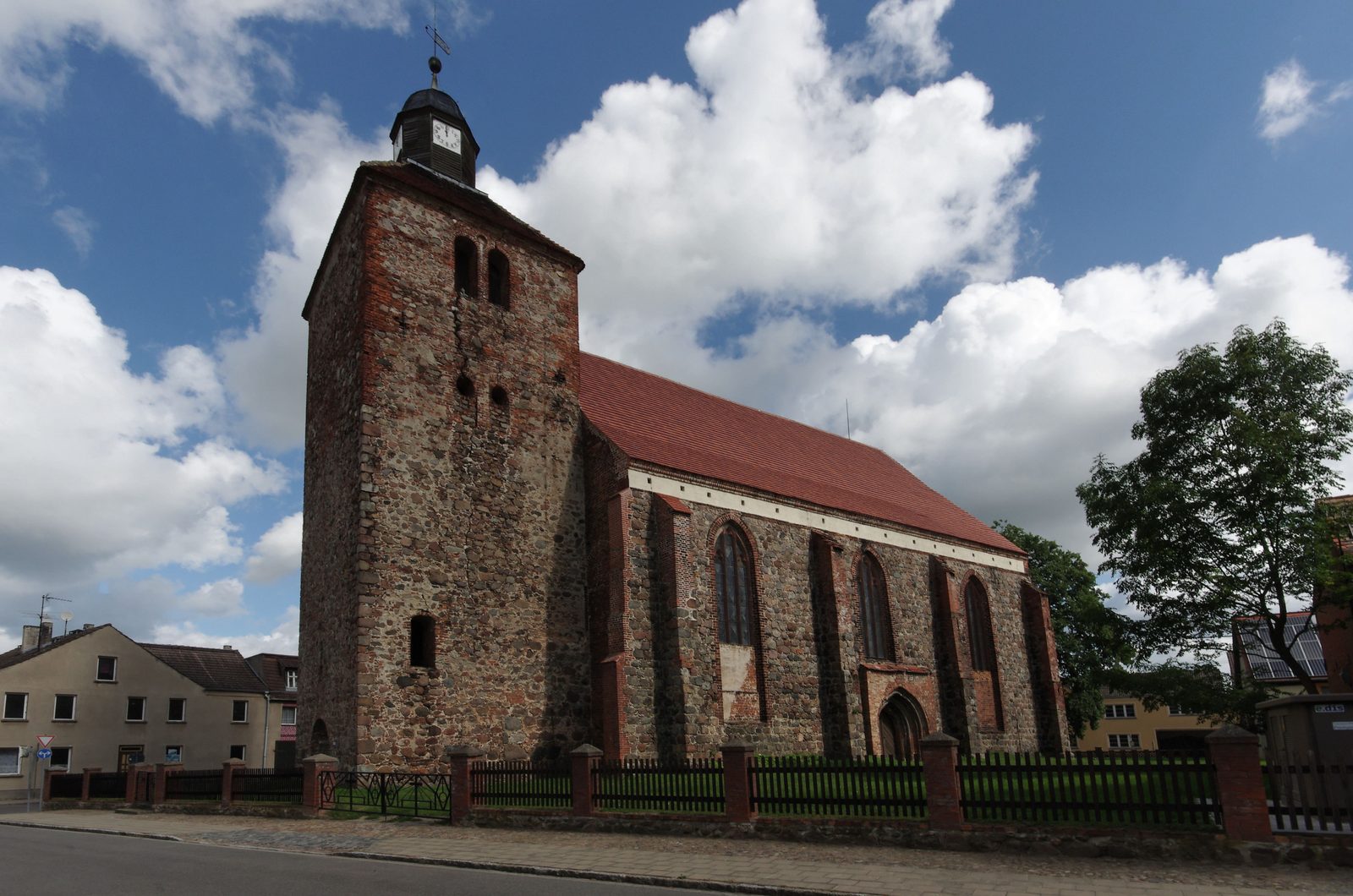
The Protestant town church of Freyenstein is an early Gothic fieldstone church in the Freyenstein district of Wittstock/Dosse in the Ostprignitz-Ruppin district of Brandenburg. It belongs to the Heilig-Geist-Nordprignitz parish association in the Prignitz church district of the Evangelical Church Berlin-Brandenburg-Silesian Upper Lusatia.
History and Architecture+
The town church of Freyenstein is a three-aisled, three-bay hall church from around 1300 with a straight eastern end, built mostly of fieldstone masonry with partial use of brick. It was built during the new founding of the town in 1287, when the margraves Otto IV and Konrad moved it from a hilltop to a more protected location further east in a lowland of the Dosse. The altar consecration in honor of the Blessed Virgin Mary took place in 1325. The transversely rectangular west tower, the width of the central nave, was probably built around 1500, incorporating remnants of an older tower structure. However, the Förderkreis Alte Kirchen Berlin-Brandenburg points out that, according to the latest findings of historian Dirk Schumann, the tower was only built around 1700. After a fire, the church was rebuilt in 1718, with the vault being re-inserted and the tower top renewed. It is also assumed that the interior pillars at least partially date from this period. The outer walls of the hall church are provided with stepped buttresses, which are orthogonally placed at the corners. The originally high pointed-arch windows with smooth reveals in brick were later walled up in the lower part and provided with neo-Gothic tracery. The windows in the brick-built west wall next to the tower were walled up. In the east wall, three high pointed-arch windows are arranged; the unadorned brick gable was only built in 1718. The nave features jamb portals in rectangular wall projections in the middle of the north and south walls, articulated with round, quarter, and pear-shaped rods. A similar portal is preserved in the tower hall and is covered by the mighty late Gothic west tower, which is largely unarticulated and topped by a pyramid roof with an octagonal roof turret with a hood. The outer west portal is roughly designed with a segmental-arched deep splayed reveal. Inside, the hall is closed with longitudinally rectangular bays with groin vaults from the renovation after 1718, supported by heavy octagonal pillars with simple capstones and multi-stepped arcade arches. In the west, the church was equipped with a double, slightly curved forward in the middle, horseshoe-shaped in the lower part gallery from the Baroque period, which was altered in the 19th century. In the east wall, a sacrament niche with an iron door is preserved. In 2007, the bells had to be silenced for static reasons. Two years later, an inventory was taken, which showed a considerable need for renovation. In 2012, the roof of the nave could be rebuilt and re-covered; in 2017/2018, the masonry was renovated. The facade and the interior were restored in 2020. It is planned to also restore the bells.
Furnishings+
A large altar structure shows a painting of the Transfiguration of Christ from the beginning of the 19th century, flanked by Ionic double columns. The painting was restored from April 2023 to 2023 for a total of approximately 21,000 euros. The simple basket of the pulpit once belonged to a pulpit altar from 1770 and is now set up separately. The gallery balustrade is adorned with a small Baroque wooden relief of a Madonna in a halo. To the right of the sandstone altar are three tombs of the von Winterfeldt family: for Joachim Dettlov von Winterfeldt († 1733), with a life-size female lamenting figure on a high inscription plinth, for Georg Christian von Winterfeldt († 1773), with a relief portrait of the deceased in marble, and for Detlof Ludewig Alexander von Winterfeldt († 1809). In the north wall is a sandstone epitaph from 1688. The organ is a work by the organ builder Gottlieb Heise from 1840, which was rebuilt in 1901 by Albert Hollenbach and now has 13 stops on one manual and pedal. The instrument was restored by the company Alexander Schuke Potsdam Orgelbau. A baptismal angel from around 1730 comes from the village church in Brügge in the Prignitz and is attributed to Elias Keßler.
Take Mobile History with you
You are reading this text for free. Premium adds what matters on the road: descriptions read aloud, sites found through your camera, whole regions taken offline.
- Every description, including the ~17,700 Premium sites
- Audio guide: have descriptions read to you on location
- AR finder: see sites through your camera, with distance and bearing
- Unlimited saved sites
14 days free, then from €2.99 a month. Cancel anytime.
Source: Wikipedia · Licence: CC BY-SA 4.0 · Image: Clemensfranz · Wikimedia Commons · CC BY-SA 4.0
This description is a machine translation of an excerpt from the linked Wikipedia article. The source text was written by its authors, the translation is by Mobile History; like the original it is licensed under CC BY-SA 4.0.
Location: 53.2864, 12.3537