The church can be visited
ChurchBraunau am Inn
St. Stephan Parish Church
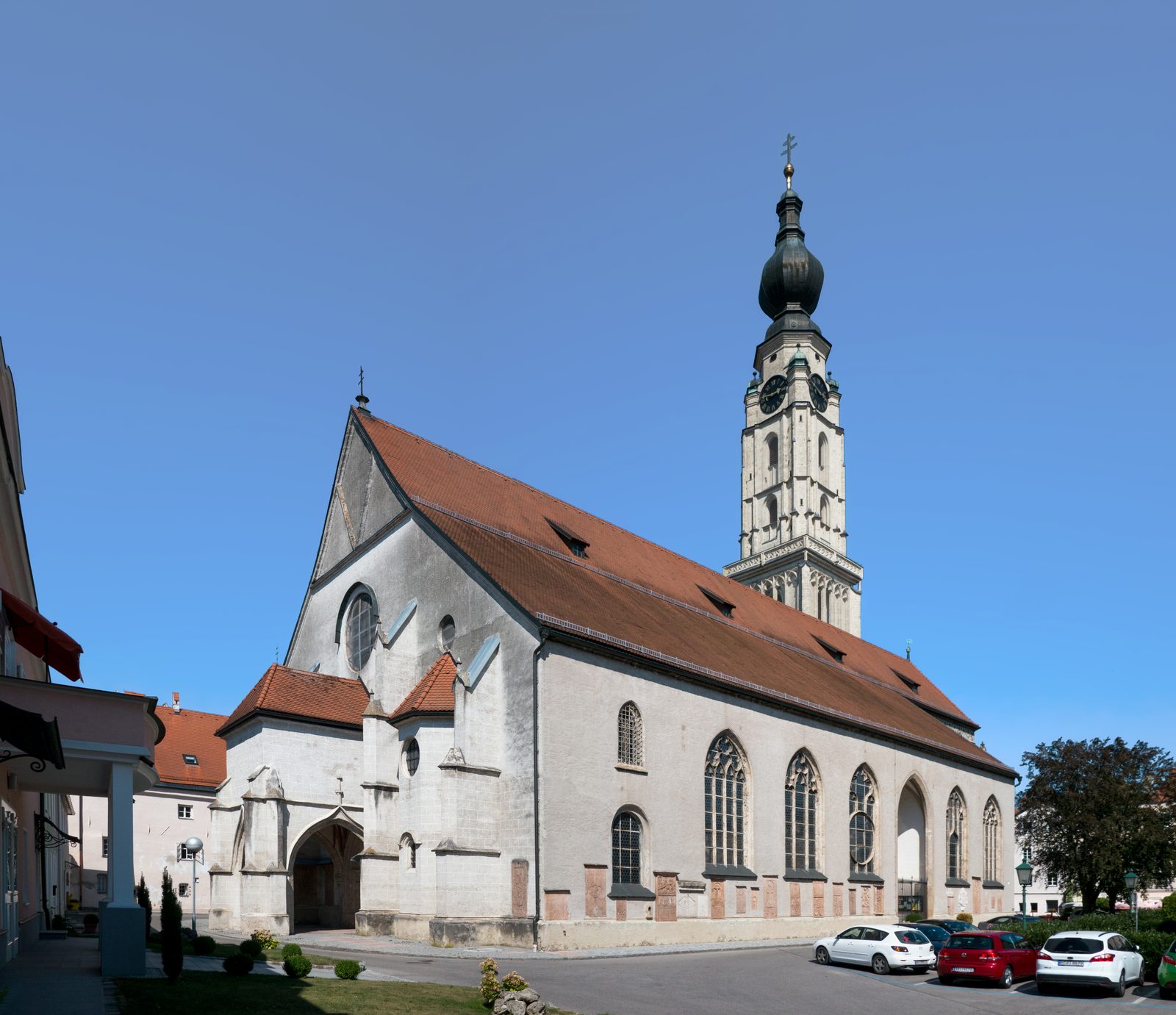
The Roman Catholic parish church of St. Stephan is a landmark of the city of Braunau am Inn and, with its 87 m high tower, has one of the highest church towers in Austria. Since January 1, 2023, St. Stephan has been one of 14 parish sub-communities belonging to the Braunau parish of the Diocese of Linz. Typologically, the building stands in the tradition of the Landshut School of Architecture and, with regard to its vault figuration, is related to or exemplary for the St. Johannes Church in Dingolfing, the Heilig Geist Hospital Church in Landshut, or the St. Nikolaus Parish Church in Eggenfelden. The floor plan of the nave, in turn, shows the influence of Landshut's St. Martin's Church.
Building History+
In 1110, a chapel dedicated to St. Stephan was already mentioned in "Prounaw", which was consecrated in 1138 by Bishop Konrad I (1106–1147) of Salzburg. The building was subordinate to the Augustinian Canons' Monastery of Ranshofen and was located further north than the present church. During the Crusades around the middle of the 13th century, the chapel was destroyed. In the course of the city's founding in 1260, a church was built at the site of the present city gate, transitioning from late Romanesque to early Gothic. In 1236, Braunau was granted its own parish by the Ranshofen monastery, and in 1406, a cemetery was laid out. Due to an economic boom, the "Stephansmünster" was rebuilt in Braunau in the 15th century, with the population bearing a large part of the costs. The craft guilds donated the chapels and their furnishings. The best known is the Bakers' Chapel with its Gothic winged altarpiece. The main master builder of the church was Stephan Krumenauer, son of the Passau cathedral master builder Hans Krumenauer and student of Hans von Burghausen. The foundation stone was laid on October 26, 1439, by Provost Erasmus von Ranshofen. On April 18, 1466, the church was consecrated by the Passau Bishop Ulrich von Nußdorf. Jörg Perger and Wolfgang Wiesinger completed the building. At the beginning of the 16th century, the sacristy was added, which is attributed to the master stonemason Hans von Braunau. Also striking is the 87 m high tower, for which the foundation stone was laid in 1492. The master builder was Wolfgang Wiesinger. In 1759, the tower received its current onion dome. Between 1670 and 1730, the side chapels were baroqueized. Between 1896 and 1906, the church was then re-Gothicized by the Viennese cathedral master builder Friedrich von Schmidt. In 1907, the church was electrified, and ten years later, the bells were melted down for metal requirements in World War I. On October 18, 1925, five bells from the bell foundry in St. Florian were consecrated.
Dimensions+
Length without tower: 60 m Length with tower: 67 m Width: 25 m Main nave height: 20 m Height of the tower: 87 m The tower of the Braunau parish church is often mistakenly referred to as the third highest church tower in Austria. The three highest church towers in Austria are located in Vienna (St. Stephen's Cathedral), Linz (New Cathedral), and Graz (Church of the Sacred Heart). Also, the height of the church tower of the Braunau parish church is repeatedly incorrectly stated as 96 or even 99 m, which is due to a calculation error in the 19th century that is often adopted unchecked (even in specialist literature, for example, in the church guide listed below under "Literature"). According to the Braunau Surveying Office, the correct height of the tower is 87 m.
Furnishings+
The church is known, among other things, for the so-called Bakers' Altar from the late 15th century. The other guild chapels were baroqueized between 1670 and 1730. In 1905, the valuable high altar, which Michael Zürn erected in 1642, was replaced by the neo-Gothic winged altarpiece created by Georg Schreiner of Regensburg according to plans by Friedrich von Schmidt. The Baroque altarpiece by the Passau painter Matthäus Lettenpichler from 1642 now hangs to the side of the winged altarpiece in the presbytery. The impressive Renaissance-style choir stalls date from 1598 and were reserved for the mayor, council, and guild masters of Braunau. Michael Zürn also created other Baroque altars in the church.
Organ+
There has been an organ in St. Stephan's Church since 1640. Over the years, the Baroque organ had become old and rotten, so repairs had to be carried out repeatedly. In 1919, 1931, and 1936, attempts were made to acquire a new organ, which could not be financed. In 1939, the parish church council decided to renew or renovate the organ work. Between 1941 and 1946, the organ no longer sounded until the first restoration began. Thus, the organ could be played again provisionally in 1947. Due to the financial situation, the organ renovation could only be continued in 1959, which, however, was not carried out by professionals. All this did not do the instrument any good. On September 30, 1992, it was decided to purchase a new organ, and an organ committee was founded for this purpose. On March 19, 1994, the old organ was dismantled. The valuable pipes were safely stored in St. Martin's Church. On August 8, 1995, a new organ case arrived. On November 25, 1995, the new organ was consecrated, and the old pipes were sold. The Metzler family worked on the organ for nine to ten months. The slider chest instrument has 46 stops on three manuals and pedal.
Trivia+
On April 22, 1889, Adolf Hitler was baptized in the Braunau parish church by Father Ignaz Probst.
Take Mobile History with you
You are reading this text for free. Premium adds what matters on the road: descriptions read aloud, sites found through your camera, whole regions taken offline.
- Every description, including the ~17,700 Premium sites
- Audio guide: have descriptions read to you on location
- AR finder: see sites through your camera, with distance and bearing
- Unlimited saved sites
14 days free, then from €2.99 a month. Cancel anytime.
Source: Wikipedia · Licence: CC BY-SA 4.0 · Image: Thomas Ledl · Wikimedia Commons · CC BY-SA 4.0
This description is a machine translation of an excerpt from the linked Wikipedia article. The source text was written by its authors, the translation is by Mobile History; like the original it is licensed under CC BY-SA 4.0.
Location: 48.2575, 13.0339