The Fort can be visited
Defence Line of Amsterdam-Fort aan de Ossenmarkt
The UNESCO World Heritage Site known as the Defence Line of Amsterdam (in Dutch named Stelling van Amsterdam) is a 135 km long ring of fortifications around Amsterdam, consisting of 42 forts located between 10 to 15 kilometers the centre, and lowlands that can easily be flooded in time of war. The flooding was designed to give a depth of about 30 cm, insufficient for boats to traverse. Any buildings within 1 km of the line had to be made of wood, so that they could be burnt and the obstruction removed.
The Stelling van Amsterdam was constructed between 1880 and 1920. The invention of the aeroplane and tank made the forts obsolete almost as soon as they were finished. Many of the forts now are under the control of the town councils and the nature department, and may be visited. Monuments Day, on the second Saturday in September, is the ideal day to visit as entrance is free.
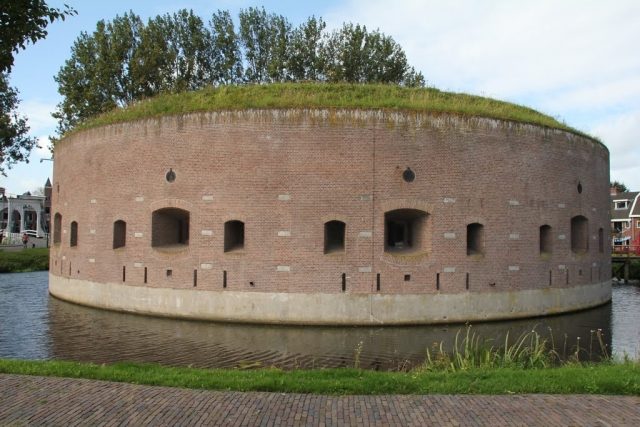
A while ago, the Fort at the Ossenmarkt was restored. The draw mechanism of the former drawbridge is still present at the entrance to the fort. On the former engineering grounds you’ll now find a garden shop, whereas the wooden artillery depot dating back to 1877 is used as an exhibition space. In addition, the Fort at the Ossenmarkt houses a music school and is home to various associations and offices.
During the Defence Line Season, the Historisch Maatschap (a historical association) organizes tours and cruises in and around the Fort at the Ossenmarkt. The Fort at the Ossenmarkt also serves as the starting point for the sound walk ‘Waterlanders’ (approximately 4 kilometres; 2.5 miles). The ‘Waterlanders’ walk takes you on a theatrical voyage of discovery along the river Vecht. During Stellingmaand (Defence Line Month) in September, the Fort at the Ossenmarkt is open to visitors every Saturday.
After 1815, the fortified town of Weesp formed part of the New Dutch Waterline. In 1892, it was incorporated into the Defence Line of Amsterdam. The Fort at de Ossenmarkt was built to defend both banks of the river Vecht, the sluices and the Amsterdam-Hilversum railroad with the bridge over the river Vecht. The tower fort at the Ossenmarkt dates back to 1861. Later, a protective wall was erected on the east side and the moat was filled. In 1983-1985, this wall was removed and the moat and bridge were restored to their former glory.
More information is available here.
Take Mobile History with you
You are reading this text for free. Premium adds what matters on the road: descriptions read aloud, sites found through your camera, whole regions taken offline.
- Every description, including the ~17,700 Premium sites
- Audio guide: have descriptions read to you on location
- AR finder: see sites through your camera, with distance and bearing
- Unlimited saved sites
14 days free, then from €2.99 a month. Cancel anytime.
Source: Wikipedia · Licence: CC BY-SA 4.0
This description draws on the facts documented in the linked Wikipedia article; Wikipedia content is licensed under CC BY-SA 4.0. Wording and editing: Mobile History.
Location: 52.3077, 5.0459