The Abbey can be visited
Museum
Clarholz Abbey
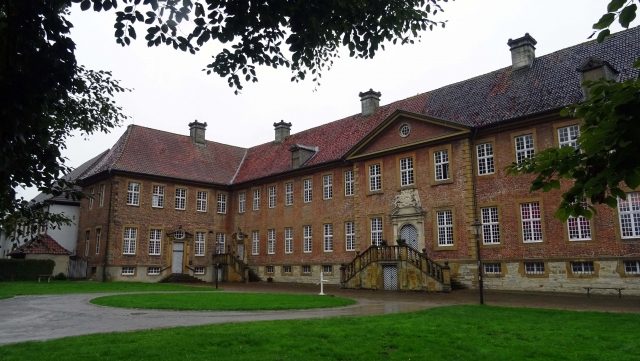
Clarholz Abbey, usually called Clarholz Monastery, is located in the municipality of Herzebrock-Clarholz in the district of Gütersloh in North Rhine-Westphalia. Clarholz Abbey was a Premonstratensian provostry between 1133 and the secularization in 1803. For 670 years, it was a religious center, a place of culture, and a not insignificant economic factor in the borderland of the dioceses of Münster, Osnabrück, and Paderborn. In the Middle Ages, it maintained economic and spiritual relations with the land of Vollenhove on the Zuiderzee (Diocese of Utrecht) until the sale of its properties there in 1549. In the 19th century, it became the castle of the Counts of Bentheim-Tecklenburg.
Foundation+
In 1133, the nobleman Rudolf von Steinfurt donated his estates in Clarholz and the neighboring Lette, which each included a chapel, "for his and his parents' eternal memory" to the Premonstratensian Order. The foundation was confirmed in January 1134 by Lothar III with the participation of the order's founder, Saint Norbert of Xanten, then Archbishop of Magdeburg. It was settled from Cappenberg Monastery, the first Premonstratensian settlement in Germany, in the form typical for the early days of the order as a double monastery with a male convent in Clarholz and a female convent in Lette. Bishop Werner of Münster further increased the initial endowment in 1134 and transferred the pastoral care in the neighboring community of Beelen, located to the northwest, to the abbey. In 1146, Pope Eugen III took the young abbey under his protection; he specifically mentioned the first provost, Ermward, who remained in office until 1184.
Middle Ages+
In 1175, the completed collegiate church, a flat-roofed Romanesque basilica with a westwork, transept, and three apses, was consecrated by Bishop Arnold of Osnabrück. He also granted it parish rights and established the parish of Clarholz with the farming community of Heerde, which thereafter belonged to the Diocese of Osnabrück, while Lette and Beelen remained in the Diocese of Münster. The collegiate church received a relic of Archbishop Thomas Becket, murdered in Canterbury in 1170, who had been associated with the reform order; the reliquary – a work from Limoges – is preserved.
The second provost, Friedrich von Tecklenburg (1187–1216), developed lively economic activities but failed in his applications for the bishopric in Münster and the abbacy in Corvey; he was eventually deposed and was last abbot in Knechtsteden Monastery. His successor, Ludger (1217–1234), who was close to the Cologne Archbishop Engelbert von Berg (1216–1225), received a declaration of protection for the abbey from Pope Gregory IX in 1231; it listed as its property 20 farmsteads, 45 inheritances, two mills, fishing rights on the Ems from Hüttinghausen to Warendorf, income from the saltworks in Werl, and much more. Count Simon von Lippe received the Vogtship over the abbey in 1296, which had initially been exercised by the founder's descendants.
Clarholz was located at the intersection of the road from Münster to Paderborn with a road from Bielefeld to Hamm. The monastery hospital, mentioned in 1300, served to accommodate travelers, pilgrims, and the sick; one of the conventuals acted as "master of the infirmary." From about 1320, the collegiate church was rebuilt into a Gothic hall church; the vault paintings from this period, characterized by symbolic animal and plant motifs, were uncovered by Hilde Claussen (1919–2009).
In the 14th century, the decline in the number of lay brothers led to the conversion of agriculture to leasing and paid labor. During the decades-long Lippe-Tecklenburg feud, the abbey was plundered in 1437. Internally, the convent was also in a crisis at that time.
At the intervention of the Council of Basel, two Marienfeld Cistercians took over the leading offices of provost and prior in 1439. They repeatedly invited the Premonstratensian abbots of Steinfeld (Eifel) and Wittewierum (Friesland) for visitations to emphasize their reforms in the Clarholz convent. Wittewierum was under the influence of the "Devotio moderna" and the Windesheim Congregation. Under Provost Johannes Hundebeke (1456–1487), there were numerous new entries into the abbey, the establishment of a school (1463), the construction of a rood screen in the church, and the reorganization of the administration of the Dutch estates around Vollenhove. In 1496, the Cistercian Abbey Marienfeld, the Premonstratensian Abbey Clarholz, and the Benedictine convent Herzebrock, which had belonged to the Bursfelde Congregation since 1467, formed a bond of friendship.
Early Modern Period+
Against the territorial and reformatory encroachments of the Lord of Rheda, Count Konrad von Tecklenburg (1530–1557), the monasteries Marienfeld, Clarholz, and Herzebrock sought the protection of Emperor Charles V. After tough negotiations at the Imperial Chamber Court, they succeeded in preserving the Catholic confession in the parishes of Lette, Clarholz, and Herzebrock and positioning themselves as territorial estates of the Lordship of Rheda.
In the last third of the 16th century, the Clarholz convent assimilated to the lifestyle of the landed gentry and became neglected. Female monastic life in Lette completely dissolved. Only from about 1625 onwards could the Westphalian Circary of the Premonstratensian Order and its outstanding abbeys Knechtsteden and Steinfeld gradually enforce the reforms of the Council of Trent in Clarholz. Under Provost Bernhard von Kerckering (1666–1693), the convent found new stability. In 1679, the "Archconfraternity of Our Lady of Mount Carmel" was constituted at the Clarholz church. From 1680 to 1685, the Steinfeld Premonstratensian Leonhard Goffiné worked as a pastor in Clarholz; here he began work on the "Handpostille," his household and devotional book for Catholic families, which was repeatedly reissued and translated into many languages until the 20th century.
Elbert von Kückelsheim, elected provost in 1693 at the age of 34, developed lively building and artistic activity during his long tenure – he died on May 10, 1750, at the age of 91. He is responsible for the baroque interior of the collegiate church (altars, pulpit, organ), the provostry built according to plans by Gottfried Laurenz Pictorius by the Lippstadt master builder Nikolaus Wurmstich in 1705/07, the farmstead, and the monastery gate (1725/28). The incorporated parishes of St. Vitus in Lette and St. Johannes Baptist in Beelen received new parsonages and new organs from the Beckum organ builder Heinrich Menke in 1709 and 1746 respectively (1716, Beelen already 1713). Kückelsheim's successor Leopold von Rübel (1750–1763) built the Clarholz tithe barn and the gardener's house in Lette in 1759.
The penultimate provost Franz Philipp von Meuseren (1765–1794) was close to the Catholic Enlightenment. He established a house study (with library) in the abbey. His cellarer Clemens August von Dücker modernized agriculture, mills, and the brickworks. The last provost, Jodokus van Oldeneel, who came from a Catholic noble family in Overijssel, permanently took in numerous Premonstratensians and other clerics who had fled France from the terror of the Revolution from 1794 until they could return to their homeland in 1802. In 1798, he became godfather to the eldest son of his secretary and legal advisor Carl Bernhard Temme, Jodokus Temme, who became known in the revolutionary years of 1848/49 as an upright champion of democracy in Germany and died in Swiss exile in 1881.
Secularization and its Consequences+
Against the impending secularization, the abbey sought legal assistance from the Imperial Aulic Council in Vienna and obtained a corresponding mandate, which, however, could not be enforced because the Count of Bentheim-Tecklenburg, with Prussian military assistance, forced the evacuation of the monastery on October 27, 1803, and expropriated the convent. Numerous buildings such as the chapter house, the cloisters, and some farm buildings were demolished. The provostry was separated from the convent house in the 19th century and converted into a castle. A prominent resident from 1849/52 was Prince August Ludwig zu Sayn-Wittgenstein-Berleburg, from 1852 to 1866 the last leading minister of the Duchy of Nassau.
After the dissolution of the patronage of the Counts of Bentheim-Tecklenburg, established in 1806, the church and convent house have been owned by the Catholic Parish of St. Laurentius Clarholz since 1969. The provostry, farm buildings, and tithe barn are owned by the Princes of Bentheim-Tecklenburg in Rheda. In the chapter hall of the provostry, the "Freundeskreis Propstei Clarholz" (Friends of Clarholz Provostry) holds concerts and cultural events, and in the cellar, it operates a monastery museum. The municipality of Herzebrock-Clarholz uses the tithe barn as a meeting place. The monastery gardens were redesigned between 1999 and 2003 as part of the "Gartenlandschaft Ostwestfalen-Lippe" (Garden Landscape East Westphalia-Lippe) project, based on historical specifications.
The Prelates' Way connects Clarholz Monastery with the monastery complexes of Herzebrock and Marienfeld.
Take Mobile History with you
You are reading this text for free. Premium adds what matters on the road: descriptions read aloud, sites found through your camera, whole regions taken offline.
- Every description, including the ~17,700 Premium sites
- Audio guide: have descriptions read to you on location
- AR finder: see sites through your camera, with distance and bearing
- Unlimited saved sites
14 days free, then from €2.99 a month. Cancel anytime.
Location: 51.9014, 8.1912