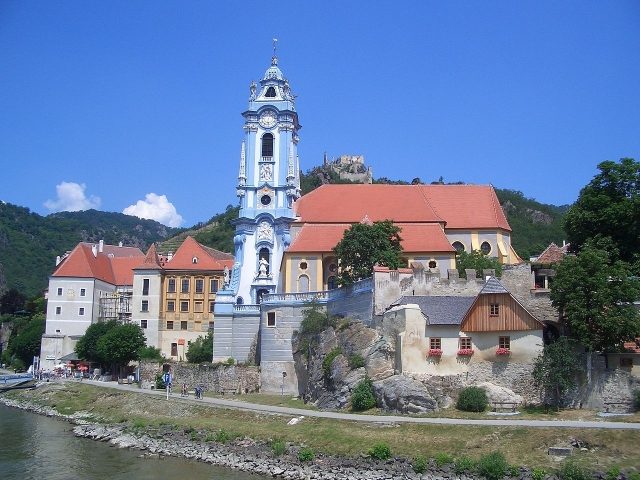
The Abbey can be visited
Dürnstein Abbey

Dürnstein Abbey is a former monastery in Dürnstein in the Wachau region of Lower Austria. Today, the buildings and the extensive property belong to the Augustinian Canons Regular of Herzogenburg Abbey, which also administers the parish of Dürnstein. The tower of the abbey church, with its blue and white coloring, is considered the landmark of the Wachau.
In 1372, a chapel was founded on the site of the present abbey. In 1400, it was expanded and a crypt was built. Dürnstein Abbey was founded in 1410. With the dissolution of the monastery in 1788 under Emperor Joseph II, Dürnstein Abbey, with its parishes and extensive property, came under the Augustinian Canons Regular of Herzogenburg Abbey, to which it still belongs today.
Today, it houses an international meeting center.
Building History+
- 1371 Elsbeth von Wallsee erected a chapel in honor of St. Mary and, together with her cousin Heidenreich von Meissau, endowed 3 chaplaincies.
- 1395 Hans III von Meissau endowed a 4th chaplaincy and stipulated that a choral mass be held daily and three silent masses be read daily.
- 1399 Hans III von Meissau and Stephan von Haslach bought estates in Willendorf from the Wallsees and donated them to the Dürnstein foundation.
- 1402 under Otto IV and Leutold II von Kuenring, with the consent of Duke Albrecht IV, the chapel of Dürnstein Castle was merged with the Frauenkapelle (Our Lady's Chapel). This secured the livelihood of 10 priests. This was a significant step in the development of the Dürnstein provostry.
- 1408 Bishop Count Georg Hohenlohe of Passau appointed the chief chaplain Stephan von Haslach as dean.
- 1409 with the death of the Dürnstein parish priest Heinrich Schenk, the parish of the Kunigunden parish church came under Dean Stephan von Haslach to the Frauenkirche. Bishop Count Georg Hohenlohe made the merger of the churches conditional on the establishment of a collegiate chapter within 2 years.
- 1410 with the relocation of regular canons from Wittingau (Bohemia) to Dürnstein, Bishop Hohenlohe's condition was met. Instead of the required collegiate chapter, a monastic order was established. Martin of Wittingau was elected the first provost of Dürnstein Abbey, after Stephan von Haslach declined. Bishop Count Georg Hohenlohe confirmed the founding of the Dürnstein Canons Regular Abbey on June 14, 1410. The parish of Dürnstein, the chapel of Dürnstein Castle, and the parish of Grafenwörth were incorporated.
300 years after the founding of the monastery, Hieronymus Übelbacher was elected provost in 1710. The building was in poor condition, so he decided to baroque it. He combined this with a grand conceptual design and was the focal point and coordinator of the artistic program. The current interior and exterior design comes from the architects and master builders Joseph Munggenast, Jakob Prandtauer, and Matthias Steinl. When Dürnstein received its Baroque appearance, religion, science, and culture were closely interrelated. Most striking is the blue and white tower of the abbey church, which has been restored to its original coloring. The theological program of the Dürnstein abbey tower is:
- “In the cross there is salvation, through the cross we are saved, all suffering culminates in the glory of the resurrection.”
The tower is covered with precious reliefs of the Passion of Christ. At the crowning stands the transfigured cross: in this sign, Christ conquered suffering and death. Below the cross stand the Evangelists as its interpreters. Four obelisks on the tower bear the images of the Apostles. They are witnesses of Christ: witnesses of his life, suffering, and resurrection.
Restoration
For two centuries, only the most urgent maintenance work could be carried out on the monastery. Since 1985, through a joint initiative of Herzogenburg Abbey, the Province of Lower Austria, the Diocese of St. Pölten, the Ministry of Science, the City of Dürnstein, the media, and many private donors, it has been possible to raise the total cost of 50 million Schilling and subject the building, both externally and in significant interior areas (cloister, ballroom), to a thorough restoration. In 1994, work began in the crypt chapel. In 1998, the completion of the exterior renovation was celebrated with the Thanksgiving festival. The renovation of the actual abbey building is still pending.
During the restoration in the 1980s, a blue coloring was discovered. Based on numerous invoices under Provost Hieronymus for smalt-blue dyes, it is assumed that the tower of the abbey church received this color at that time. For this reason, it was decided to give the church tower this original color. At the time of the restoration, this color was highly controversial. Only in the following years did the appearance in this color develop into a landmark in the Wachau. Due to its striking colors and the noble material that makes it appear ceramic, it stands as an architectural signal in the landscape.
Take Mobile History with you
You are reading this text for free. Premium adds what matters on the road: descriptions read aloud, sites found through your camera, whole regions taken offline.
- Every description, including the ~17,700 Premium sites
- Audio guide: have descriptions read to you on location
- AR finder: see sites through your camera, with distance and bearing
- Unlimited saved sites
14 days free, then from €2.99 a month. Cancel anytime.
Source: Wikipedia · Licence: CC BY-SA 4.0 · Image: http://commons.wikimedia.org/wiki/File:Stift_Duernstein_Wachau.jpg
This description draws on the facts documented in the linked Wikipedia article; Wikipedia content is licensed under CC BY-SA 4.0. Wording and editing: Mobile History.
Location: 48.3954, 15.5193