MonasteryRegensburg

Unserer Lieben Frau Abbey
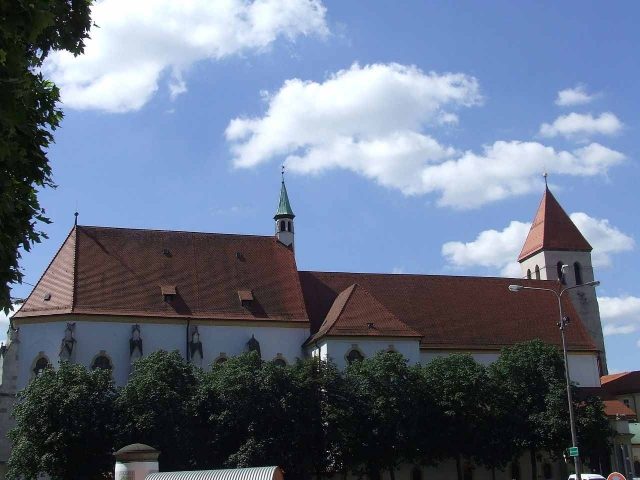
Unserer Lieben Frau Abbey

Abbey

The Collegiate Church of Our Lady (Alte Kapelle) is a collegiate church in the city of Regensburg (Diocese of Regensburg, Bavaria).

According to tradition, the Alte Kapelle (Old Chapel) dates back to a Roman Juno temple. On the square, the Alter Kornmarkt, where the Alte Kapelle now stands, the prefecture was located at the time of the Roman camp Castra Regina. Legend sees the Alte Kapelle as the oldest church in Bavaria. Around the year 700, the Agilolfingian Duke Theodo II was baptized here by Saint Bishop Rupert, and the church was made a court chapel. It is historically confirmed that a palatinate with an associated chapel was located here at the latest since the turn of the 7th to the 8th century. Charlemagne is traditionally considered the first founder. A church dedicated to the Mother of God Mary and an associated collegiate church are first mentioned in writing in a document by Louis the German from 875. The church originally served the Carolingians and Ottonians and later the Bavarian dukes as a palatine chapel, where the courtiers celebrated divine service, in contrast to the citizens who attended the parish church of St. Kassian. Emperor Arnulf moved the palatinate to another location in 887, so the Alte Kapelle was no longer needed and gradually fell into disrepair. Only King Henry, later Emperor Henry II, moved his residence back to the Alte Kapelle in 1002. He had the ruined church rebuilt and renewed the collegiate church. At this time, the church received the honorary title of "mater ecclesiae," a mother of the church. Henry and his wife Kunigunde endowed the church with numerous gifts and donated it in 1009 to the newly founded Diocese of Bamberg, where the Alte Kapelle remained until secularization. Henry and Kunigunde are revered as the second founders of the church. Although numerous indulgences from the 13th and 14th centuries are preserved, according to church historian Joseph Staber, it cannot necessarily be concluded that a Marian pilgrimage to the Alte Kapelle took place at that time. Such a pilgrimage is only verifiable in the 17th century. Over time, the church underwent numerous structural changes. In the 15th century, a Gothic high choir with a flèche was added to the Romanesque nave. Under Dean Johann Michael Franz von Velhorn, the church was splendidly decorated in the Rococo style in the second half of the 18th century. Until the 15th century, the collegiate church consisted mainly of nobles; from 1581, the canons had to be priests.

In the Middle Ages, the collegiate church consisted of an average of 15 canons. Today, the chapter confers a total of 7 canonries. A dean is elected from the 7 canons, who presides over the collegiate church. The church also earned great merit in the cultivation of church music. Particularly noteworthy are the musicologist Dr. Carl Proske, the musicians Dominikus Mettenleiter, Johann Georg Mettenleiter, and the church composer Michael Haller. In the second half of the 19th century, the Alte Kapelle became a center of Caecilianism. Since the 12th century, the church maintained its own school for the training of choirboys. In the 19th century, the "Studien- und Musikseminar zur Alten Kapelle" was founded for this purpose, which operated until 1957. The collegiate church was not dissolved during the secularization in Bavaria, probably because most of its assets were invested in Austria, and there was fear of losing them in case of dissolution. King Ludwig I granted the church its self-administration again in 1838. In 1964, at the suggestion of Bishop Rudolf Graber, the collegiate church of Our Lady to the Alte Kapelle was elevated to a Basilica minor by Pope Paul VI. The collegiate church has existed continuously from 1002 to the present day.

Collegiate Church (Alte Kapelle)+

Early Middle Ages

The Alte Kapelle dates back to the palatine chapel of the early medieval ducal and royal palatinate. In 875, the Alte Kapelle and the associated canonry are mentioned in a document. The document by King Louis the German suggests that this royal palatinate, previously located in the area of today's Niedermünster, i.e., the northeast corner of the Roman castellum, was newly built on today's Alter Kornmarkt. To obtain building materials, parts of the city wall (wall of the Roman legionary camp) were allegedly demolished. Due to their importance as city fortifications, it is now assumed that parts of other Roman ruins found new use. These also include inscribed stones from Roman tombs. Further Roman ashlar stones were discovered during post-war renovation work and in 1997. Some of them are still visible today on the western outer wall.

The palatine chapel was a three-aisled Romanesque basilica with a ruler's gallery in the west. The findings also suggest that the freestanding western tower was planned without a connection to the palatine chapel, although both parts were built at the same time.

Buildings of Emperor Henry II from 1002

Due to his close connection to Regensburg, the Bavarian Duke and later Emperor Henry II began to renovate the church in 1002, while retaining the old floor plan: the tower was raised and equipped with a belfry, and a transept was added in the east. During the Regensburg city fires of 1156 and 1172, which also destroyed the Carolingian cathedral, the church was damaged. At that time, a charnel house was located southeast of the church, the basement of which has been preserved under the sacristy and was uncovered in 1993. With the construction of the late Gothic choir, which is still preserved today, in 1441, this charnel house and the old choir complex were lost. Both this Gothic high choir and the somewhat lower imperial building are clearly recognizable in the exterior view.

Rococo Transformation in the 18th Century

From 1747, the church was redesigned in the style of Bavarian Rococo. Almost all medieval elements were lost in the process. Only the Romanesque portal is preserved at the south entrance of the nave (from the Chapel of Grace). The nave and transept received wooden vaults, and the medieval windows, still recognizable in the exterior plaster, were replaced by bass viol windows. The work on the magnificent interior decoration was carried out by the Wessobrunn stucco artist Anton Landes, the Augsburg painters Christoph Thomas Scheffler in the nave and transept and Gottfried Bernhard Götz in the presbytery, and the Regensburg sculptor Simon Sorg.

The frescoes depict the legend of the handing over of the miraculous image, still displayed in the Chapel of Grace today, by Pope Benedict VIII to Emperor Henry II in Rome. According to legend, the miraculous image comes from the hand of the Evangelist Luke, but it is dated to the period between 1150 and 1235.

The reasons for the changes were the 750th anniversary of the collegiate church and the desire to demonstrate its independence from the powerful cathedral chapter and the bishop through the building. The saying "St. Peter (Cathedral) is the mighty, the Chapel the magnificent" is still handed down today. The miraculous image was also intended to emphasize the high rank of the collegiate chapter. After the Wieskirche, the Alte Kapelle is the most important Bavarian Rococo building.

20th Century

The first renovations and transformations were undertaken in 1886 and 1934/35. A bomb hit in 1944 caused damage to the northern transept. In 1990, the last exterior renovation was completed, and the interior was restored between 1992 and 2002.

In 1964, the church was elevated to a papal "Basilica minor." The reasons lie in the tradition and importance of the "Bavarian Mother Church" for the Christianization of Bavaria.

In 2006, a new organ by the Swiss company Mathis was installed, which Pope Benedict XVI consecrated during his pastoral visit to Regensburg on September 13, 2006, and which bears the name Pope Benedict Organ.

Miraculous Image+

In the Chapel of Grace, which is attached to the south of the nave, is the so-called Miraculous Image. It depicts the Mother of God Mary with the Child Jesus. According to legend, it was painted by the holy Evangelist Luke. Pope Benedict VIII gave it to Emperor Henry II on the occasion of his coronation as Roman-German Emperor on February 14, 1014. He later donated it to the Alte Kapelle, which he had renovated a few years earlier and transferred to his favorite foundation, Bamberg. The Miraculous Image is of the "Dexiokratusa" Madonna type, because she carries the child on her right arm, and belongs to the devotional image type of the Luke image. So much for the legend; the panel painting with its location is first mentioned in a document from 1451 and is dated by art history to the first half of the 13th century. The pilgrimage to the Luke image of the Alte Kapelle "probably only arose late after the Thirty Years' War," as the Regensburg church historian Josef Staber states - contrary to other self-representations of the collegiate church. Until the second half of the 17th century, the Miraculous Image was in the choir of the collegiate church. In the 17th century, a so-called miracle occurred in the Alte Kapelle: a boy born blind gained sight in the Alte Kapelle. Therefore, to make it more accessible to the people, the Miraculous Image was transferred in 1694 to the former Chapel of St. James, which has since been called the "Chapel of Grace" and was splendidly decorated.

It was a hard blow for the collegiate church and parts of the Regensburg population when, during the secularization, the Miraculous Image was transferred in 1810 to the gallery of Schleißheim Castle and later to the Bavarian National Museum. The collegiate church had to make do with a copy. Bishop Ignatius von Senestrey obtained the return of the original image in 1862. On April 27, 1864, it was solemnly returned to its rightful place.

In 1998, the diocesan pilgrimage to Our Lady of the Alte Kapelle took place.

The Pope Benedict Organ in the Alte Kapelle+

The new instrument with two manuals and 40 registers, which is named the Pope Benedict Organ in honor of the Pope (Pope Benedict XVI gladly agreed to this proposal), was installed and intoned in the Papal Basilica and Collegiate Church "Our Lady of the Alte Kapelle" during 2006 and consecrated on September 13, 2006, by Pope Benedict XVI during his visit to Germany and Regensburg. The new instrument is built according to the model of the important organ work that was built in 1791 by the Nabburg organ builder Andreas Weiß for the Alte Kapelle. The financing was provided by the Peter Kaiser Memorial Foundation (Liechtenstein). The orientation towards the disposition of that time, expanded by some important registers, combines the typical features of Bavarian Baroque and at the same time takes into account the requirements of today's liturgy. This church organ is currently probably the only organ personally consecrated by the Pope, which now serves the liturgy and regular church music at a high level (soloists, choir, orchestra, organ) - in the Alte Kapelle, among other things, works by the Liechtenstein composer Josef Gabriel Rheinberger (1839–1901) are intensively cultivated.

Take Mobile History with you

You are reading this text for free. Premium adds what matters on the road: descriptions read aloud, sites found through your camera, whole regions taken offline.

  • Every description, including the ~17,700 Premium sites
  • Audio guide: have descriptions read to you on location
  • AR finder: see sites through your camera, with distance and bearing
  • Unlimited saved sites

14 days free, then from €2.99 a month. Cancel anytime.

Source: Wikipedia · Licence: CC BY-SA 4.0

This description draws on the facts documented in the linked Wikipedia article; Wikipedia content is licensed under CC BY-SA 4.0. Wording and editing: Mobile History.

Location: 49.0183, 12.1000