CastleNienburg

Stockturm Castle

Stockturm Castle

Apartments

The Stockturm in Nienburg/Weser was part of Nienburg Castle, which belonged to the Counts of Hoya.

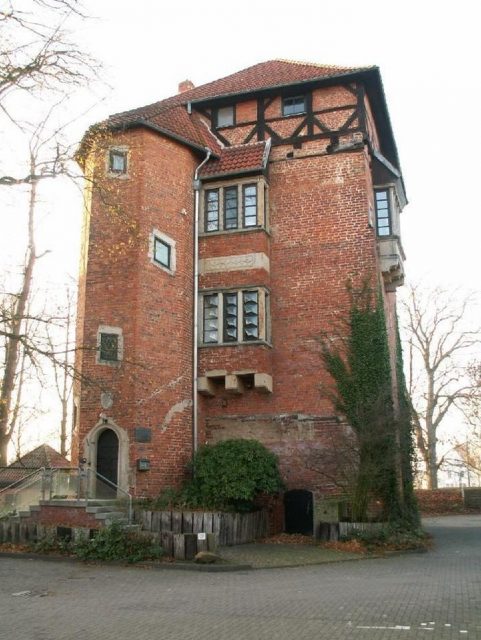
The Stockturm is a freestanding brick tower with Renaissance style elements. A staircase is located on the east side of the tower. Bay windows are on the east, south, and west sides. The uppermost of the four floors is executed in half-timbered style. The roof is a simple pyramid roof made of red tiles.

It is not known what purpose the Stockturm originally served. It is sometimes referred to as a battery tower. It was part of Nienburg Castle, which emerged from a moated castle. The castle was an independent defensive structure within the city fortifications of Nienburg. A Merian engraving from 1647 shows a smaller tower next to the main tower of the castle, which somewhat resembles the current Stockturm. It was probably a defensive or residential tower. It is possible that the tower was formerly taller or had a different roof.

The tower was built in the first half of the 16th century. At the same time, the Counts of Hoya expanded Nienburg into a representative castle. Models were the castles of Stadthagen and Bückeburg. After the death of the last Count of Hoya (1582), the castle served as the seat of the Droste of the Dukes of Brunswick-Lüneburg and as an administrative seat. During the Thirty Years' War, the castle and outbuildings were partially destroyed and completely demolished after the Thirty Years' War. Only the Stockturm remained. The area of the former castle and fortifications was built over with military barracks in the 17th and 18th centuries. In the 19th and 20th centuries, the district court, district administration office, prison, building trade school (later university of applied sciences, today Police Academy of Lower Saxony) and district house followed, and in the 21st century, an electronics store. At times, there was also a bus station there.

After the demolition of the castle, the Stockturm served as a prison tower ("im Stock" = imprisoned). The name is obviously based, as with the Stockhof Hameln, on the fact that prisoners were chained to a stock at night due to the risk of escape. In 1975, the tower was renovated by Stockturm e.V. and has since been used by the Rühmkorffbund (association of former Nienburg university of applied sciences students) as a museum and by Corps Hannoverania (a student fraternity) as a fraternity house. Furthermore, there are several rooms in the tower that are rented to students.

Take Mobile History with you

You are reading this text for free. Premium adds what matters on the road: descriptions read aloud, sites found through your camera, whole regions taken offline.

  • Every description, including the ~17,700 Premium sites
  • Audio guide: have descriptions read to you on location
  • AR finder: see sites through your camera, with distance and bearing
  • Unlimited saved sites

14 days free, then from €2.99 a month. Cancel anytime.

Source: Wikipedia · Licence: CC BY-SA 4.0 · Image: http://www.wehrbauten.de/thread.php?threadid=557

This description draws on the facts documented in the linked Wikipedia article; Wikipedia content is licensed under CC BY-SA 4.0. Wording and editing: Mobile History.

Location: 52.6415, 9.2042