The church can be visited
ChurchBaden-Baden
Stourdza-Kapelle
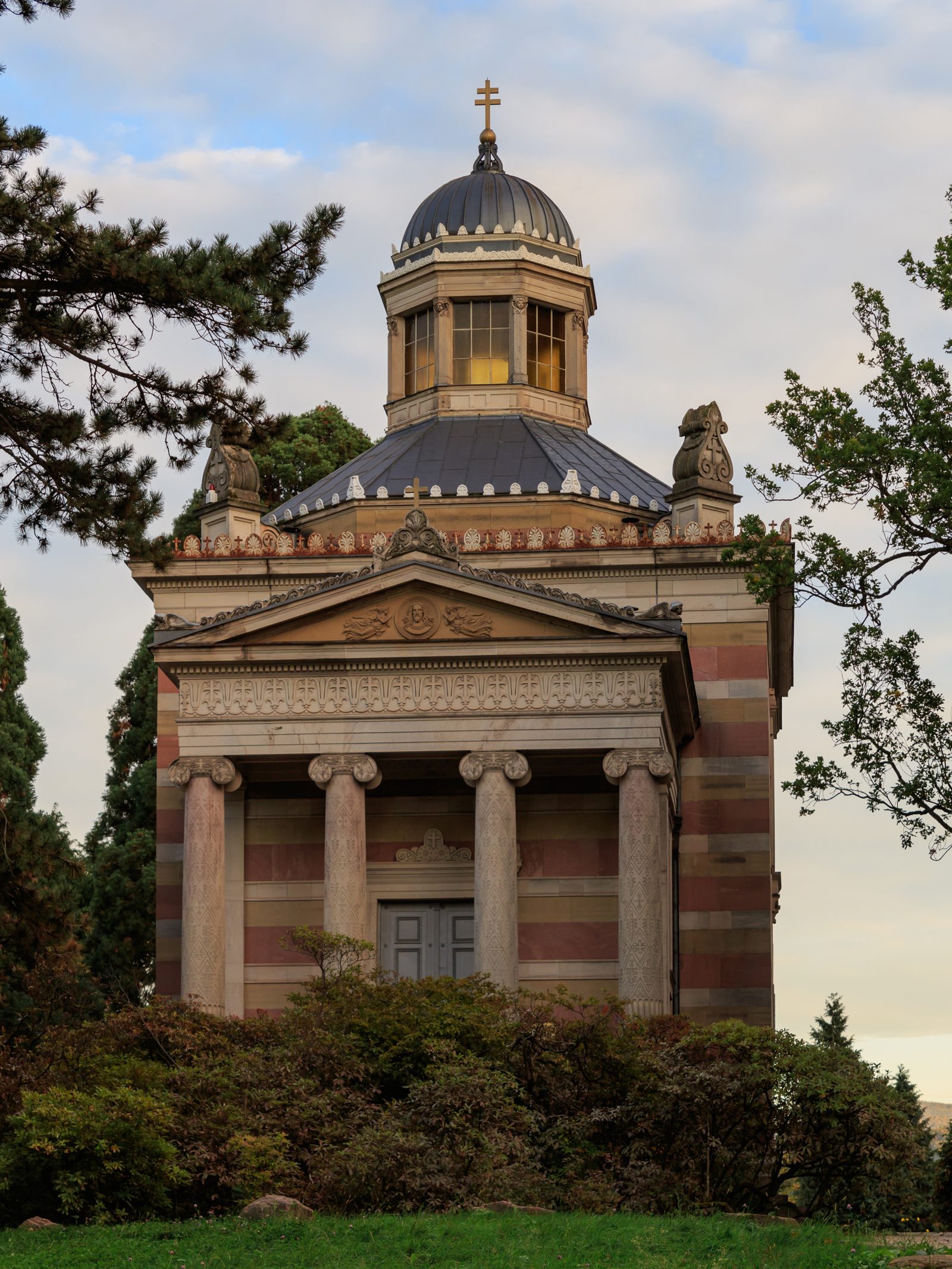
The Romanian Orthodox Chapel of Saint Archangel Michael in Baden-Baden, known as the Stourdza Chapel, was built between 1863 and 1866 in the Neoclassical style according to plans by architects Leo von Klenze and Georg von Dollmann. It stands on Michaelsberg in Baden-Baden.
History+
Its founder, Prince Michael Stourdza, was the ruler of Moldavia from 1834 to 1848. After the revolution of 1848, he left his throne and homeland and traveled to Paris, where, after a brief stay in Vienna, he settled in 1849. As they were close to the Russian princely families, the family of the former Moldavian prince preferred to stay in Baden-Baden, Germany, in the summer, where they owned a castle in the center of the town. On June 30, 1863, Stourdza's son (from his second marriage), Prince Michael, died unexpectedly at the age of seventeen in Paris, where he attended the Lycée Napoleon Bonaparte. In his memory and as a family resting place, his parents had the burial chapel built with the help of renowned artists. Until 1882, the Greek Orthodox consecrated chapel was under the jurisdiction of the Ecumenical Patriarchate in Constantinople, then the Prince placed it under the canonical care of the Metropolitan Church of Moldavia and Bukovina, "to prove my devotion as a son of the Moldavian Church, my homeland." But he expressed his will that it should never become a parish church, but remain a princely burial chapel, where he and his family members would remain in eternal memory. Since 1923, the chapel has been under the administration of the city of Baden-Baden. In 1997, a project was launched to restore the dilapidated crypt and the interior of the chapel (narthex and nave). The chapel was included in the list of historical monuments of Germany. The work lasted six years. Prince Dimitrie Stourdza and Prince Stefan Dimitrie Ferdinand, the great-grandson and great-great-grandson of the founder (in direct line, descended from the first marriage of Prince Michael Stourdza with Princess Elisabeta Rosetti), also contributed massively financially and visit the family chapel regularly. It was re-consecrated on May 19, 2002, by the Metropolitan of Moldavia and Bukovina, Daniel, today the Romanian head of the Orthodox Church. Family members Stourdza, representatives of the city, representatives of the Romanian embassy in Geneva, Strasbourg and Bern, as well as numerous Romanian faithful from Germany, France, Switzerland and Italy participated in this event. Next to the church stands an oak tree brought from Moldavia and planted by Michael Stourdza on the day of the church's consecration, surrounded by sequoias and magnolias. The chapel is open for prayer on holidays during services, but also during the week by appointment.
Description+
Above the entrance portal in the narthex (inside) is the votive inscription with the Greek text:
At the entrance, on the right inner side, Prince Michael Stourdza (1794–1884) is depicted next to his daughter Maria (1848–1905), who was married to the Russian Prince Gorceacoff, and on the left side Princess Smaragda Stourdza, née Vogoride (1810–1885), next to her son Michael (1846–1863). These four paintings were painted on copper plates in 1866 by the Parisian painter J. Pérignon. In the crypt under the altar area, Prince Michael Stourdza († 1884), his second wife Smaragda († 1885) and their children Princess Maria († 1905) and Prince Michael († 1863) are buried. In the middle of the church, on the right side, there is a tomb monument depicting young Michael studying in Paris. This sculpture was made by the Italian sculptor Rinaldo Rinaldi from Carrara marble. Opposite is the monument, executed by the Frenchman Thomas Gabriel, depicting the sorrowful parents. Leo von Klenze incorporated Renaissance elements with a Neoclassical structure and combined them with German folk elements. Significant is the 24 m high dome, a miniature replica of the dome of St. Peter's Basilica in Rome, which gives the chapel a special acoustics. The painting on the dome was created on copper sheets by the church artist André Müller, Munich. He also painted the iconostasis on copper sheets. The paintings on the walls of the house of God were executed in fresco technique by Professor Wilhelm Hauschild from Munich. The icons of the chapel are painted on wood with oil; the icons on the four lecterns in front of the iconostasis, which depict the Archangel Michael, the Mother of God with the Child, the Redeemer Jesus Christ and the Resurrection of our Lord together with the 12 Royal Feasts during the year, are coated with silver. Next to the monument on the left stands the holy epitaph, painted by the Russian Prince Nikolai Nikolaievici Gagarin. The epitaph was embroidered by Princess Maria Stourdza with a Slavonic gold thread inscription.
Take Mobile History with you
You are reading this text for free. Premium adds what matters on the road: descriptions read aloud, sites found through your camera, whole regions taken offline.
- Every description, including the ~17,700 Premium sites
- Audio guide: have descriptions read to you on location
- AR finder: see sites through your camera, with distance and bearing
- Unlimited saved sites
14 days free, then from €2.99 a month. Cancel anytime.
Source: Wikipedia · Licence: CC BY-SA 4.0 · Image: A.Savin · Wikimedia Commons · CC BY-SA 3.0
This description is a machine translation of an excerpt from the linked Wikipedia article. The source text was written by its authors, the translation is by Mobile History; like the original it is licensed under CC BY-SA 4.0.
Location: 48.7632, 8.2332