Ancient BuildingRoma

Tempio di Vesta (Temple of Vesta)
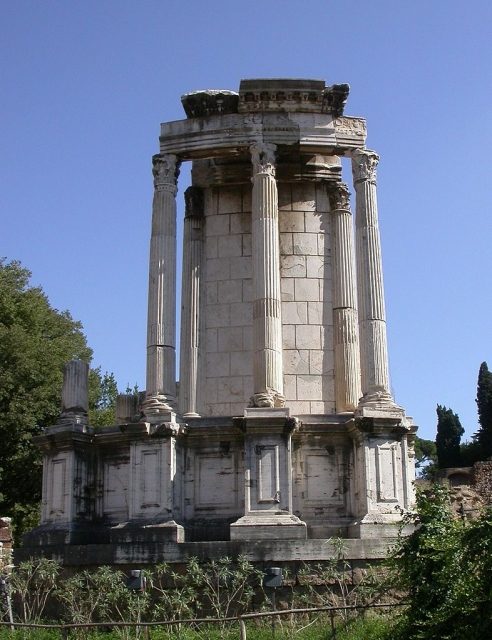
Tempio di Vesta (Temple of Vesta)

The remains of the ancient town can be visited

The Temple of Vesta (Latin Aedes Vestae, Italian Tempio di Vesta) is an ancient edifice in Rome, Italy, located in the Roman Forum near the Regia and the House of the Vestal Virgins. The temple's most recognizable feature is its circular footprint. Since the worship of Vesta began in private homes, the architecture seems to be a reminder of its history. The extant temple used Greek architecture with Corinthian columns, marble, and a central cella. The remaining structure indicates that there were twenty Corinthian columns built on a podium fifteen meters in diameter. The roof probably had a vent at the apex to allow smoke release.

All temples to Vesta were round, and had entrances facing east to symbolize connection between Vesta’s fire and the sun as sources of life. The Temple of Vesta represents the site of ancient cult activity as far back as 7th century BCE. Numa Pompilius is believed to have built this temple along with the original Regia and House of the Vestal Virgins in its original form. Around the Temple stood The Sacred Grove, in which also there was a graveyard for the priests and virgins.

It was one of the earliest structures located in the Roman Forum although its present reincarnation is the result of subsequent rebuilding. Instead of a cult statue in the cella there was a hearth which held the sacred flame. The temple was the storehouse for the legal wills and documents of Roman Senators and cult objects such as the Palladium. The Palladium was a statue of Athena (Roman Minerva) believed to have been brought by Aeneas from Troy; the statue was felt to be one of the Pignora Imperii, or pledges of imperium, of Ancient Rome. According to Dionysius of Halicarnassus, the Romans believed that the Sacred fire of Vesta was closely tied to the fortunes of the city and viewed its extinction as a portent of disaster.

Reconstructions+

Although there was a fire in the temple, it did not pose a great risk to burning down since the fire was maintained in a hearth and watched closely by the Vestals. Rather, the city of Rome itself was often the source of conflagration that destroyed the temple. The Temple of Vesta did burn twice in written history. In 64 CE, the Great Fire of Rome burned most of Rome, including the Temple of Vesta. It was said by Cassius Dio to have been started by the infamous Nero, but according to Tacitus, Nero was at Antium at the time of the fire. After a fire in 191, Julia Domna, the wife of Septimius Severus, had the temple restored. The sacred flame was put out in 394 by Theodosius I after he won the Battle of the Frigidus, defeating Eugenius and Arbogast. The Temple of Vesta remained reasonably intact until the Renaissance. However, in 1549 the building was completely demolished and its marble reused in churches and papal palaces. The section standing today was reconstructed in the 1930s during the dictatorship of Benito Mussolini.

Take Mobile History with you

You are reading this text for free. Premium adds what matters on the road: descriptions read aloud, sites found through your camera, whole regions taken offline.

  • Every description, including the ~17,700 Premium sites
  • Audio guide: have descriptions read to you on location
  • AR finder: see sites through your camera, with distance and bearing
  • Unlimited saved sites

14 days free, then from €2.99 a month. Cancel anytime.

Source: Wikipedia · Licence: CC BY-SA 4.0 · Image: http://de.wikipedia.org/wiki/Datei:Rom_vesta_tempel.jpg

This description draws on the facts documented in the linked Wikipedia article; Wikipedia content is licensed under CC BY-SA 4.0. Wording and editing: Mobile History.

Location: 41.8917, 12.4862