The remains of the Castle can be visited
CastleCastle Douglas
Threave Castle
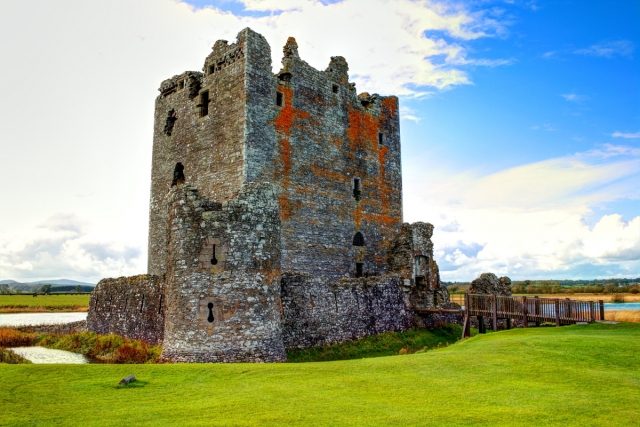
Threave (or Thrieve, or Treve) Castle is situated on an island in the River Dee, 2.5 km (1.5miles) west of Castle Douglas, in Dumfries and Galloway, Scotland. It was the home of 'Black' Douglas Earls of Douglas from the late 14th century until their fall in 1455.
The island was probably inhabited from the 6th century, and the name is most likely derived from the Old Welsh Tref, meaning homestead. It is possible that Fergus of Galloway built a timber castle on the island after 1000, but it was burned in 1308 by Edward Bruce.
Douglas stronghold
Threave Castle was built in the 1370s by Archibald Douglas, "the Grim", later the third Earl of Douglas, soon after he was created Lord of Galloway in 1369. A small collection of buildings were built around the main keep, including a hall and chapel. Threave Castle became Archibald's stronghold and he died there in 1400. His son Archibald married Princess Margaret, daughter of Robert III of Scotland.
Archibald Douglas, 5th Earl of Douglas, was appointed Regent to the infant King James II in 1437. Archibald died in 1439 and in the ensuing power struggle his 16-year-old son William was murdered at Edinburgh Castle, in 1440. Threave passed, with the Lordship of Galloway, to his sister Margaret, the "Fair Maid of Galloway".
William Douglas, 8th Earl of Douglas married Margaret, his cousin, in order to retrieve Galloway for the Douglases. He began a series of improvements to the Castle's fortifications in 1447, demolishing the earlier outbuildings and constructing a defensive wall along the river bank closest to the keep. In 1452 Patrick Maclellan of Bombie was imprisoned and murdered by the 8th Earl, against the order of James II. The deed was reciprocated the same year, when James II murdered William Douglas at Stirling Castle.
William's brother James Douglas, now 9th Earl, hastily continued the additions to Threave, building a curtain wall with three corner towers and a gatehouse, as well as an outer ditch and an earth rampart to the north of the keep. After his brother's murder, he intrigued with the English court, receiving money from Henry VI's government for the works. The 9th Earl's uprising was defeated at the Battle of Arkinholm near Langholm and his strongholds were systematically besieged. Threave Castle was subject to a two month siege in 1455. The castle survived the attack and only succumbed when the garrison were bribed and promised safe conduct.
One story associated with the siege, which is repeated by Nigel Tranter, is that the great cannon Mons Meg was built in Kirkcudbright, by a smith named Mollance, for the Maclellans. The cannon was presented to James II and employed against Threave. The first cannonball fired supposedly smashed through the castle, taking off Margaret Douglas' hand as she drank. However, the undamaged state of the keep, and the alternative provenance of Mons Meg via Burgundy render these details dubious. Some of the King's artillery was used at Threave, as recorded in the Exchequer Rolls;
"For the expenses made by Brother Andrew Lisours,carpenter, and John Were, burgess of Linlithgow, in the carriage of the Great Bombard to the siege of Threave, and its return to Linlithgow, £59 eighteen pence. For wood cut to its mountings, for iron and stones, coals, wedges and spades, £22 four pence. And for a pair of wheels used to bring the bombard from Threave to Linlithgow, 14 shilling four pence."
Royal fortress
The castle was annexed by the Crown, and a succession of keepers appointed, although it is unlikely that the castle was again used as a residence. In 1513, Robert Maxwell, 5th Lord Maxwell, was appointed keeper following the death of the previous keeper, John Dunbar of Mochrum, at Flodden. In 1526 the position was made hereditary to the Maxwells (later Earls of Nithsdale).
In 1542, Robert Maxwell was captured after the battle of Solway Moss, and forced to hand Threave over to the English invaders. It was retrieved for Scotland by the Earl of Arran in 1545.
During the Bishops' Wars of 1638-1640, the Maxwells supported Charles I of England. A garrison of up to 100 men was installed and a grassy embankment was added to the Castle's defences.
Source: Wikipedia · Licence: CC BY-SA 4.0
This description draws on the facts documented in the linked Wikipedia article; Wikipedia content is licensed under CC BY-SA 4.0. Wording and editing: Mobile History.
Location: 54.9392, -3.9697