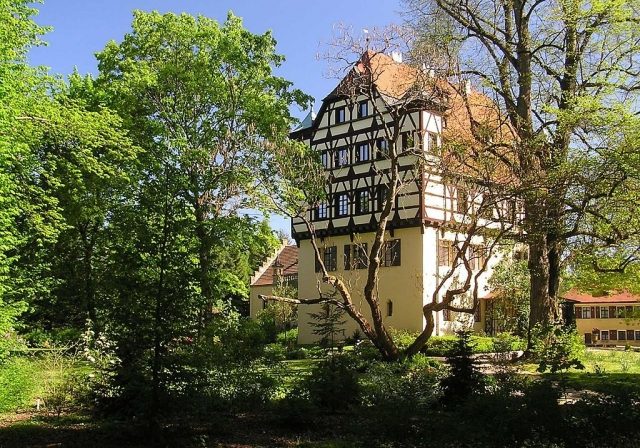
CastleSimmelsdorf

Tucher Castle

Tucher Castle

Foundation

The Tucher Castle in Simmelsdorf once ideally corresponded to a so-called moated house: The residential tower-like main building was located in the middle of a pond-moat system, which only had to make way for the landscape garden in the 19th century. The construction period is not handed down; Gustav Voit names Dietrich III von Wildenstein, who in 1350 donated an annuity from an estate in Simmelsdorf to Michelfeld Monastery for his anniversary and is no longer mentioned thereafter, as the builder, but this assumption cannot be substantiated. However, a first reference appears for 1352, when a Ulrich Neidung named himself after Simmelsdorf. In 1360, he and his brother Fritz were handed over to Emperor Charles IV by Heinrich XI von Wildenstein with Rothenberg Castle and are therefore attested as liegemen of the Crown of Bohemia for 1366/68. The Neidunge family, who named themselves after various castles depending on their place of service, can also be found among Nuremberg citizens and mining entrepreneurs in the region.

After 1368, the Türriegel von Riegelstein acquired the Simmelsdorf seat by unknown means, perhaps through marriage. After all, the Rothenberg castle keeper Dietrich Türriegel also owned other properties from the Neidunge's assets in 1379. In 1417, Heinrich IV Türriegel received the fiefs in Simmelsdorf from King Sigismund. In 1430, his brother Georg received permission from the king to secure his wife's dowry on his imperial fief of Simmelsdorf. Whether these reports refer to the seat is unclear, because from then on it appears as a Bohemian fief, for example when Werner Türriegel was enfeoffed in 1454 by King Ladislaus of Bohemia. At least the wooden constructions of the moated house, which rest on a plinth of limestone rubble, were fundamentally renewed between 1445 and 1455, as a dendrochronological analysis in 1990 showed. It could at least partly have been a repair of war damage, because according to the report of the Nuremberg war captain Erhart Schürstab, his mercenaries also burned down the village of Simmelsdorf in 1450. Whether the seat, protected by the moated system, was also affected is not known.

In 1500, an inheritance division took place among the brothers Heinrich, Hans, and Conz Türriegel. Significant debts soon forced Hans and Conz to sell their Simmelsdorf property. Sixt von Seckendorff acquired half of it from his brother-in-law Conz Türriegel in 1504. The sales document of March 15, 1504, for the first time describes a fortified complex with towers, Zwinger, moats, and gatehouses. In 1506, Seckendorff also took over the half of the tragically deceased Hans Türriegel, who is said to have been among the defenders of Kufstein Fortress in 1504, who were executed by sword on Emperor Maximilian's order after its capture.

Simmelsdorf Castle now remained with the Seckendorff family for decades: In 1517, Caspar, like his father Sixt, Margravial bailiff in Schönberg, followed, and around 1523, his brother Lorenz. His descendants Hans and Georg von Seckendorff left considerable debts, so that their widows, daughters of Conz III. Türriegel, had to sell both halves of the property to Werner II. Türriegel, administrator of the Palatinate office of Hartenstein, in 1570 and 1572. Again, debts forced Georg Michael Türriegel, who had received Simmelsdorf after an inheritance division, in 1594 to enter into purchase negotiations with the Tucher family. Only after lengthy, partly violent disputes with the Ganerbenherrschaft Rothenberg, which had even led to Türriegel's imprisonment and the temporary occupation of the castle, did the Nuremberg family succeed in 1598 in acquiring the Simmelsdorf manor for the Dr. Lorenz Tucher Foundation. The objection of the Electoral Palatinate, which claimed feudal lordship over Rothenberg, then further delayed the Tucher's possession. Only the recognition of Elector Friedrich IV of the Palatinate as sovereign and the obligation of the Tucher as Palatinate vassals cleared the way for the Tucher Foundation. In February 1607, the castle, which was by then in considerable need of renovation, was handed over to the foundation administrators. Under the direction of Endres VI. Tucher (1551–1630), the seat was repaired from spring 1607 onwards.

Although the Tucher Foundation continuously maintained the building throughout the centuries, the castle only lost its medieval appearance, which is preserved in an etching from around 1677 (not around 1650), presumably based on a drawing by Johann Keill (1642–1719), after 1830. First, the pond-moat system was drained and filled in, so that an English-style landscape garden could be laid out around the middle of the 19th century. For the garden's planning, the Tucher family brought in none other than Carl Eduard von Pezold (1815–1891). Pezold was the first student of Hermann Fürst von Pückler-Muskau, who had created two of the world's most magnificent landscape gardens in Bad Muskau and Branitz. Pezold took over the further development of Muskau Park as garden director at the time and was one of the most famous landscape architects in Europe dedicated to the English Garden. During this measure, the wooden bridge systems disappeared, which, partly covered, partly designed as drawbridges, provided access to the forecourt, which itself was on an island, and to the manor house.

Around 1845/48, the manor house was also altered. The renovation was allegedly carried out according to designs by the former Nuremberg city building inspector Leonhard Schmidtner (1799–1873), civil building inspector in Passau and Landshut since 1837/38, and resulted in the four distinctive corner turrets and a historicizing, octagonal stair tower on the northwest side. The timberwork for the corner turrets is said to have come from the Rothenberg fortress, which was abandoned from 1838; at that time, all easily usable building materials (roof tiles and gutters, roof and ceiling beams, etc.) were sold from there. The castle complex in Simmelsdorf still belongs to the Tucher Foundation today.

Take Mobile History with you

You are reading this text for free. Premium adds what matters on the road: descriptions read aloud, sites found through your camera, whole regions taken offline.

  • Every description, including the ~17,700 Premium sites
  • Audio guide: have descriptions read to you on location
  • AR finder: see sites through your camera, with distance and bearing
  • Unlimited saved sites

14 days free, then from €2.99 a month. Cancel anytime.

Source: Wikipedia · Licence: CC BY-SA 4.0 · Image: http://commons.wikimedia.org/wiki/File:Simmelsdorf_Tucherschloss1.jpg

This description draws on the facts documented in the linked Wikipedia article; Wikipedia content is licensed under CC BY-SA 4.0. Wording and editing: Mobile History.

Location: 49.5972, 11.3365