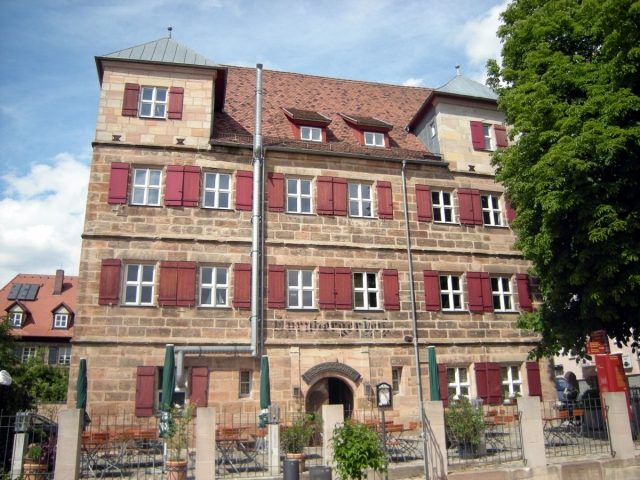
Residential and commercial building
Restaurant
Tucher Castle

The Tucherschloss, along with the Pfinzingschloss and the Zeidlerschloss, is one of three preserved castles in Feucht. The castle has been in private ownership since 1990 and was restored by the owner in the following years. In addition to a restaurant (Schlosswirt), the building houses apartments and offices.
In 2007/2008, the market town of Feucht renovated a nearby garden, the so-called Baroque Garden, according to a historical plan from 1757.
The so-called Tucherschloss in Feucht was only built in the late 16th century on peasant land. Herdegen IV. Tucher, born in 1533, married to Katharina Pfinzing and, together with his brother Paul, head of the Tucher trading company since 1568, acquired Jörg Seckler's Zeidelgütlein in Feucht in 1586. Only the modest small-scale farmhouse stood on the property, so the buyer erected a manor house. In view of the restrictive approval practice of the Nuremberg forest offices, which generally did not permit an expansion of the building mass to protect the forest, Herdegen Tucher justified the special size of the house with the allegedly damp building ground, which would not allow the ground floor to be inhabited. He undertook to build the enclosures exclusively solid and to always leave the ground floor unheated. After the building permit in autumn 1590, the manor house is likely to have been built in 1591/92.
The room structure handed down from the 17th and 18th centuries shows how little attention was paid to the conditions of the building permit of 1590. On the ground floor, not only storage and food vaults, but also a parlor and a lower kitchen were grouped around the house's threshing floor. The lord's living quarters, an upper kitchen, bedrooms, the writing room, and the living room were on the first floor. The most representative rooms were on the second floor, where primarily the hall, called the "large guest room," was furnished. The floors were accessed from the beginning via a stair tower, which provided access to the respective Soller (forecourt). Even the first attic was at least partially developed with maid's chambers in the 17th century.
Even before his death in 1614 at the age of 81, Herdegen Tucher, due to a lack of male descendants, founded a family foundation, usually called Vorschickung in Nuremberg. The eldest descendant of his brother Paul was to administer the foundation's assets. Only after the extinction of the Tucher family was the assets to fall to the Nuremberg Heilig-Geist-Spital. Until 1636, Anton IX. Tucher administered the manor house and in 1632 had to witness the devastation and looting of the manor house by imperial soldiers, during which the Voithaus also burned down. Then his brother Karl III. Tucher followed until 1646, briefly inherited by his cousin Anton X. The series of administrators was continued before 1648 by Thomas III. Tucher, in 1657 by Stephan, in 1689 by Georg Stephan the Elder, in 1732 by Johann Jakob Tucher, in 1746 by Georg Stephan the Younger, until 1777 by Carl Gottfried, until 1785 by Georg Friedrich and after a temporary guardianship by Jakob Gottlieb Friedrich Tucher.
During this time, the Tucher family usually only used the Feucht manor house for summer stays. On the ground floor, probably since the destruction of the Voithaus in the Thirty Years' War – contrary to the agreements of 1590 – the Voit lived. The Voit property had been rebuilt after the war, but had since been leased to a farmer. The appropriate setting for the lord's visits was provided by an artfully laid out "Lust-Gärtlein" (pleasure garden), which was redesigned as a Baroque garden in the course of the 18th century. It also contained a gardener's house and a summer house with a summer hall and a wintering room. These two buildings, which are extremely valuable from a garden-historical perspective, have been preserved in the immediate vicinity of the castle.
After the death of Jakob Gottlieb Friedrich Tucher in 1832, the heirs agreed to auction the estate to the highest bidder. Only after several attempts did the Feucht innkeeper Johann Pfann and the tenant of the farm, Georg Böhm, submit acceptable bids. After the purchase, the Tucher property was divided: while Böhm took over the agricultural estate, the castle fell to Johann Pfann, who successfully applied for the tavern license for the property in 1833, thus establishing the tradition of the Gasthaus Nürnberger Hof. During this time, the four characteristic corner turrets are also said to have been demolished. Under his son Georg Pfann, around 1840, the baroque garden was largely destroyed by the construction of a stable. Around 1845, the property was sold to the brewer Johann Paulus Rückert. After the early death of the brewer, decades of rapid changes of ownership followed: bankruptcies, auctions, and speculative purchases characterized this period. On these occasions, a large part of the associated plots of land was also lost. Only with the acquisition by the innkeeper Johann Heerdegen in 1909 did a longer tradition of ownership return. The Heerdegen family managed the Nürnberger Hof until the early 1980s. In 1990/91, the architect Fred Brunner acquired the now dilapidated manor house and, with great commitment, restored it in a manner appropriate to its historical monument status.
Take Mobile History with you
You are reading this text for free. Premium adds what matters on the road: descriptions read aloud, sites found through your camera, whole regions taken offline.
- Every description, including the ~17,700 Premium sites
- Audio guide: have descriptions read to you on location
- AR finder: see sites through your camera, with distance and bearing
- Unlimited saved sites
14 days free, then from €2.99 a month. Cancel anytime.
Source: Wikipedia · Licence: CC BY-SA 4.0 · Image: http://schloesserrundschau.de/bayern/schloesser01/nuernbergland003.html
This description draws on the facts documented in the linked Wikipedia article; Wikipedia content is licensed under CC BY-SA 4.0. Wording and editing: Mobile History.
Location: 49.3742, 11.2137