agricultural holding
Uckermannsches Castle (Bendeleben)

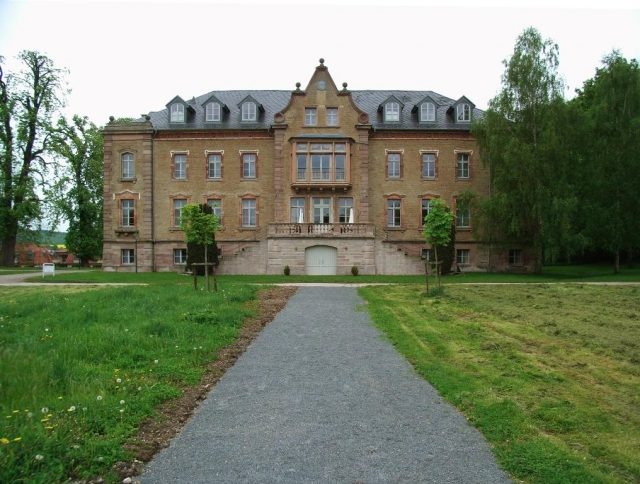
In 1763, Johann Jacob von Uckermann (the "Second") acquired the estate and castle. He had the dilapidated knight's seat demolished and a castle erected in its place, along with an inspector's house of identical construction – together forming a symmetrical complex. At the same time, residential and farm buildings, as well as other structures, were built in the Baroque style. In 1770, the pleasure garden was redesigned, and an orangery was built. The deer park was transformed into a large English-style castle park. In 1816, Bendeleben became part of the Principality of Schwarzburg-Sondershausen. In 1827, Major and scientist Johann Jacob Uckermann (the "Third") inherited the property, established an observatory in the castle tower, and in 1831, he abolished serfdom. In 1835, pastor and geographer Cannabich came to Bendeleben. In 1849, merchant Wilhelm Krause from Braunschweig acquired the knight's estate and castle. He was ennobled in 1852. In 1853, he successfully began lignite mining in the "Luisengrube"; the deposit was exhausted in 1878. In 1860/61, von Krause had the "New Castle" built. From 1865, the "art gardener" Heinemann promoted fruit and vegetable cultivation in the village. After his return from war and captivity in 1920, diplomat and estate owner Wilhelm Baron von Krause dedicated himself fully to his property in Bendeleben from 1920 onwards. Under him and his wife Franziska von Krause (née von Schmidthals, widowed Princess von Lieven), the castle was thoroughly redesigned and modernized, and a sports field and bathhouse were built in the park. The knight's estate became a model agricultural enterprise with influence on the region. The estate administrator from 1927 was Max Hansen, a successful animal and plant breeder. In the 1920s and early 1930s, Alexandra von Oelsen (from 1933 Alexandra von Arnim), Franziska von Krause's daughter, was also involved in plant breeding. The bred fodder varieties "Bendelebener" alfalfa (1935) and sainfoin as "Bendelebener D4" (1944) were officially recognized.
On April 11, 1945, Bendeleben was occupied by US troops. After their replacement by the Red Army in early July 1945, the von Krause family was dispossessed without compensation and had to leave the castle and village within 24 hours. Wilhelm von Krause was arrested, taken to Sondershausen prison along with other estate owners, and later released. The von Krauses went to Grainau in Upper Bavaria. Estate administrator Max Hansen was picked up and taken to the Soviet special camp Buchenwald, where he died in December 1945 and was buried in a mass grave. The castle with its valuable inventory was plundered. Among the paintings that disappeared was a historical depiction of King Jerome of Westphalia inspecting a maneuver of his troops in 1809 near Bendeleben. In the 1946 land reform, 300 hectares of land were distributed to land-poor farmers; the rest became a state-owned seed breeding farm. In 1951, a seed breeding station was built. In the early 1950s, the LPG "Friedrich Engels" was founded. In 1970, the castle was converted into an old people's and nursing home. Many buildings fell into disrepair during the GDR era. Parts of the wall around the castle park were used as a quarry for road construction.
In 1990, the LPG transformed into a cooperative (e.G.). In 1991, the VEG and the seed breeding station were liquidated. In the same year, the estate, with 360 hectares of arable land, was leased by Alexandra Countess von Arnim (Wilhelm von Krause's adopted daughter) and her son Professor Dr. Thomas Count von Arnim. Both dedicated themselves greatly to restoring the Baroque estate complex of Bendeleben. Alexandra passed away in 1999 in Bavaria. In 1999, with financial participation from the German Foundation for Monument Protection, the restoration of the orangery (completed in 2010) and the former pleasure garden began. Overall, the "Baroque village of Bendeleben" shows how many initiatives from citizens, the municipality, various institutions, and not least the couple Thomas and Sabine von Arnim have become effective there. The agricultural cooperative is now part of Landgut GmbH Bendeleben/Badra.
Castle Park
Baron Johann Jacob von Uckermann and his wife Christiane began creating an English landscape park from 1765. The 21-hectare park contains valuable trees and shrubs – including a mighty 300-year-old copper beech – seven fish ponds, and a Roman bath. The park is surrounded by a historic sandstone wall.
Take Mobile History with you
You are reading this text for free. Premium adds what matters on the road: descriptions read aloud, sites found through your camera, whole regions taken offline.
- Every description, including the ~17,700 Premium sites
- Audio guide: have descriptions read to you on location
- AR finder: see sites through your camera, with distance and bearing
- Unlimited saved sites
14 days free, then from €2.99 a month. Cancel anytime.
Source: Wikipedia · Licence: CC BY-SA 4.0
This description draws on the facts documented in the linked Wikipedia article; Wikipedia content is licensed under CC BY-SA 4.0. Wording and editing: Mobile History.
Location: 51.3705, 11.0026