Local Authorities
CastleSiegen
Unteres Castle (Siegen)
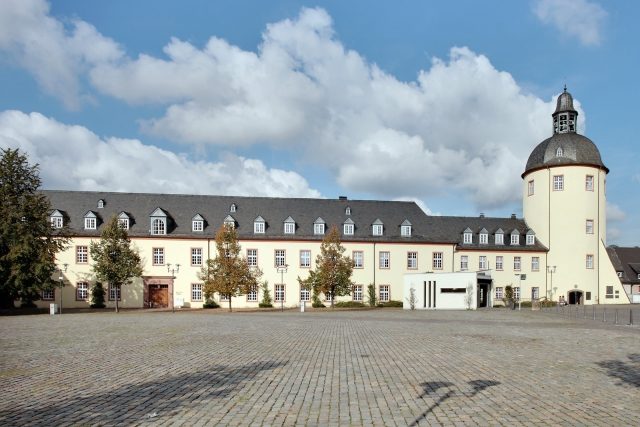
The Lower Castle in Siegen, a former residence of the Protestant line of the House of Nassau-Siegen, is in the city center of Siegen. Originally a Franciscan monastery, it transformed into a seat of power in the 17th century and now serves as a state administrative building.
History+
The origins of the Lower Castle date back to 1489, when a Franciscan monastery was built on this site. After the Reformation and the dissolution of the monastery, the building temporarily housed the Hohe Schule from Herborn starting in 1534. When the House of Nassau-Siegen split into a Catholic and a Protestant line after 1623, the complex became the residence of the Protestant line and was named Nassauischer Hof. Under Johann Moritz von Nassau-Siegen, a former Governor-General of Dutch Brazil, negotiations began for the expansion of the building. Around 1668, the Dutch master builder Maurits Post created the princely crypt, and a gallery wing was built, parts of which can still be found in the north wing today. Construction continued under subsequent princes; a gatehouse was erected in 1690, its portal later moved to the Upper Castle. A large part of the complex fell victim to a city fire in 1695; only the gate and the princely crypt remained. Between 1698 and 1711, Peter Remboldt rebuilt the complex, constructing the north wing ("Kurländerflügel") and other outbuildings. A new central wing ("Corps de Logis") integrated the princely crypt, whose facade is characterized by an arcade with 21 pillars. In 1884, the princely crypt was visually highlighted by the addition of a central risalit.
Source: Wikipedia · Licence: CC BY-SA 4.0
This description draws on the facts documented in the linked Wikipedia article; Wikipedia content is licensed under CC BY-SA 4.0. Wording and editing: Mobile History.
Location: 50.8739, 8.0214