The remains of the roman Villa can be visited
Ancient BuildingBiberach an der Riß
Burrenwald Roman Villa Rustica
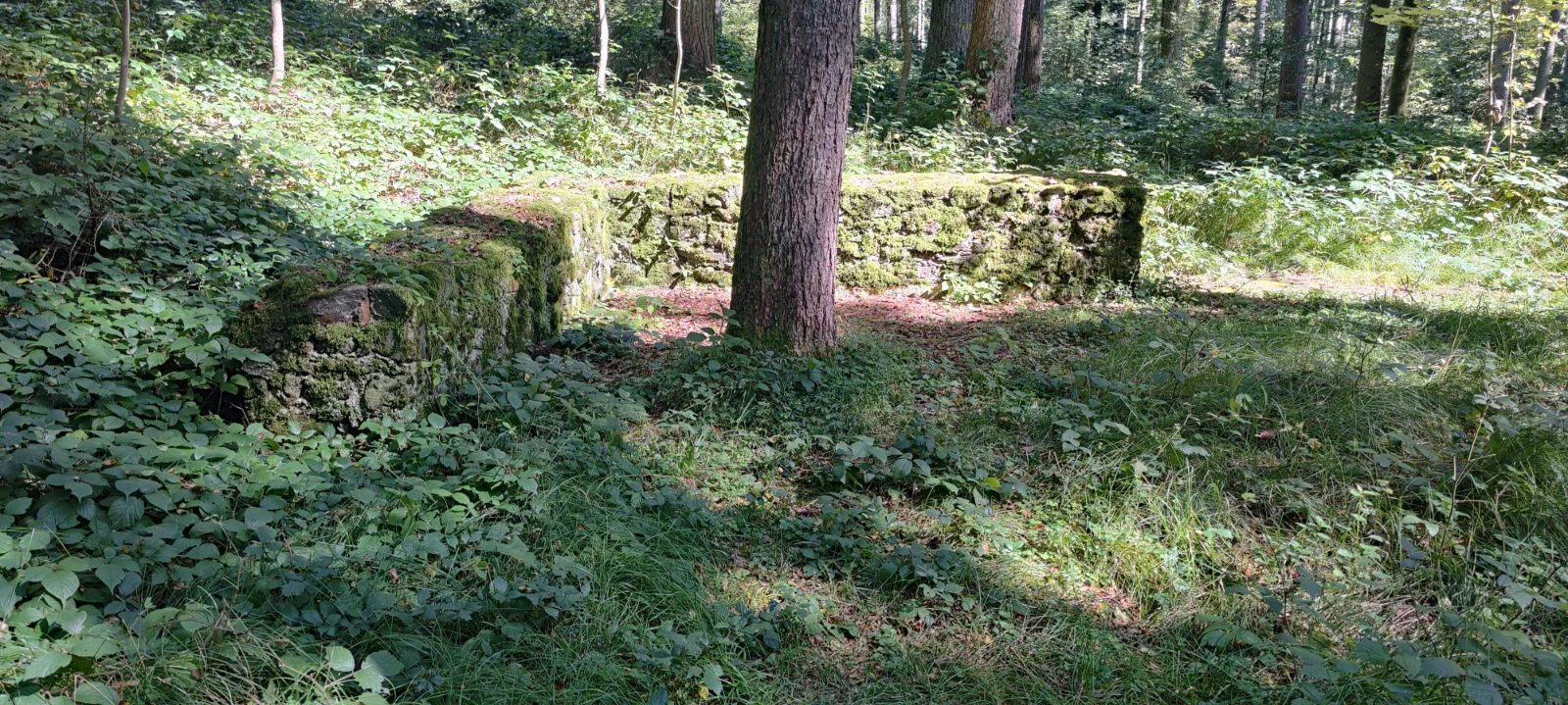
The Villa rustica in Burrenwald is a former Roman estate located two and a half kilometers north of the town exit of Biberach an der Riß near federal highway 312 between Biberach and Riedlingen in Burrenwald near the forest playground.
Location+
The agricultural property is situated on a terraced, leveled area called Burrenwald on a gently sloping southeast hillside of a mixed forest with deciduous tree stands.
Research History+
The site was discovered in 1921 by the Biberach dentist Karl Heinrich Forschner based on an entry in the 1837 description of the Oberamt Biberach by Johann Daniel Georg von Memminger. Forschner carried out several smaller soundings in the main building and the bathhouse located to the southeast until 1950. From 1976 to 1978, larger parts of the manor house were excavated with funds from the State Office for Monument Preservation Baden-Württemberg and the city of Biberach.
Estate+
At first glance, one can recognize the two reconstructed northern fieldstone walls of the rear facade of the main building. The front side of the complex faces downhill to the southeast and measured 30.60 meters in length and 22 meters in width. Two presumably two-story corner projections with living quarters were connected by a single-story columned hall open to the front. The northern larger corner projection, seven meters in length and width, had a hypocaust heating system, while the southern smaller square living room, 5.40 m in length, had a cellar with a floor height of two meters. A total of 3800 recovered wall plaster fragments prove that the living quarters featured colored frescoes. Connected to the front part was a rear open courtyard enclosed by a wall with a sloping lean-to roof. The courtyard complex is constructed in a combination of masonry and timber framing. The estate was built around the middle of the 2nd century AD and served to supply troops of the Roman army on the Upper Germanic-Rhaetian Limes. The complex was abandoned in the second third of the 3rd century. Today's Upper Swabia, until then essentially located in the Roman province of Raetia, was gradually resettled by the Alamanni, and the imperial border was withdrawn to the Danube-Iller-Rhine line due to general population pressure from Germania magna.
Finds and Monument Protection+
The finds from the site can be viewed in the municipal Braith-Mali-Museum in Biberach. Further finds are located in the Landesmuseum Württemberg in the Old Palace Stuttgart. The archaeological monument is protected as a registered cultural monument within the meaning of the Monument Protection Act of the State of Baden-Württemberg (DSchG). Research and targeted collection of finds require permission; accidental finds must be reported to the monument authorities.
Take Mobile History with you
You are reading this text for free. Premium adds what matters on the road: descriptions read aloud, sites found through your camera, whole regions taken offline.
- Every description, including the ~17,700 Premium sites
- Audio guide: have descriptions read to you on location
- AR finder: see sites through your camera, with distance and bearing
- Unlimited saved sites
14 days free, then from €2.99 a month. Cancel anytime.
Source: Wikipedia · Licence: CC BY-SA 4.0 · Image: Von Toz25 - Eigenes Werk, CC BY-SA 4.0, https://commons.wikimedia.org/w/index.php?curid=175213002
This description is a machine translation of an excerpt from the linked Wikipedia article. The source text was written by its authors, the translation is by Mobile History; like the original it is licensed under CC BY-SA 4.0.
Location: 48.1195, 9.7413