To be privately owned
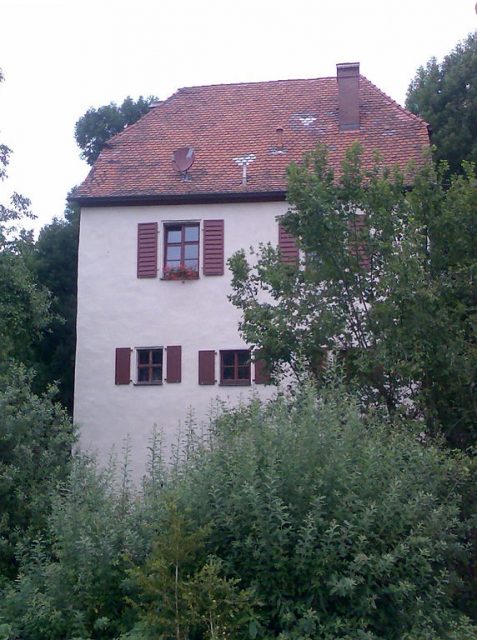
Front Manor Diepoltsdorf

It is not known since when two manor houses stood on what is now the Loefen seat; only one was mentioned in the enfeoffment of 1398, and again in 1549. The damage lists of the Second Margrave War also only mention "the lord's seat", which was burned down in May 1553. Whether this refers to the "old" or the "front" dwelling must remain open. The latter residential tower, according to an inscription found on the building, was built or restored relatively early after the end of the war, in 1555.
After Christoph Groland's death in 1561, his younger brother Sebastian took over the estate. With his demise in 1582, daughter Clara and son-in-law Georg Coburger inherited the front seat. Their daughter Maria brought the front house to the Nuremberg patrician Christoph Gottfried Gugel in 1627 through her marriage. In 1660, he also acquired the rear manor house and reunited the estate under one owner. The now 81-year-old owner reported in 1674 that the front house also suffered considerable damage during the Thirty Years' War.
The Gugel family remained in possession for almost two and a half centuries after Christoph Gottfried. The family's Diepoltsdorf properties also included a hammer mill, a mirror glass grinding shop, and a mill. The last of the Diepoltsdorf line, Joseph Maria Ludwig Christoph (1764–1843), sold the estate in 1816 to his nephew Franz Wilhelm Christoph von Gugel (1771–1848); the alliance coat of arms Gugel/Muffel above the entrance commemorates him and his second wife Adelheid. After an inheritance agreement among his daughters, the property passed in 1872 to daughter Luise and her husband, Wilhelm Johann von Loefen, who came from an old Upper Palatinate hammer lord family. The von Loefen family still owns the manor today.
The front seat is located in the southeastern area of what was probably an artificially raised castle site. It is a three-story residential tower with a half-hipped roof and plastered facades. A renovation in the years after 1648 can be assumed given the thorough demolition of the fixed furnishings during the Thirty Years' War. Major alterations followed around 1775, 1820, and finally 1953/54.
Take Mobile History with you
You are reading this text for free. Premium adds what matters on the road: descriptions read aloud, sites found through your camera, whole regions taken offline.
- Every description, including the ~17,700 Premium sites
- Audio guide: have descriptions read to you on location
- AR finder: see sites through your camera, with distance and bearing
- Unlimited saved sites
14 days free, then from €2.99 a month. Cancel anytime.
Source: Wikipedia · Licence: CC BY-SA 4.0 · Image: http://commons.wikimedia.org/wiki/File:Vordere_Behausung_Diepoltsdorf.jpg
This description draws on the facts documented in the linked Wikipedia article; Wikipedia content is licensed under CC BY-SA 4.0. Wording and editing: Mobile History.
Location: 49.6082, 11.3556