The church can be visited
Maria von der Tann Church

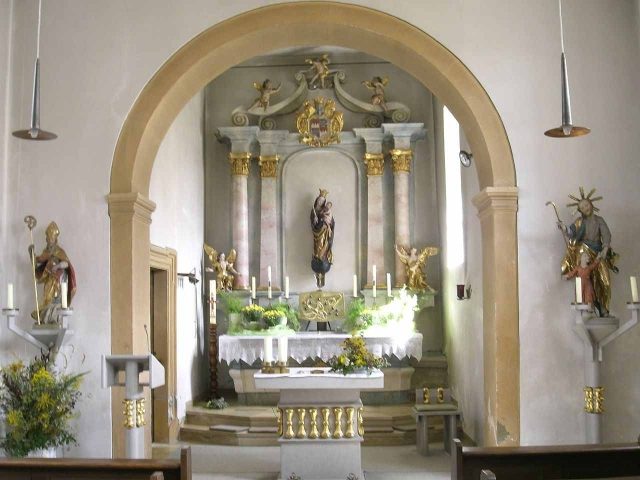
The pilgrimage church of Maria von der Tann in Rüschenhausen is today a filial church of the Greßthal parish. Its origins are shrouded in history. The historically highly interesting building receives special attention due to the miraculous image attributed to the early environment of Tilman Riemenschneider. Already in the 14th century, the first pilgrimages from the Franconian land came here. Today, the former pilgrimage church celebrates its patron saint on the Feast of the Nativity of Mary (September 8).
Pilgrimage+
The written sources that speak of the pilgrimage to Maria von der Tann are sparse. According to old reports, smaller pilgrimages to a "Marian image in the fir trees" began in the 13th century. However, it is unclear whether this was an apparition of the Mother of God in the fir thicket, or a miraculous image that had its place in a green fir forest. Pious pilgrims from wide parts of the Franconian land came here during this time. It was a time of Christian reorientation. Numerous pilgrimage sites formed in the 13th century as a response to "Franconian Marian piety". In the middle of the 15th century, this pilgrimage had largely fallen into oblivion. Archpriest Eberhard von Grumbach revived the venerable place of grace after taking office in 1443. On all Marian feasts, the localities of his territory (Brebersdorf, Greßthal, Kaisten, Schwemmelsbach and Wasserlosen) now gathered for divine service. At times, the villages of Burghausen and Wülfershausen also came here on these days.
Prince-Bishop Julius Echter von Mespelbrunn and Archpriest Erhard von Lichtenstein were informed in 1587 that the "Christian faithful in Reichtal" had all fallen to Lutheran doctrine. After several counter-reformation measures, the pilgrimage church now gained a completely new significance. The parish vicar Andreas Bastmann, residing in Greßthal, was instructed by the Prince-Bishop to preach the Catholic doctrine from here again and to re-Catholicize the surrounding places. This was successful. On St. Martin's Day 1614, Prince-Bishop Echter and Archpriest von Lichtenstein celebrated the successful Counter-Reformation in Reichtal with the altar consecration in the parish church of Greßthal.
The last pilgrimages to Maria von der Tann ended with the secularization. In the subsequent period, religious life largely lay fallow, and during the reorganization of the Greßthal parish in 1808, the Marian chapel unfortunately received no further attention. Since then, it has had the status of a filial church.
Building History+
The oldest existing masonry parts of the chapel date back to the middle of the 13th century. During this time, the inhabitants of the then very small clustered village erected a first church on this site. According to an old legend, a rich man is said to have given various building materials and money for the construction of the chapel. When all the stones were at the construction site, however, construction could not begin, as the next day all the stones were no longer there. A farmer then found them at another place in the village. With great effort, the stones were brought back. But the next morning they were again at the other place. This went on for three days. Then the decision was made that it must be the wish of the Mother of God to build the chapel there. Only heavenly hosts - so it was believed - would ultimately be able to remove the quantities of stone overnight. Less legendary was the time of the already mentioned Archpriest Eberhard von Grumbach. He did everything to make his territory as self-sufficient as possible. This included, in addition to economic facilities (such as grain mills), also its own pilgrimage site. Between 1483 and 1485, a comprehensive renovation of the chapel took place. In remembrance of old traditions, he revived the pilgrimage to Maria von der Tann. Parts of the present tower may date back to this time. Grumbach had the present miraculous image made in Würzburg. Presumably in the closer vicinity of the then still young Tilman Riemenschneider.
In 1593, the construction phase began that still most strongly characterizes the church today. The typical Echter tower was erected. The nave was raised and extended. In 1598, the construction measures were completed. Late Gothic fish bladders now adorned the skylights of the chapel. The stone pulpit (1593) still bears witness to that time in the interior. The completion of the renovation was celebrated in 1609 after a painter from Gerolzhofen redesigned the altars.
Under parish vicar Valentin Klee, who apparently showed great interest in the pilgrimage, there was a redesign of the interior in 1659. An extension of the chapel took place in 1712 towards the west. However, Archpriest Ignaz Theobald Hartmann von Reinach, with his new liturgy, opposed the pilgrimage cult to Maria von der Tann. Only on September 8, the Feast of the Nativity of Mary, did he tolerate a pilgrimage to Rüschenhausen. His nephew and successor in office, Archpriest Wilhelm Jakob von Reinach, on the other hand, promoted the pilgrimage again.
The liturgical reorientation of the altar area was completed with the altar consecration by Auxiliary Bishop Alfons Kempf in 1987. Since 1996, a new organ has provided a musically dignified liturgy with its sounds.
Text on the plaque above the church entrance door
Dear Franconian land, you are blessed
Julius, a prince of peace, is given to you
Who guides you from error to the path
Of true faith
Adorns you with beautiful churches
As he then restored this one
The excellent prince has done much
If one only truly recognizes it
1615
Julius Echter Coat of Arms
The three metal rings on the coat of arms come from the coat of arms of the noble Echter family. The red and white quartered flag on the lance pole corresponds to the Würzburg coat of arms.
Take Mobile History with you
You are reading this text for free. Premium adds what matters on the road: descriptions read aloud, sites found through your camera, whole regions taken offline.
- Every description, including the ~17,700 Premium sites
- Audio guide: have descriptions read to you on location
- AR finder: see sites through your camera, with distance and bearing
- Unlimited saved sites
14 days free, then from €2.99 a month. Cancel anytime.
Source: Wikipedia · Licence: CC BY-SA 4.0
This description draws on the facts documented in the linked Wikipedia article; Wikipedia content is licensed under CC BY-SA 4.0. Wording and editing: Mobile History.
Location: 50.0607, 10.0557