Museum
Kapellendorf Castle
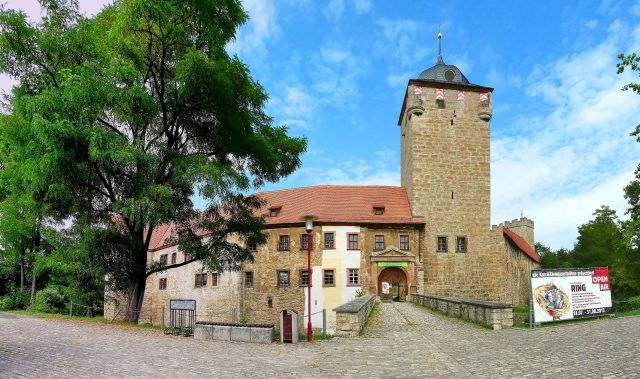
Kapellendorf moated castle is located in a valley basin of the Sulzbach in the middle of the municipality of Kapellendorf, which lies in the center of the city triangle of Jena - Weimar - Apolda. The moated castle is one of the largest and best-preserved castles in Thuringia. It was founded in the 12th century and is currently used as a museum and event venue. Kapellendorf moated castle is an outpost of the Erfurt City Museum.
Prehistoric and Early Historic Settlement and the Archaeological Investigations of 1933+
Archaeological investigations, which began in 1932 with excavation work using the Reich Labor Service on the castle grounds and were led from 1933 under the scientific supervision of Prof. Dr. Gotthard Neumann and Erwin Schirmer (both Germanisches Museum of the University of Jena), revealed that the area in the lowlands of the Sulzbach northwest of the present-day village of Kapellendorf was already settled in the early Bronze Age. Pottery of the Aunjetitz culture was found in the outer bailey area. The majority of the finds and findings, however, date from the Middle Ages; in total, almost 1,000 kilograms of medieval ceramic, glass, metal, and bone finds were recovered during the earthworks on the entire site.
The Village of Kapellendorf in the Early Middle Ages+
The village of Capelladorf is already mentioned in 833 in the donation deeds of Fulda Monastery. The donor was a Count Asis – not a Count Hessi in 875, as is still often incorrectly claimed – an extraordinarily powerful man in Thuringia, who held a county granted by the king and could freely dispose of extensive private property, as in Kapellendorf. According to the Fulda necrology, in which his name is prominently entered, Asis died in 837. From historical tradition, it can be concluded that a church existed in Kapellendorf, which may have already been founded by the ancestors of Count Asis and his brothers, but not that this family itself was resident in the village – as older research always assumed. In addition to extensive possessions in the Weimar and Erfurt area, the family also owned estates in Southern Thuringia and Franconia, in the area around Hildburghausen and Gotha.
An early and mostly still postulated, and in 1961 even reconstructed as a model, wooden motte-and-bailey castle from the 8th to 10th century as a predecessor complex is a scholarly invention, intended to establish continuity with the early mention. Findings and finds that would allow conclusions about an early motte-and-bailey castle are not available. Only a few surface finds from the 11th century from an area near the church in the village indicate the existence of an unfortified settlement at this location.
The Founding of the Castle under the Burgraves of Kirchberg in the 12th Century+
The next mention of Kapellendorf dates only from 1182. A Theoderico de Capellendorph was involved in a transfer of property to the Cistercian monastery of Altzelle, which was confirmed by Landgrave Ludwig III of Thuringia. He belonged to a noble free family who served the Empire as burgraves of Kirchberg near Jena and first appeared in sources in 1149 under the name de Kyrberch. A long-assumed connection between this family and Count Asis, mentioned in the 9th century, is highly unlikely. According to Wolfgang Hartmann's research, the noble free lords of Kirchberg and Kapellendorf could have been members of the Reginbodonen noble family.
During the excavations in 1933, large parts of the first stone fortification from the second half of the 12th century were explored. It is an almost circular castle complex with a diameter of 32 meters, surrounded by a 1.80 meter thick ring wall and a moat. In the northeast of the complex, the remains of the Romanesque residential building, which was directly attached to the ring wall, have been preserved. In the center of the castle, the lower part of a freestanding keep, which was demolished by the end of the 18th century, with an outer diameter of ten meters, was uncovered. The use of bossed ashlar, which is relatively rare in the Thuringian-Saxon region, is striking. The keep was probably built in the late 12th or early 13th century, probably only after the construction of the ring wall and the peripheral buildings, or even with a certain time lag. The dating "probably not before 1120 and not later than 1180-1200", which has mostly been given so far, is not compelling and seems too early. The water supply was ensured by a castle well, investigated to a depth of 10.80 meters, and a cistern. The four-meter-deep filter cistern presumably collected rainwater flowing down from the palace roof.
The Castle in the Possession of the City of Erfurt and its Expansion in the 14th Century+
The decline of the Burgraves of Kirchberg began as early as the beginning of the 14th century with the destruction of the three castles on the Hausberg near Jena (1304). On July 13, 1348, Burgrave Hartmann von Kirchberg even had to sell the ancestral seat of Kapellendorf to an intermediary of the city of Erfurt due to financial difficulties. In 1350, the city acquired several villages in the surrounding area, and two years later also the judicial lordship, and subsequently had a part of the Kapellendorf lordship granted to it by King Charles IV as an imperial fief. This led to the establishment of an administrative seat and a significant expansion of the castle complex. The building stock from this expansion phase in the second half of the 14th century has largely been preserved to this day. This includes the five-story residential tower, the so-called Kemenate, and the kitchen building with a large fireplace ("Ochsenbratküche") in the center of the castle complex.
The castle was significantly expanded by the construction of an approximately pentagonal outer bailey, now covering an area of 2.25 hectares. It is surrounded by a moat up to 30 meters wide, which originally had a rampart in front of it, so that the total diameter of the castle complex was about 180 meters. On the north side, this outer fortification is still well preserved today; in the east and southeast, only smaller remains indicate its former course. On the main attack sides in the south and east, two high and closed flanking towers with loop-holes were erected on the new ring wall, while the other three corners were only occupied by shell towers. The original access to the outer bailey was in the south; the Gothic portal is still clearly visible in the masonry today. Several residential and commercial buildings are attached to the new ring wall, but their form mostly dates from more recent times. The city of Erfurt stored large quantities of weapons, armor, war material, and food in the castle, which are listed in detail in an inventory from 1392.
The Castle under the "Robber Knights" of Vitzthum+
In 1446, the people of Erfurt entrusted the protection of their merchants in the vicinity of Kapellendorf to the knight Apel Vitzthum von Roßla and handed over the castle and office to him for repurchase for 21 years. However, they had "put the fox in charge of the henhouse," because together with his brothers Busso and Bernhard, Apel Vitzthum, who had fallen out of favor at the Saxon court, turned against Landgrave Wilhelm III of Thuringia and repeatedly attacked merchants from Erfurt and elsewhere. When in October 1451 an embassy of the Burgundian Duke was on its way for a planned marriage alliance with the Saxon Elector Frederick II the Gentle, it was ambushed by the Vitzthum brothers, plundered, and taken captive to Kapellendorf. The Saxon Dukes then, together with the cities of Erfurt, Sangerhausen, Mühlhausen, and Nordhausen, and surrounding nobles, undertook the conquest of the Vitzthum castles Wachsenburg, Kapellendorf, Gleisberg (Kunitzburg), Dornburg, Leuchtenburg, Isserstedt, Camburg, and others. Around December 30, 1451, the sloz Cappilndorf, in which some of the Burgundian councilors were held captive, was surrendered after an eight-week siege due to lack of food and ammunition, and the defenders were granted free withdrawal.
The Moated Castle in the Early Modern Period+
In exchange for the Wachsenburg, Kapellendorf returned to the possession of the city of Erfurt in 1452. Due to pressing financial difficulties, the city council of Kapellendorf had to pledge it to Elector Frederick the Wise and Duke John of Saxony in 1508, which led to an uprising – the so-called "Mad Year" of the Erfurt citizens against their council. In the second half of the 16th century, the gate was relocated to the tower in the southwest, and a stone bridge was built over the moat. In the following centuries, the castle experienced several partial destructions by fires, such as in 1599, or storms in 1613, but also phases of renewed construction, such as after the establishment of a judicial and revenue office in 1684. The bossed ashlar tower, which is still preserved at a considerable height in a pen-and-ink drawing from 1657, was demolished down to its stump in the second half of the 17th century and in the 18th century, and the stones, along with other demolition material, were taken to Weimar to be used there. In October 1806, Prince Hohenlohe-Ingelfingen established his headquarters in Kapellendorf Castle as commander-in-chief of a part of the Prussian army in the Battle of Jena and Auerstedt against Napoleon's troops. From 1866 to 1879, the University of Jena housed its "lunatic asylum" in the castle. Afterwards, the village school moved in.
The Castle in the 20th Century and Today+
The Grand Dukes of Saxe-Weimar-Eisenach remained in possession of Kapellendorf until 1918. In 1922, the castle was sold by the Thuringian State Government to a private individual, and in 1929, after more than 400 years, it came into the possession of an Erfurt citizen. In 1930, the "Burggemeinde Kapellendorf" (Castle Community of Kapellendorf), founded by the Association for the History and Antiquity of Erfurt, became the owner of the castle and began in 1932 with the excavation and securing of the complex for tourist use. In 1933, the Burggemeinde facilitated the purchase of the castle by the city of Erfurt and contributed significantly to the renovation of the attractive complex.
From 1943, the documents of the Erfurt City Archives and holdings of the Scientific General Library Erfurt were relocated to the moated castle for protection against increasing air raids.
Expansion and restorations were promoted in the GDR by the "Arbeitskreis Wasserburg Kapellendorf" (Working Group Kapellendorf Moated Castle). In 1975, an exhibition on the castle and city in the Middle Ages was opened in the "Kemenate" of Kapellendorf moated castle. Since 1998, the castle has been owned by the Foundation of Thuringian Palaces and Gardens and houses a museum, which is operated by the city of Erfurt and shows changing exhibitions. The castle also serves as a venue for various festivals, theater performances, and children's projects.
Take Mobile History with you
You are reading this text for free. Premium adds what matters on the road: descriptions read aloud, sites found through your camera, whole regions taken offline.
- Every description, including the ~17,700 Premium sites
- Audio guide: have descriptions read to you on location
- AR finder: see sites through your camera, with distance and bearing
- Unlimited saved sites
14 days free, then from €2.99 a month. Cancel anytime.
Source: Wikipedia · Licence: CC BY-SA 4.0 · Image: Thomas Eichler
This description draws on the facts documented in the linked Wikipedia article; Wikipedia content is licensed under CC BY-SA 4.0. Wording and editing: Mobile History.
Location: 50.9753, 11.4667