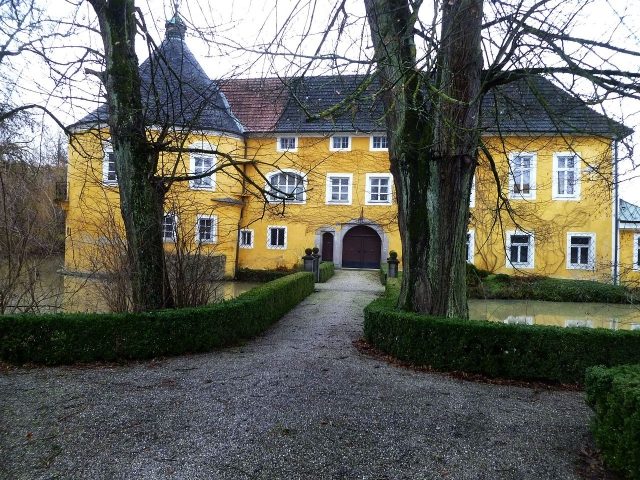
CastleGallspach

Gallspach Castle

Gallspach Castle

To be privately owned

Gallspach Water Castle is located in the Upper Austrian municipality of Gallspach in the district of Grieskirchen (Valentin-Zeileis-Straße 33).

The noble seat is first mentioned in a document in 1120 (1111). Gallspach is named after the noble family of Gallspacher; the Gallspacher (Gailispacher) were vassals of the Schaunberger. As early as around 1100, a Sigiboto Gailispach is attested in a document of the St. Nikola monastery, and around 1120, Reginhart Gallispach is also mentioned in a document from St. Nikola. A Heinrich von Gallspach is mentioned around 1250, and Hans Gailispegh is mentioned as a Schaunberger liegeman between 1376 and 1378. The Gallspacher then resided at Haitzing Castle. In 1343, both a house and a fortress of Gallspach are mentioned.

From 1343–1354, Eberhard von Wallsee V was the owner of Gallspach. In 1354, he sold the castle to Heinrich Geumann (Geymann, Gewman), but reserved the feudal rights. Thus, in 1461, Stephan II von Geumann († 1473) and his brother Bartholomäus were granted the lordship of Gallspach. In 1479, Reinprecht von Wallsee granted Gallspach to Christoph II von Geumann with the castle and church benefice.

“Anno 1566 died the noble and honorable Hanns Hainrich Geymann zu Gallspach und Trätneck. Royal Imperial Majesty's Councillor and rests here with his three virtuous wives. Kye the first Magtalena a Hehenfelderin, the second Salome a Kölnpöckin, the third Brigitta a Wallomitzin, may God be merciful to them, Amen.”

– Inscription on the tombstone of Hanns Hainrich Geumann from 1566 at the Gallspach parish church

After the extinction of the Wallsee family, Gallspach was granted directly by the sovereign. Under the reign of Emperor Frederick III, Hans, Tristram, and Balthasar Geymann were enfeoffed with Gallspach in 1492. Emperor Maximilian I granted the castle and lordship of Gallspach again to Hans Geymann, administrator of Lankowitz, for himself and his two cousins Balthasar and Tristram in 1496. In 1502, the two cousins divided their inheritance, Balthasar received Gallspach including the market, and Tristram Tratteneck. The Geumann family remained in possession of Gallspach until the Counter-Reformation. As they were Protestants, they had to emigrate, and Gallspach was sold to Christoph Weiß von Würthing in 1633. In 1638, the guardians of Christoph Ludwig Weiß sold Gallspach to Tobias Prodvischer von Waldberg († 1670); Prodvischer freed Gallspach from the princely feudal lordship by a payment of 211 fl. His widow Johanna, Lady of Hofeck (Hofegg) and Pernau Castle, bequeathed Gallspach to her brother Veit Spindler in 1685.

Several sales characterized the ownership in the following years. Baron Dr. Augustin von Erhardt was the owner from 1688–1695, followed by his daughter Maria Theresia von Erhardt, married to Count Ehrgott von Kueffstein, from 1695-1706. From this family, Ehrgott von Kueffstein was the owner from 1706–1708, followed by Liebgott von Kueffstein from 1708-1709. In 1709, Gallspach came to the Hohenecker family, with Johann Georg Adam von Hoheneck incorporating it into a fideicommiss (which also included Schlüßlberg Castle and Tratteneck Castle). The last Hohenecker was Johann Georg Achaz Graf Hohenegg († 1796). The fideicommiss was then dissolved, and Gallspach went to the Imsland family from 1796–1871 (Maria Anna Freiin von Imsland was a born Hohenegg). Further owners were Maria von Spieß from 1871–1880, Franz Brodböck from 1880–1901, Georg and Elise Schiernerl from 1901–1908, and Hugo Seyrl from 1908–1912. Through these sales, the estate was gradually reduced.

From 1912 until now, Gallspach Castle has been owned by the Zeileis family. Dr. Valentin Zeileis († 1939) founded his radiation physics institute here in 1920.

Gallspach Castle today+

The current building was erected between the 16th and 18th centuries. During the Peasants' Wars, the castle suffered fire damage. It is a two-story, four-winged complex, accessible via a gatehouse. It generally resembles a Vierkanthof (a type of quadrangular farmstead). Of the former castle, a round tower projecting from the masonry and arcades on two sides of the inner courtyard are still preserved. The main entrance, a gate with a wicket, faces the village square. The path leads over a bridge to the entrance. The rear courtyard housed the former brewery, with a bridge connecting the castle to the brewery buildings. The castle is surrounded by a pond-like moat and another pond.

On an adjacent property, the Zeileis Curative Institute was built according to designs by Heinrich Schmid and Hermann Aichinger. In the garden, two bronze statues (one rolling a rock and one emptying a water jug) created by the Viennese sculptor Josef Riedl in 1930 were erected in 1975 in honor of the institute's founder.

The water castle is privately owned by the Zeileis family and can only be viewed from the outside.

Take Mobile History with you

You are reading this text for free. Premium adds what matters on the road: descriptions read aloud, sites found through your camera, whole regions taken offline.

  • Every description, including the ~17,700 Premium sites
  • Audio guide: have descriptions read to you on location
  • AR finder: see sites through your camera, with distance and bearing
  • Unlimited saved sites

14 days free, then from €2.99 a month. Cancel anytime.

Source: Wikipedia · Licence: CC BY-SA 4.0 · Image: http://commons.wikimedia.org/wiki/File:Schloss-Gallspach.jpg

This description draws on the facts documented in the linked Wikipedia article; Wikipedia content is licensed under CC BY-SA 4.0. Wording and editing: Mobile History.

Location: 48.2065, 13.8127