Apartments
To be privately owned
Weiße Castle (Friesheim)

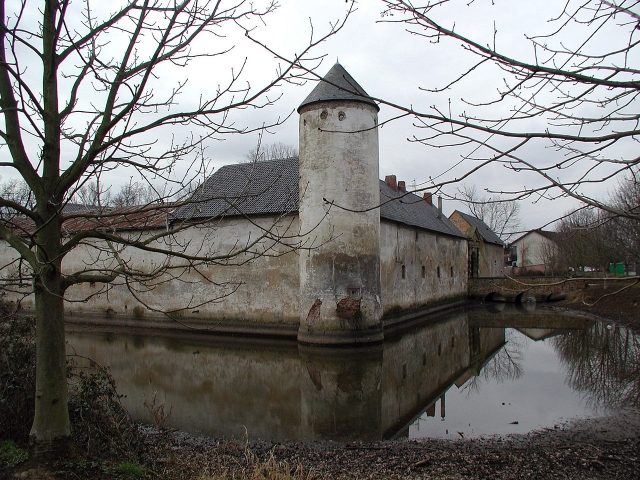
The Weiße Burg (White Castle) is a moated castle and former knight's seat in the Friesheim district of Erftstadt, in the Rhein-Erft-Kreis, North Rhine-Westphalia. The manor house was destroyed in World War II, but parts of the outer bailey are still preserved.
Fronhof of the Cologne Cathedral Chapter
The lowland castle was probably the successor to a Fronhof (manorial farm) mentioned in documents as early as the 11th century, which in the 9th century was owned by Count Emundus of Friesheim. Count Emundus, who was buried in Cologne Cathedral, donated his property "Friesheim" around 830 to the patron of the Cologne Cathedral Church, Saint Peter, whose earthly administrator of goods was the Archbishop of Cologne. In the "property transfer" carried out by Archbishop Gunthar in 866, the Friesheim villication fell to the Cathedral Chapter.
Schlendersburg
The castle was first mentioned in a document in 1399, when the Cologne Cathedral Provost Heinrich von Berg (de Monte) enfeoffed the vassal Winrich von Schlenderhan with it.
After the sale of the castle by the descendants of Winrich von Schlenderhan to Johann von Munster in 1539, the latter had a new manor house built in 1540, which had to be an open house of the Cathedral Chapter. From 1554, the von Hoemen-Odenkirchen family owned it, then from 1568 the von Harff family, from whom it passed to the von Efferen zu Stolberg family in 1592.
Quentelsburg
From them, the castle came to Ferdinand von Frenz in 1661, whose descendants sold the free noble seat in Friesheim in 1681 to the Cologne Canon Thomas von Quentel and his nephew Franz von Quentel. In 1683, it was declared allodial property to the Cathedral Provost and Cathedral Chapter against an annual rent of 200 gold guilders.
When Archbishop Joseph Clemens, the successor to Archbishop Maximilian Heinrich, had the properties of his opponents confiscated, Thomas von Quentel, who had supported Wilhelm Egon von Fürstenberg, the successor candidate favored by the French King Louis XIV, lost his property. After Lechenich Castle and the cellarage were set on fire by Wilhelm Egon von Fürstenberg's French allies in 1689, the Lechenich chief cellarer lived for several years in Friesheim at the confiscated Quentelsburg, whose house had been restored and whose buildings had been partly rebuilt. The property included a well-maintained garden on a separate island behind the castle.
In 1697, Franz von Quentel succeeded in buying back the castle and the associated property for a sum of 13,000 thalers. Thereafter, the castle, referred to as "Weiße Burg" in 1773, remained in the possession of his descendants.
Weiße Burg
After the death of the last von Quentel in 1776, the castle, with all its appurtenances, came in 1780, in accordance with the will of Thomas von Quentel, to the Cologne Hospital St. Revilien in Stolkgasse, until the property was taken over by the poor administration of the city of Cologne.
In 1917, the city of Cologne sold the castle with most of the lands to the farmer Ludwig Leuffen. From him, the Leser/Rath family acquired the castle, which is still in the possession of their descendants today.
Until World War II, the square complex, surrounded by a moat, consisted of the outer bailey and the manor house located west of the farmyard. From the north side, a bridge led to the main portal, above which the rollers for the drawbridge were still preserved. Long farm buildings lay on both sides of the portal. At the outer ends of the windowless eastern wing were tall corner towers of unplastered bricks with slate roofs.
The manor house was a two-story building. A stair tower adjoined the northern gable of the house. The weather vane with the Efferen/Metternich coat of arms bore the year 1645.
In the 19th century, four uniform window axes were installed. The garden was separate from the castle on its own island.
During a bombing raid in World War II in November 1943, the castle was severely hit. The residential building was destroyed down to its foundations, and parts of the outer bailey were heavily damaged.
Current Complex+
On the southern outskirts of Friesheim, on Weilerswister Straße, lies the Weiße Burg, surrounded by a two-part moat, whose moats are fed by the Rotbach stream flowing directly past. The white paint of the plastered brickwork is considered to be in need of restoration.
The outer bailey is U-shaped. At its outer ends, there is a bastion tower, one of which was rebuilt after the destruction of 1943, while the other remained in ruins. The farm buildings of the outer bailey were restored in a simplified form for the agriculture still practiced after World War II, with the roof on the east side not being built to its original height. The slightly curved stepped gables mentioned by Clemen are also missing. The manor house, destroyed down to its foundations, was not rebuilt.
From the north side, an arched bridge leads over the moat to the main portal. The round arch is flanked by two rusticated pilasters. Above it is a heavy architrave, on which a triangular gable rests. In the gable field, the city of Cologne had its coat of arms affixed.
The outer bailey is predominantly used today for storing agricultural equipment, and apartments have been set up in the part facing the street.
Take Mobile History with you
You are reading this text for free. Premium adds what matters on the road: descriptions read aloud, sites found through your camera, whole regions taken offline.
- Every description, including the ~17,700 Premium sites
- Audio guide: have descriptions read to you on location
- AR finder: see sites through your camera, with distance and bearing
- Unlimited saved sites
14 days free, then from €2.99 a month. Cancel anytime.
Source: Wikipedia · Licence: CC BY-SA 4.0
This description draws on the facts documented in the linked Wikipedia article; Wikipedia content is licensed under CC BY-SA 4.0. Wording and editing: Mobile History.
Location: 50.7546, 6.7715