Restaurant
Weitmoser Castle

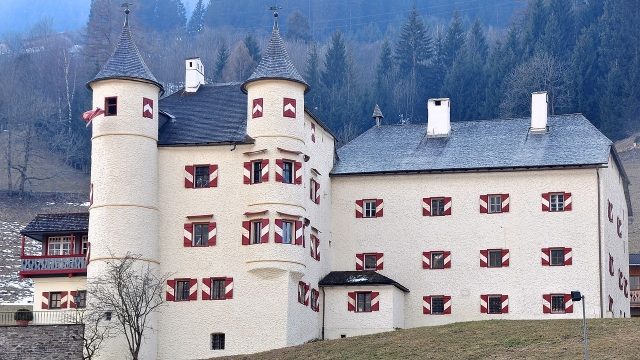
Weitmoserschlössl (sometimes also called Hundsdorf Castle after a former owner) is located in the Vorderschneeberg district of the municipality of Bad Hofgastein in the St. Johann im Pongau district of Salzburg (Schlossgasse 14). The widely visible castle is situated on the west side of the Gastein Valley.
The castle is closely associated with the Weitmoser family. First to be mentioned here is Hans Weitmoser, who is documented as the owner of various properties in the Gastein Valley from 1518, such as the Eliasgütl and the Maurachlehen in Hundsdorf. Hans Weitmoser was also one of the leaders of the Salzburg peasant uprising; for this, he made amends and was reinstated by the sovereign Matthäus Lang. In 1518, he even acted as an appointed commissioner on behalf of the Archbishop in a mining dispute. This Hans was also able to buy mining shares and seems to have had luck with the advancement of his adits on the Radhausberg. His heir in 1526 was his son Christoph Weitmoser (* 1506, † May 2, 1558 Hofgastein). He was matriculated at the University of Freiburg im Breisgau in 1522. Upon inheriting, he also had to take on about 10,000 guilders in debt; the sovereign helped the young Christoff at that time with a loan of 100 "Imperials". Around 1530, he himself was able to extract rich ore through the "zu unserer Frau" adit and pay off his debts. Between 1554 and 1560, he is estimated to have extracted around 300 kg of gold and about 1200 kg of silver annually, from which, after deducting all expenses, he retained a current income of at least 2.5 million Euros. Christoff Weitmoser was among the financiers of Archduke Ferdinand of Tyrol and Duke Ernst of Bavaria.
Around 1538, he acquired the old Goldeckhof (also referred to as Goldegger Hof and possibly the seat of the Lords of Goldegg). An inscription tablet indicates that the Goldeckhof burned down in 1553 and was rebuilt within two months the following year. This building today forms the northern wing of the entire complex. Already in 1552, Weitmoser was granted the title of imperial councilor, but could not achieve admission to the Salzburg Landtafel, even though he was already a Bavarian nobleman through the acquisition of the Hofmark Winkl. In 1555, he submitted a formal request to the Salzburg sovereign, expressing his wish that Archbishop Michael would elevate him to knighthood. This was granted to him.
After the death of the economically very successful Christoph Weitmoser (†1558), the Weitmoser family experienced an economic decline, not least because the immense fortune (320,000 guilders) had to be divided among three sons and four daughters from the marriage with Elisabeth Vötzl, concluded around 1531. The decline of the family is also reflected in a widely spread folk tale in the Gastein Valley about rise and hardship, up to the pawning of the bridal veil, which, however, is only marginally connected with the real events.
The property was acquired in 1606 by the mine owner Hanns Leykhofer and in 1621 by Georg, Hans, Jacob, and Kunigung Leykhofer. From 1624, Hanns and Kunigundt were the owners. They added a newly built "Stöckhl" with two round oriel windows at the eastern edges of the building. In 1628, the altar of the castle chapel was consecrated on the first floor of the new building. Leykofer, as a Protestant, had to leave Salzburg, and the property was acquired in 1625 by Leonhart Rainpacher and in 1626 by Alexander Hölzl von Sylion and his wife. The frescoes in the chapel with biblical motifs, painted by Ludwig Lindner, date from the first quarter of the 17th century. On the second floor, a room with paneling and a coffered ceiling was installed, which is incorrectly called Weitmoserstube (as it no longer has anything to do with the family). In 1634, Johann Riept, parish priest of Haus and Schladming, bought the castle. His heir was Franz Kumminger († 1691). Further documented owners include: Johann Pichler (1701), Georg Stuchner (1712), Franz Benedikt Hasler (1738).
In 1752, Benedikt Niklas Scharfetter was the first Scharfetter to acquire the property. In 1755, Josef Anton Trauner, administrator in Hundsdorf (married to Elisabeth Poschacher), is named as owner. From 1796, Andrä Scharfetter is the owner; since then, the Scharfetter family (Gastein line) has owned the property.
Weitmoserschlössl today+
In 1850, the interior of the castle underwent a thorough renovation (and, as a report states, "without sparing the old"). In 1937, the frescoes in the chapel were rediscovered and restored. In 1952, an exterior renovation took place with the addition of a terrace for café operations on the south side. The year 1400 above the entrance to the older part of the building has no historical basis. Today, the Restaurant-Café Weitmoser is located here.
Take Mobile History with you
You are reading this text for free. Premium adds what matters on the road: descriptions read aloud, sites found through your camera, whole regions taken offline.
- Every description, including the ~17,700 Premium sites
- Audio guide: have descriptions read to you on location
- AR finder: see sites through your camera, with distance and bearing
- Unlimited saved sites
14 days free, then from €2.99 a month. Cancel anytime.
Source: Wikipedia · Licence: CC BY-SA 4.0 · Image: http://commons.wikimedia.org/wiki/File:Weitmoserschl%C3%B6%C3%9Fl_in_Bad_Hofgastein.jpg
This description draws on the facts documented in the linked Wikipedia article; Wikipedia content is licensed under CC BY-SA 4.0. Wording and editing: Mobile History.
Location: 47.1626, 13.0996