CastleFriesenhagen

Wildenburg Castle

Wildenburg Castle

To be privately owned
The castle
can be visited in part


Wildenburg Castle is a smaller castle building in the Wildenburger Land in the northern part of the Altenkirchen district near Friesenhagen, above the small castle settlement of Wildenburg located in the valley, on the road connecting Friesenhagen via Wildenburg to the former train station of the same name on the disused and now dismantled Finnentrop–Freudenberg railway line.

The term "Wildenburger Land" has been mentioned in local history books since the early 15th century. The owner of this dominion at that time was Gerhard von Wildenburg. The property was administered from Wildenburg Palace, which is now, however, called "Wildenburg Castle".

Wildenburg is the ancestral seat of the Lords of Wildenburg, who in the early 13th century were, as Lords of Aremberg, bailiffs of the Werden property in that area. They built the castle, after which they named themselves in 1239. The last Lord of Wildenburg, Hermann von Wildenburg, died in 1418. His nephews, the sons of his sister Jutta, who had been married to Johann von Hatzfeldt since 1387, inherited the Wildenburg property. Since then, the Hatzfeldt family has owned the castle; in 1806, the Wildenburger Land fell to the Grand Duchy of Berg, in 1815 to Prussia, and in 1946 to Rhineland-Palatinate. From 1808 to 1815, Wildenburg was the seat of a canton administration in the Département Sieg, before it was abandoned and fell into disrepair in the mid-19th century.

Description+

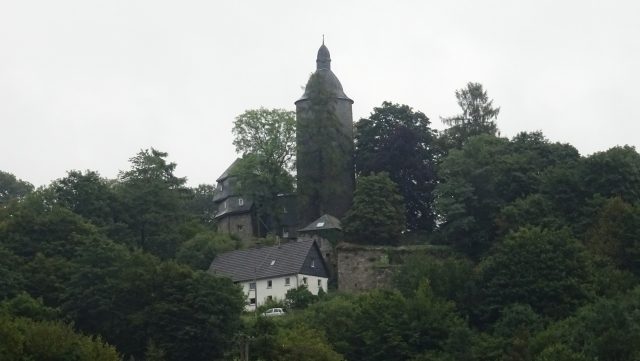
The complex, which was still preserved and inhabited around 1830, was used as a quarry in the later 19th century, which is why it is largely a ruin today. The hilltop castle stands on a mountain spur that slopes steeply on three sides; it thus dominated the Bergische Eisenstraße, which passed by here and was called Hileweg in 1048. Besides sections of walls, the more than 20-meter-high and round keep, which has a Baroque dome and is partly slated, and remains of buildings from the 14th to 18th centuries, as well as a polygonal bastion from the 15th/16th century, which was expanded in 1757 and 1932/33, have been preserved.

Only the outer bailey can be visited at any time. The buildings housing the v.Hatzfeldt forestry office are privately owned.

Take Mobile History with you

You are reading this text for free. Premium adds what matters on the road: descriptions read aloud, sites found through your camera, whole regions taken offline.

  • Every description, including the ~17,700 Premium sites
  • Audio guide: have descriptions read to you on location
  • AR finder: see sites through your camera, with distance and bearing
  • Unlimited saved sites

14 days free, then from €2.99 a month. Cancel anytime.

Source: Wikipedia · Licence: CC BY-SA 4.0 · Image: Jörg Heldt

This description draws on the facts documented in the linked Wikipedia article; Wikipedia content is licensed under CC BY-SA 4.0. Wording and editing: Mobile History.

Location: 50.9150, 7.8179