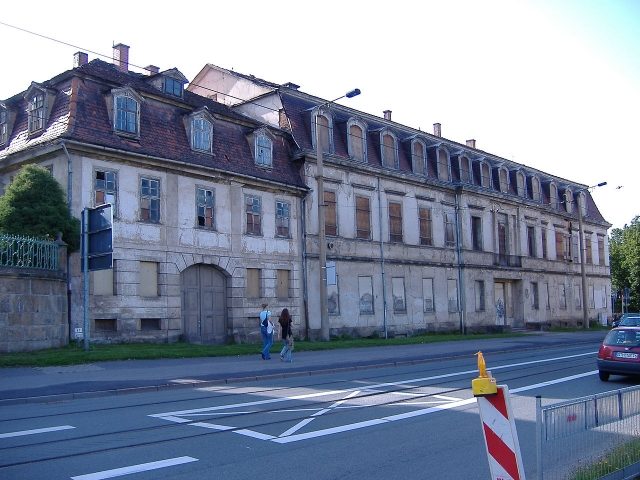
refurbishment measures
Winterpalais (Gotha)

The Winter Palace in Gotha, Friedrichstraße 2, is a predominantly Neoclassical city palace built in 1822 and a significant cultural monument.
History
Predecessor Buildings since 1730
Predecessor buildings of the Winter Palace can already be seen on a city view of Gotha created around 1730. At that time, the property was located outside the city fortifications in front of the Siebleber Tor, marked with No. 25. Around 1790, Hofmarschall Eberhard S. von Frankenberg (1731–1797), a cousin of the more well-known Minister of State to three Dukes, Sylvius Friedrich Ludwig von Frankenberg (1728–1815), lived there.
In 1798, Duke Ernst II of Saxe-Gotha-Altenburg (1745–1804) acquired the residence in front of the Siebleber barrier from the widow of the deceased Hofmarschall von Frankenberg, to use it as a guesthouse.
In 1802, his son and successor August Emil of Saxe-Gotha-Altenburg (1772–1822) married Caroline Amalie of Hesse-Kassel, after his first wife Luise Charlotte of Mecklenburg-Schwerin died 15 days after the birth of their daughter Luise of Saxe-Gotha-Altenburg on December 20, 1800. In 1804, Duke Ernst II died on April 20, and his son August Emil took over the government.
After the occupation of Hesse-Kassel by Napoleon in 1806, the Elector and Electress fled into exile. While Wilhelm I stayed with his mistress, among other places, in Schleswig and Prague, Wilhelmine Karoline spent these years with her younger daughter Caroline Amalie in Gotha. The Electress was temporarily accommodated by her son-in-law Duke August in the Winter Palace, which was significantly expanded for this purpose in 1811 by incorporating the smaller residence located between it and the court gardener's house. In addition, an annex was built at the rear to accommodate the servants.
In 1813, Napoleon had to flee back to France, and the Hessian Elector and Electress returned to Kassel on November 21. The Winter Palace was now increasingly inhabited by Duchess Caroline. The reason for this can be seen in a growing estrangement from her husband Duke August Emil, with whom the marriage remained childless and who is said to have caused her many inconveniences due to his peculiar behavior. The Duchess therefore apparently found it appropriate to withdraw from public life.
In 1821, Duke Emil August gifted his wife Caroline the Winter Palace and the opposite Friedrichsthal Palace as a summer residence, along with its associated garden and grotto area, the neighboring Orangery Garden, and the Tea Pavilion.
Expansion and Redesign 1822–1823, Use as a Dowager Palace
In 1822, Duke Emil August died on May 17; his brother Friedrich IV, who succeeded him in government, confirmed the gifts. Already a few weeks later, on August 8, Court Building Councillor Heinrich Andreas Poersch submitted a "humble report concerning: the extension to the house formerly inhabited by the Electress of Hesse, Royal Highness, at the Siebleber barrier and its establishment as a residence for Her Highness the widowed Duchess" to the Lord Chamberlain von Scheliha. According to this, the Duchess desired an extension to the residence, a new washhouse, new coach houses, and stables. Required were 38 heated rooms, including a dining room of the same size as the one in Friedrichsthal, 25 chambers and cabinets, a coach house for four carriages, a stable for eight horses, a washhouse, a mangling room, an ironing room, and a woodshed. Poersch explained that "an extension could only be continued on the northern gable in the main front of the house with due consideration for skill and with possible cost savings." Poersch submitted three building plans to the Duke. Only Plan III was considered, as the cost estimate did not exceed 8475 Thalers. On August 19, 1822, Duke Friedrich approved this plan. Some of the Duchess's wishes regarding the interior design were also granted, despite the additional cost of several thousand Thalers.
In 1823, the construction was largely completed in the form that still exists today. Through the northern extension, the corresponding enlargement of the intermediate building to the court gardener's house, the side wing bending off to the west with a passage, the installation of a staircase, and the comprehensive redesign of the facades in the Neoclassical style, practically a new building had been created. Only in the cellar and plinth on the courtyard side were remnants of the predecessor buildings preserved. On November 24, 1823, attention turned to the outdoor facilities, and the Court Chamber decided that the area on the north side of the palace, which had become desolate due to the current construction, should finally be put back in order. Master Gardener Johann Rudolph Eyserbeck was commissioned with these works and the creation of a "living fence" of twelve score young lime trees.
In August 1845, British Queen Victoria and her husband Prince Albert visited Albert's beloved step-grandmother Caroline at the Winter Palace. The Privilegirte Gothaische Zeitung wrote about this: "The entry was as festive as it was moving, for every Gothan rejoiced heartily in the happiness that the highly revered noble Princess, the widowed Duchess Caroline Amalia, was to experience, to embrace the exalted wife of her dearly beloved grandson, Prince Albert, in her maternal arms."
In 1848, the Dowager Duchess Caroline died on February 22 in the Winter Palace. In memory of his childhood, Prince Albert then commissioned Ferdinand Rothbart to create several watercolors of the interiors as they looked during his grandmother's lifetime.
History of Use since 1848
In 1849, on December 1, Camillo Freiherr von Seebach (1808–1894) was appointed Minister of State and moved into some attic rooms of the Winter Palace, which he inhabited until his retirement in 1888. The ground floor and first floor were subsequently converted for Department I of the Ducal Ministry of State and for the Statistical Bureau.
His successor in office, Gisbert von Bonin-Brettin (1841–1913), also lived in the Winter Palace until his retirement in 1891. The next Minister of State, Carl Stenge (1843–1907), however, remained in his own property at Gartenstraße 21. Other tenants from 1880–1885 were Colonel Malotki and Colonel von Westernhagen, from 1887–1888 Royal Prussian Lieutenant Colonel von Treskow, and in 1891 Freiherr Reinhard zu Berlin.
From 1896 to 1900, the sisters Marie and Martha Seyfarth ran a boarding school in the Winter Palace, where architect Richard Klepzig also lived from 1899 to 1900. Subsequently, the house was again occupied by a minister, the lawyer Otto Hentig (1852–1935), who, among other things, had the still existing intermediate ceilings made of Gothicizing papier-mâché installed. He was followed in 1905 by Hofmarschall Fritz von Rüxleben (1860–1923), who, however, only lived in Gotha in winter and, among other things, directed the ducal court theaters. He had the house thoroughly renovated in 1905–1906.
After the abdication of Duke Carl Eduard Duke of Saxe-Coburg and Gotha and the founding of the Free State of Gotha, the palace was rented to various institutions: including the War Disabled Welfare, the District Library, the Small Settlement Society, the Land Settlement Society Saxe-Weimar-Eisenach, and the Chamber of Crafts. For this purpose, modernization work was carried out on the building again from 1920–1923.
In 1938, it became the publishing house of the Thüringer Gauzeitung – Gothaer Beobachter and housed a branch of the weekly newspaper Der Stürmer. For this purpose, it was again rebuilt and renovated: the balcony on the south side was demolished, and the entrance hall was enlarged by incorporating the two rooms located to the south. The facade rustication on the ground floor was replaced by new smooth plaster, and the entrance was changed in a Neoclassical style. The roof was re-covered with red beaver tails.
In 1949, the Winter Palace became a branch of the GDR daily newspaper Das Volk, an organ of the SED district leadership in the Erfurt district.
Decay since 1990 and Demolition
In 1990, the Winter Palace was assigned to the city of Gotha. The newspaper Das Volk was taken over by the Essen media group WAZ and continued as Thüringer Allgemeine. After an offer by Thüringer Allgemeine to also acquire the Winter Palace property for approximately 1,500,000 DM was rejected by the city, the newspaper abandoned the location. Subsequently, the Gotha Youth Club used the Winter Palace until 1991 and left corresponding traces there. The rooms were partly heavily devastated and their walls defaced. After that, the palace stood empty.
As the zinc sheet coverings and valleys, last renewed in 1938, gradually corroded, and the city neglected all maintenance measures on the cultural monument, rainwater eventually continuously penetrated the building, especially at the valleys of the dormers and at the concealed box gutter. This primarily damaged the upper wall plates connecting the ceiling beams to the facade, as well as the ends of the roof beams and rafters. In August 2006, two posts on the upper floor therefore detached and threatened to fall onto the street. Instead of professionally repairing the then still manageable damage and sealing the roof, the Gotha city council decided on September 13, 2006, to prepare for demolition. After energetic protests from Germany and abroad, on November 21, 2006, Mayor Knut Kreuch informed the city council and the public that the Winter Palace would initially be secured with 50,000 Euros. However, a professional sealing of the roof did not take place, so water continued to enter the building. Shortly thereafter, a plan for its use as a city library was commissioned, which, however, only provides for the preservation of the facades and a completely new concrete construction behind them. In April 2007, the servant's wing built in 1811 behind the main building was demolished.
In March 2011, to the surprise of the public, demolition work began on the Winter Palace. According to statements from the city administration, the street facades of the building were to be preserved and used for reconstruction. After the demolition of the side wing with the gate passage, built in 1823, the roof of the main building and the courtyard-side facade were also demolished. In the process, a large part of the street-side facade, including the central risalit, also collapsed, as the facades had neither been statically secured nor separated from the rest of the building. Only small remnants of the ground floor of the street front remained of the palace.
New Construction from 2011
In September 2011, the foundation stone was laid for the new construction of the Winter Palace, which is expected to house the Heinrich Heine City Library, currently located in the neighboring Orangery House of the Orangery Garden, from 2014 (as of September 2011). The palace is to be rebuilt, at least externally, in its historical form, incorporating the preserved remnants of the original building. The new building will be connected to the neighboring former court gardener's house (built in 1773 by Johann David Weidner). Instead of the former side wing on Philosophenweg, a modern extension of steel and glass is planned, while the servant's wing from 1811 will not be rebuilt. Inside, the building is to be designed to meet the requirements of a modern library building, but it is planned to reconstruct at least the balcony room on the first floor according to historical models. The city estimates the total project cost at six million Euros.
Miscellaneous
In 2009, Gotha authors Andreas M. Cramer and Ralph-Uwe Heinz made the Winter Palace the alleged origin of Dinner for One in their play "Dar neunzschsde Gebordsdaach oder Dinner for one auf Goth'sch". In the preface to their dialect adaptation of the New Year's Eve classic, it is claimed that the Dowager Duchess Karoline Amalie (whom they call Sophie Karoline Amalie, or Duchess Sophie for short) celebrated her birthdays there in the company of her four long-deceased, prominent friends, who were represented by her butler. The anecdote of this strange birthday ritual is said to have come to Great Britain in 1845 after the visit of Prince Albert of Saxe-Coburg and Gotha, the Dowager Duchess's favorite grandson, where the playwright Lauri Wylie rediscovered it in the 1930s and adapted it for the stage as Dinner for One. The tongue-in-cheek mixture of real names, places, and events with fictional occurrences makes the palace the "origin" of the famous dinner.
With regard to the history of the house, the Gotha city administration has used the extended name Queen-Victoria-and-Prince-Albert-Winterpalais for the building since 2009.
Take Mobile History with you
You are reading this text for free. Premium adds what matters on the road: descriptions read aloud, sites found through your camera, whole regions taken offline.
- Every description, including the ~17,700 Premium sites
- Audio guide: have descriptions read to you on location
- AR finder: see sites through your camera, with distance and bearing
- Unlimited saved sites
14 days free, then from €2.99 a month. Cancel anytime.
Source: Wikipedia · Licence: CC BY-SA 4.0
This description draws on the facts documented in the linked Wikipedia article; Wikipedia content is licensed under CC BY-SA 4.0. Wording and editing: Mobile History.
Location: 50.9478, 10.7092