Museum
ResidenceWeimar
Wittumspalais
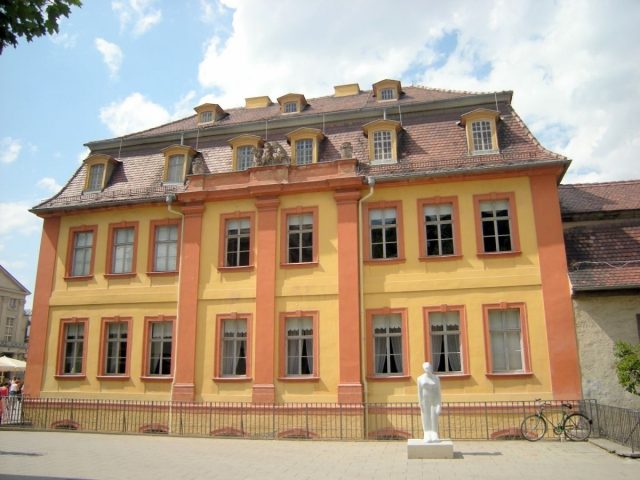
The Wittumspalais in Weimar is a residence, notable for its close association with Duchess Anna Amalia and its role as a cultural hub during the Weimar Classicism period. Today, it houses a museum that offers insights into 18th-century courtly life.
History+
The construction of the Wittumspalais took place between 1767 and 1769 under the direction of Jakob Friedrich von Fritsch, a privy councillor and minister of Weimar. The design was created by the Saxon master builder Johann Gottfried Schlegel. The palace was built on the grounds of a former Franciscan monastery on what was then the Esplanade, now Schillerstraße. Following the palace fire in Weimar in 1774, Duchess Anna Amalia moved into the Palais in May of that year and purchased it in 1775 for 20,100 Reichstalers. She resided there until her death in 1807. From 1775 onwards, the interiors were decorated, with Adam Friedrich Oeser creating the ceiling paintings. After Anna Amalia's death, the Ducal Court Marshal's Office managed the building. Between 1808 and 1848, it served as the meeting place for the Weimar Masonic Lodge Amalia, and from 1833 to 1848, the state parliament convened in the ballroom.
Source: Wikipedia · Licence: CC BY-SA 4.0 · Image: http://schloesserrundschau.de/thueringen/schloesser/weimar003.html
This description draws on the facts documented in the linked Wikipedia article; Wikipedia content is licensed under CC BY-SA 4.0. Wording and editing: Mobile History.
Location: 50.9797, 11.3266