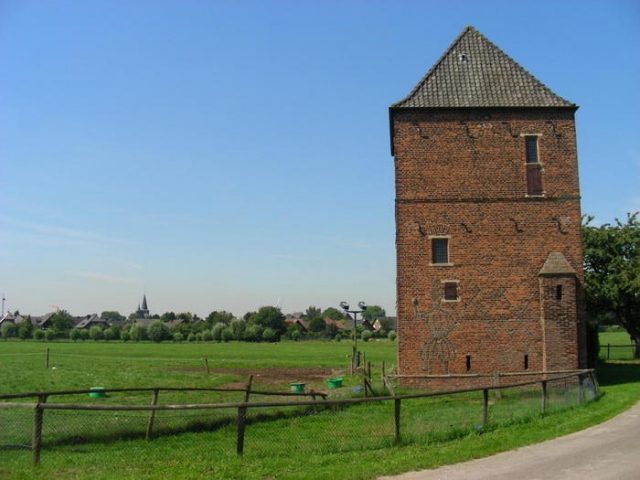
The Tower can be visited
Battenbergturm Castle

The Battenberg Tower is a late medieval residential tower in Haldern, a district of Rees in the Kleve district of North Rhine-Westphalia. It is located northeast of Haldern, directly next to a farm, and is a rare example of a lightly fortified residential tower in the Rhineland.
The Buschkampshof, next to which the Battenberg Tower stands, was first mentioned in 1377. In 1494, Duke Johann II of Kleve enfeoffed the armored knight Amelongh von Escharden with the farm. Amelongh made a career, becoming a court messenger in 1494 and a judge in Rees and Aspel in 1498. He is probably the builder of the tower, which was erected at the beginning of the 16th century. The tower probably owes its name to the builder's office: Batenberg is the tower (Old German Berg) of the messenger (Bote). According to an inscription inserted in glazed bricks, the tower was built in 1506. Originally, the complex was intended to include at least one more building, as suggested by the remnants of the moat and traces for the connection of high walls on the north and west sides. However, these buildings were never erected.
In 1639, the property was still referred to as a knight's seat, but no longer in 1674. In 1676 and definitively in 1681, the Buschkampshof came into the possession of the von Wittenhorst-Sonsfeld family, who also laid out an avenue from their park belonging to Sonsfeld Castle, aligned with the Battenberg Tower. After the tower was used as a granary and stable in later centuries, it fell into disrepair until it was leased by the Haldern local history association in 1984 and exemplarily renovated by 1993. Since then, the tower has been the seat of the Haldern local history association and can be visited in summer on the first Sunday of each month.
Layout+
The eleven-meter-high tower has two stories above a low basement on an almost square floor plan. It is built of bricks, and a figure made of glazed bricks, presumably depicting the builder, is embedded in the eastern outer wall. Both residential floors could be heated with fireplaces; a latrine bay is attached to the ground floor, leading directly into the former moat. There are loopholes in the basement, but the low wall thickness and the generous mullioned windows show that the tower was only partially built as a defensive tower.
The tower avenue, aligned from the former Sonsfeld Park to the Battenberg Tower, is still partially preserved.
Assessment+
There are no documents from the builder after 1504. Why the complex was not continued is unknown. Traces of use on the fireplace and latrine show that the tower was inhabited for only a short time. Due to later agricultural use, significant alterations were avoided, so the tower is in its original condition today.
The Battenberg Tower, as a stone version of the Lower Rhenish Berfes, stands in the Rhineland without precedents. It is an attempt to combine residential value and defensibility in the late Middle Ages, without, however, being able to satisfactorily fulfill these tasks.
Take Mobile History with you
You are reading this text for free. Premium adds what matters on the road: descriptions read aloud, sites found through your camera, whole regions taken offline.
- Every description, including the ~17,700 Premium sites
- Audio guide: have descriptions read to you on location
- AR finder: see sites through your camera, with distance and bearing
- Unlimited saved sites
14 days free, then from €2.99 a month. Cancel anytime.
Source: Wikipedia · Licence: CC BY-SA 4.0 · Image: http://www.wehrbauten.de/thread.php?threadid=566&hilight=Borghees
This description draws on the facts documented in the linked Wikipedia article; Wikipedia content is licensed under CC BY-SA 4.0. Wording and editing: Mobile History.
Location: 51.7757, 6.4699