The Cathedral can be visited
ChurchWürzburg
Würzburg Cathedral
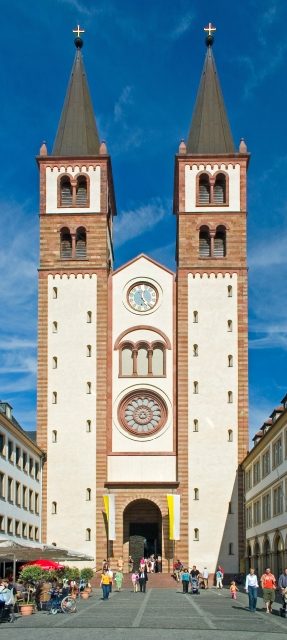
Würzburg Cathedral (German: Würzburger Dom) is a Roman Catholic cathedral in Würzburg in Bavaria, Germany, dedicated to Saint Kilian. It is the seat of the Bishop of Würzburg and has served as the burial place for the Prince-Bishops of Würzburg for hundreds of years. With an overall length of 103 metres, it is the fourth largest Romanesque church building in Germany, and a masterpiece of German architecture from the Salian period. Notable later additions include work by Tilman Riemenschneider and Balthasar Neumann. The cathedral was heavily damaged by British bombs in March 1945 but rebuilt post-World War II.
History+
A cathedral and an attached monastery existed in Würzburg as early as the 8th Century, presumably built by the city's first bishop, Burchard. On July 8, 752, Burchard transferred the relics of Kilian and his companions Totnan and Colman to the cathedral. The skulls of these three saints are still kept in the High Altar of the cathedral. The cathedral was destroyed by fire and rebuilt twice (in 787 and 855). The third and present cathedral was built from 1040 onwards by Bishop Bruno. After Bruno's accidental death in 1045, his successor Adalbero completed the building in 1075. Due to several rebuildings, notably after 1133, the cathedral was only consecrated in 1187. It retains its Romanesque cruciform layout to this day.
The cathedral school attached to the cathedral and run by the Würzburg cathedral chapter was one of the most important cathedral schools in the Holy Roman Empire in the Middle Ages, along with those of Liège and Worms. The side aisles were remodeled in a late Gothic style around 1500. A baroque renovation began in 1627, and continued through the century. In particular, numerous pieces of valuable Baroque art were created for the Cathedral's altars. The stuccoist Pietro Magno decorated the cathedral in Baroque stucco work in 1701-04. In 1721-34, Balthasar Neumann built the burial chapel for the Schönborn bishops, north of the transept. Around the foot of the eastern tower, he also added a Baroque vestry and Ornatkammer (1749). Additional Romanesque Revival changes made to the western façade and towers in 1879-85 (see picture of the cathedral in 1904) were removed after 1946. The Cathedral was heavily damaged in the bombing of Würzburg. Much of the interior was irreparably damaged. Large portions of the building, especially the nave, collapsed in the winter of 1946, almost a year after the bombing. Reconstruction was completed in 1967, in the course of which some Baroque components were removed in favour of a re-Romanisation. In particular, the collapsed nave was rebuilt unadorned, with a flat wooden roof, providing a marked contrast to the surviving baroque stucco in the rest of the building. Over the course of the renovation, the Romanesque Revival west front with its rose window, tripartite gallery, and clock niche were covered by a plain stone wall. The west front was once again revealed after a 2006 renovation. The choir was redesigned in 1988.
Description+
With a length of 103 meters, the cathedral is thought to be the fourth largest Romanesque basilica in Germany.
Works of art+
The cathedral contains numerous works of art, of which the following are of especial note:
A series of tombs and epitaphs of bishops, including the monumental effigies of the prince-bishops Rudolf II von Scherenberg (1495) and Lorenz von Bibra (1519), both by Tilman Riemenschneider Schönborn Chapel by Balthasar Neumann and Maximilian von Welsch with the tombs of Johann Philipp von Schönborn, Lothar Franz von Schönborn, Johann Philipp Franz von Schönborn and Friedrich Karl von Schönborn Double crypt. The eastern part dates from 1040 and contains the tomb of Bruno. The western one (12th century) was demolished around 1700 but rebuilt after 1962. It features an old well, the tomb of Conrad of Querfurt and the oldest piece of art of the cathedral: a bearded face which may be Carolingean or even Merovingian in origin. Burial chapel/Sepulture: Like the chapter hall above, the Gothic structure was destroyed in the bombing raids but has been rebuilt. It now contains a cycle of stained glass by Georg Meistermann. Baptismal font (1279), by Meister Eckart of Worms Seven-armed candelabra (1981) by Andreas Moritz
Layout of the main level of the building+
1. Trellis by Markus Gattinger (1750/52; outermost wings 1967, “Menorah” by Andreas Moritz, 1981) 2. Gottfried of Spitzberg (d. 1190) 3. Bishop Gottfried III von Hohenlohe (d. 1322) 4. Bishop Manegold von Neuenburg (d. 1303) 5. Bishop Otto II von Wolfskeel (d. 1345; by the so-called Wolfskeel Master) 6. Three kings with the Madonna 7. Bishop Wolfram von Grumbach (d. 1333) 8. Bishop Johann II von Brunn (d. 1440) 9. Bishop Albrecht II von Hohenlohe (d. 1372) 10. Bishop Gottfried IV Schenk von Limpurg (d. 1455) 11. Bishop Rudolf von Scherenberg (d. 1495; by Tilman Riemenschneider) 12. Bishop Melchior Zobel von Giebelstadt (d. 1558; by Peter Dell the Younger) 13. Bishop Lorenz von Bibra (d. 1519; by Tilman Riemenschneider) 14. Bishop Friedrich von Wirsberg (d. 1573) 15. Bishop Julius Echter von Mespelbrunn (d. 1617; by Nikolaus Lenkhart) 16. Chancel 17. Bishop Johann Gottfried von Aschhausen (d. 1622) 18. Ferdinand von Schlör (d. 1924) 19. Choir and apse in stucco relief 20. North transept altar and Provost's Altar (by Pietro Magno, 1704) 21. Provost Faust Franz Ludwig von Stromberg (d. 1673; by Johann Philipp Preiss) 22. Portal to the sacristy 23. Bishop Gerhard von Schwarzburg (d. 1400) 24. Lothar Franz von Schönborn (d. 1729) 25. Altar of Mary Magdalene 26. Johann Philipp Franz von Schönborn (d. 1724) 27. Fresco of the Resurrection (by Byss) 28. Door to the Schönborn Chapel, with angel (by Curé) 29. Bishop Friedrich Karl von Schönborn-Buchheim (d. 1746) 30. Altar of the Pietà 31. Bishop Johann Philipp von Schönborn, also Archbishop of Mainz and Bishop of Worms (d. 1673) 32. Bishop Conrad von Bibra (d. 1544; by Peter Dell the Elder) 33. Altar of Our Lady 34. Dean Johann Konrad Kottwitz von Aulenbach (d. 1610; by Zacharias Juncker) 35. Crypt entrance and exit 36. Bishop Konrad von Thüngen (d. 1540; bronze plate) 37. Bishop Conrad von Bibra (d. 1544; bronze plate; there is no mitre on the head of this figure, as although a bishop, this man was not consecrated as a priest) 38. Bishop Lorenz von Bibra (d. 1519; bronze plate, by Hans Vischer and Peter Vischer the Elder) 39. Erasmus Neustetter known as Stürmer (d. 1594; bronze plate) 40. Johann Philipp Fuchs von Dornheim (d. 1727; bronze plate) 41.
Source: Wikipedia · Licence: CC BY-SA 4.0 · Image: http://de.wikipedia.org/wiki/Datei:Dom_Wuerzburg.jpg
This description is an excerpt from the linked Wikipedia article and was written by its authors. Like the original it is licensed under CC BY-SA 4.0 and may be reused under the same terms.
Location: 49.7934, 9.9324