village church
MonasteryBurkardroth
Frauenroth abbey
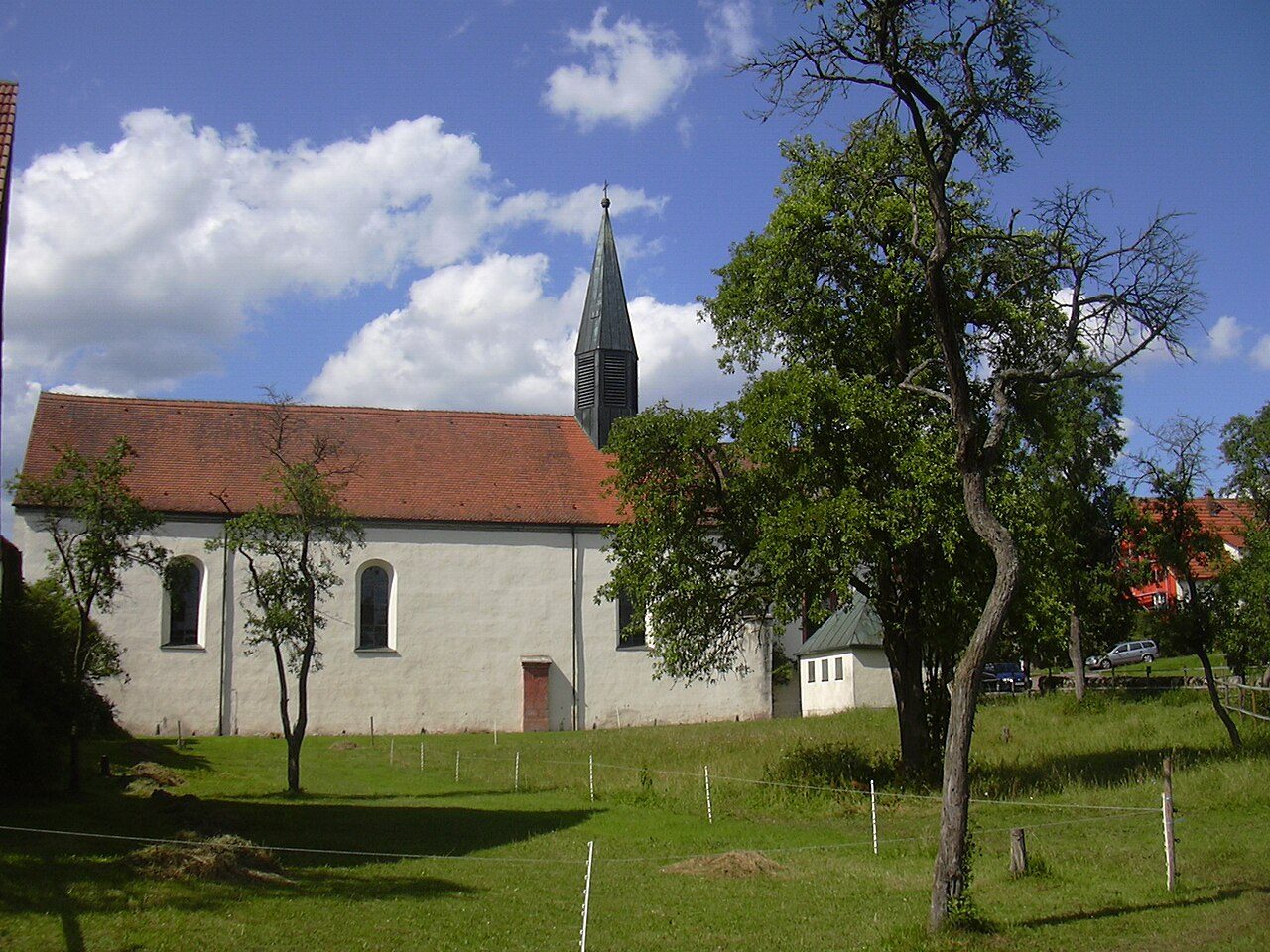
The former Cistercian convent of Frauenroth, now preserved only as the nave of the original convent church, is located in the rural surroundings of Bad Kissingen in Bavaria. The site is a significant architectural monument and bears witness to a long history dating back to the 13th century.
History+
The foundation of Frauenroth Convent took place in 1231 by the minnesinger and crusader Otto von Botenlauben and his wife Beatrix von Courtenay. The couple, wishing to withdraw from worldly life, sold their property at Botenlauben Castle to the Prince-Bishop of Würzburg. A legend states that Beatrix vowed to build a convent at the spot where the wind carried her veil. After the death of the founders, who were buried in the convent church, their son Otto took on the role of provisor. The convent expanded its possessions through exchanges and acquisitions. In 1574, the convent dissolved after the death of the last abbess, Amalia von Rumrod, and the property passed to the Prince-Bishop's chamber in Würzburg. During the Thirty Years' War, the complex was plundered. Later, under the Würzburg Prince-Bishops Johann Philipp von Schönborn and Johann Gottfried von Guttenberg, the convent was demolished except for the nave of the church. In 1691, the estates were sold to farmers, giving rise to the village of Frauenroth. After secularization in 1803, the convent church served as a simple village church. It was not until a restoration in the 1970s that the history and art treasures of the site were brought back into public awareness.
Location+
Frauenroth Convent is located in Bad Kissingen, in the Free State of Bavaria, Germany. The site is situated at an elevation of approximately 303 meters above sea level, nestled within the partly wooded ridges on the eastern edge of the Bavarian Rhön mountains.
On site+
Today, only the nave of the former St. Blasius convent church remains. This Romanesque building, with its rounded apse and round-arched blind arcades, serves as the village church. Inside, Gothic frescoes depicting Passion scenes have been partially uncovered. The most significant piece of furnishing is the high tomb of the founding couple from the 13th century, featuring expressive early Gothic sculptures.
Nearby+
- Aschach Castle (Castle, approx. 3849 m away)
- Hausen Monastery (Sacred building, approx. 4508 m away)
- Heussleinscher Hof Castle (Castle, approx. 6952 m away)
- Erthal Palace (Residence, approx. 7262 m away)
Take Mobile History with you
You are reading this text for free. Premium adds what matters on the road: descriptions read aloud, sites found through your camera, whole regions taken offline.
- Every description, including the ~17,700 Premium sites
- Audio guide: have descriptions read to you on location
- AR finder: see sites through your camera, with distance and bearing
- Unlimited saved sites
14 days free, then from €2.99 a month. Cancel anytime.
Source: Wikipedia · Licence: CC BY-SA 4.0 · Image: Gabriele Delhey / CC BY-SA 3.0 via Wikimedia Commons
This description draws on the facts documented in the linked Wikipedia article; Wikipedia content is licensed under CC BY-SA 4.0. Wording and editing: Mobile History.
Location: 50.2467, 10.0094