Museum
Cultural center
Saarn Abbey

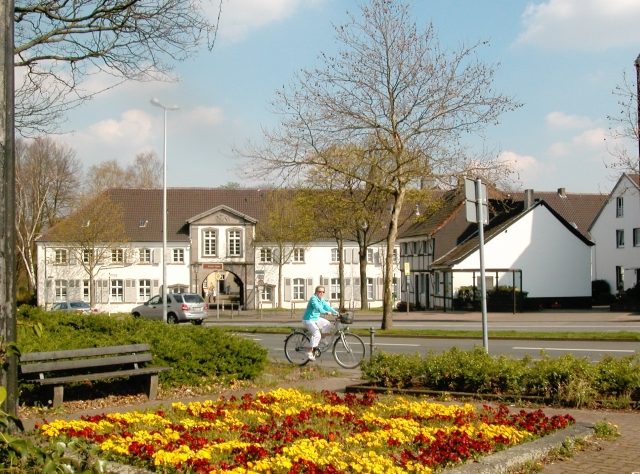
Saarn Abbey is a well-preserved and restored Cistercian nunnery in Mülheim an der Ruhr, in the Saarn district, directly on Federal Highway 1. The abbey buildings feature structural components from the 13th to the 19th century.
The abbey was founded around 1200, according to archaeological findings. No sources about the exact reason for its foundation have been preserved. Saarn Abbey was probably founded in 1214 as Mariensaal Abbey (Aula sanctae Mariae), initially as a double monastery, together with the later Eppinghoven Abbey near Kaarst, also called Mariensaal. In the first two decades, both convents were under the leadership of the common abbess Wolberna and were incorporated into the Cistercian Order in 1216 and placed under the supervision of the abbot of Kamp Abbey, who also had to ensure spiritual care. In 1237, the property of Saarn and Eppinghoven was divided.
In a second founding phase, Archbishop Engelbert I of Cologne (reg. 1220–1225), as part of his political activities as archbishop, Duke of Berg, and at the same time imperial regent and educator of the underage King Henry VII (reg. 1220–1235) – keywords include: promotion of reform orders (here: Cistercians), disentailment, defense against competing territorial lords – became aware of Saarn Abbey.
In 1223, the abbey received extensive privileges from Pope Honorius III and the Empire. Honorius confirmed Saarn's order privilege and granted papal protection. The life of the nuns and the existence of the abbey were thus placed on a new, permanent legal and material basis. His protégé Henry was – presumably at Engelbert's instigation – honored by the nuns in their memorial book as "fundator" (founder).
In the 15th century and from the 17th century onwards, there were tendencies to convert the abbey into a women's collegiate foundation.
Secularization
Saarn Abbey was dissolved in 1808 during the secularization of church property by the French government of the Grand Duchy of Berg.
Soon after, Sylvester Trenelle established the Royal Prussian Rifle Factory on the premises, receiving royal Prussian approval on January 6, 1815. A forging hammer and boring mills for manufacturing rifle barrels were operated in Hattingen. In 1840, the contract with Trenelle was terminated, and the works were continued under state supervision because the quality was unsatisfactory. In 1862, production from Saarn and Hattingen was relocated to the new Royal Prussian Rifle Factory Erfurt.
During the construction of Reichsstraße 1 (today Bundesstraße 1), which runs directly next to the abbey, some farm buildings were demolished. The city of Mülheim an der Ruhr took over the abbey in 1936 and had apartments for elderly citizens set up there.
Current Use+
During the years 1979–1989, the remaining abbey complex was restored as a historical monument; today it is used as a meeting place with a community hall, cafeteria, and meeting room. Noteworthy are the large parish library and the Abbey Museum, opened in October 2008, featuring artifacts from excavations in the years 1979 to 1989, which illustrate abbey life and the settlement of the surrounding area over 1200 years. Since autumn 2010, the Abbey Museum has been complemented by an abbey/herb garden.
The abbey church regularly hosts sophisticated sacred concerts (the "Music in Saarn Abbey" series, which also includes the annual Saarn Organ Days).
The church and parish of St. Mariä Himmelfahrt are cared for by members of the Oblates of St. Francis de Sales religious community.
Today, Saarn Abbey is part of the Route of Industrial Heritage (Theme Route 12 - History and Present of the Ruhr).
Take Mobile History with you
You are reading this text for free. Premium adds what matters on the road: descriptions read aloud, sites found through your camera, whole regions taken offline.
- Every description, including the ~17,700 Premium sites
- Audio guide: have descriptions read to you on location
- AR finder: see sites through your camera, with distance and bearing
- Unlimited saved sites
14 days free, then from €2.99 a month. Cancel anytime.
Source: Wikipedia · Licence: CC BY-SA 4.0 · Image: http://commons.wikimedia.org/wiki/File:Kloster_Saarn_Westseite.JPG
This description draws on the facts documented in the linked Wikipedia article; Wikipedia content is licensed under CC BY-SA 4.0. Wording and editing: Mobile History.
Location: 51.4029, 6.8816